A Million Millions
We have a value-distribution crisis to solve.

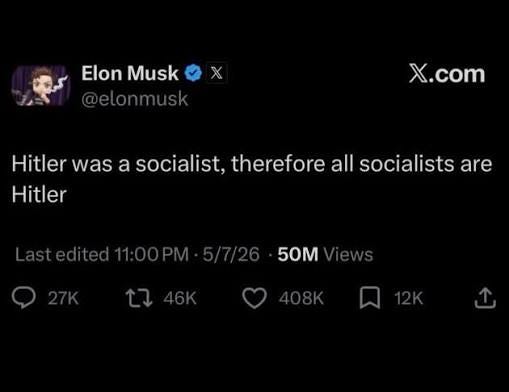
Elon Musk tweet May 7, 2026: “Hitler was a socialist, therefore all socialists are Hitler.”

People might think having a
billiontrillion dollars is just a matter of having abilliontrillion dollars, but they are constantly in motion. You never know just how much anything is worth at any time, and by the time you take the measurements you can be sure of, everything else you own is worth more (usually) or less. It’s all an estimate.And most of it is not real. It represents the future. Future production by workers, who themselves are extending credit to employers by working before being paid. Future purchases by those workers financed with credit extended by financiers, with interest to be paid into the future. Consumer credit is the promise of future production itself by workers, made by them to afford the goods they need to extend credit to their employers. It’s all an endless, ever-expanding loop.
Marx called it “fictitious capital,” and to some of us, it becomes everything consumers buy, only better. Better cars, better houses, better clothing, better vacations, better sexual partners, better lives, longer lives, richer lives. All you have to do is get ahead of the game.
Capitalism proves that incessant laboring and competition is no way to succeed—putting it in front of people’s eyes, and they refuse to see it. Instead they repeat the mantras: Hard work is the key to success, and Competition is meritorious. Then they ignore the monopoly-building leisure class, or explain them away as essentially different and better than everyone else.
The sale of labor-power is the least-efficient means of accumulating wealth, simply because Capital always sells labor short. First, by demanding labor-power be expended days before payment is made; Second, by not paying interest on the value that has been fronted; and, Third, by always paying less for labor-power than the value that labor-power has produced, by design.
Absent the nation-state system, capitalism would have irreversibly collapsed upon itself in the 1930’s. Only through collective mobilization made possible by the nation-state could resources have been redirected and redistributed in such a way as to make capitalism practical again. In other words, if not for the socialism of the nation, Capital would have been deposed as the leading economic mode of production.
State socialism, the Soviet model in particular, was portrayed as totalitarian and lifeless. The Western eye noticed but did not directly translate the absence of commercial public art (billboards, neon, other signage) as freedom from Capital.


Vermont is the only state in the U.S. that forbids billboards along highways; everywhere else, expect to be told your life is incomplete without purchase, as you travel public thoroughfares.
Our ruling class—those who successfully lay claim to capital and have leveraged it to become the dominant political power. The corporate capitalists operate a “two party” cartel, and political actors of a different economic philosophy need not apply.
One reason for the “bi-partisan” agreement that capitalism is the only possible economic form is because capitalists hate competition, when they do not stand a chance at winning. In fact, they will avoid investing in markets where they are not likely to profit at the desired rate. It is not enough that a market offer promise of profit—it must offer promise of the greatest possible profit.
Yet, when capital invests in a market, the goal is to grow to dominate that market. Why?
Because economies of scale are far more efficient at delivering goods, and thus are most profitable. Further, by cornering a market the largest players get to inflate prices and thus profits. The goal is to become as big as possible, because that makes for the greatest profitability.
This is why the U.S. Postal Service is currently being dismantled, it is why the U.S. lacks single-payer health care, it is why public education has been under direct attacks for my lifetime, and it is why Social Security will be allowed to wither and die. These public options are able to deliver services without the value-added tax to Capital (profit), so they will always be less expensive at whatever scale they operate. The greatest efficiency is found at the largest scale—this is what Capital aspires to, and fights relentlessly against when the efficiency is publicly-achieved.
By all estimates (since the 1980’s) Social Security will become insolvent in 2032 (“Social Security has run out, on you and me. We do whatever we can. Gotta duck when the shit hits the fan.” — The Circle Jerks (1983). I was fifteen when I found out, and I have watched more than forty years of recurrent threats against and attempts to “save” Social Security, but not once in all that time have I heard any elected official propose we expand it.
2032 - 1968 (my birth year) = 64. It’s due to collapse one year before I am due to collect. And some folks are still curious as to why those born after 1965 are so different than the Boomers. Some of us figured out early on that retirement was a broken promise, and that capital was inherently opposed to sustaining the lives of unproductive, former laborers. Social Security was built to get workers in the 1930’s to accept exploitation again and once they died off, there would be a new hegemony in place.
Capital concentrates. This is one of its contradictions—as value is always sucked upward toward those already holding the larger shares of it—there is less value available for the everyday operation of society. Workers are starved for cash. The consumer credit scheme described at the top of this piece had been the stopgap—it effectively pushes Capital’s failure to keep its slave within his slavery upon the worker himself, as he assumes increasing debts for necessities. Capital’s need for profit is always primary, so yes, that daily Starbucks and the new TV is a need, just not the worker’s—he is just the one held responsible for the debt and the one who suffers bankruptcy, rather than Capital.
Marx saw this concentration of Capital as not only an inherent contradiction, but also producing a smaller and smaller target. Without problematizing the positivism found in such reasoning, as Capital becomes more concentrated, the seizure of the means of production will become simpler.
For example, if we were to pursue a class-action against Elon Musk for DOGE’s violation of our privacy for taking our Social Security information, the class would be very easy to establish—it is all who have a Social Security account. The trick would be the distribution of damages. Let’s say 330 million Americans each get to claim $3,000; that’s $990,000,000,000—as of yesterday, Elon Musk is “worth” over $1trillion, so he can make the payment and still have $10billion. In what form would this payment come? He cannot sell off all his stock at once, for that would cause the value of all the stock to drop. Instead, Space X, Tesla, the Boring Company, and whatever undisclosed other capital investments held under Musk’s name would be nationalized.
Some may point out that without government subsidies, Space X could not exist, and they are correct. If not for the U.S. government covering a large share of expenses (through grants, not purchase of ownership shares) the company could not have grown to what it is today and would have likely gone bankrupt half a dozen exploding rocket ships ago. Capital tends to avoid high-risk investments with a recent string of failures.
Without the nation-state, Elon Musk is not a billionaire, much less a trillionaire. It is very important for his class interests that the collective resources that have been directed toward his corporate holdings be ignored and that value individualized and personalized. That way, when people claim that the ruling class could not exist without the labors of the working class, the ruling class can claim merit and other personal characteristics are the source of their status.
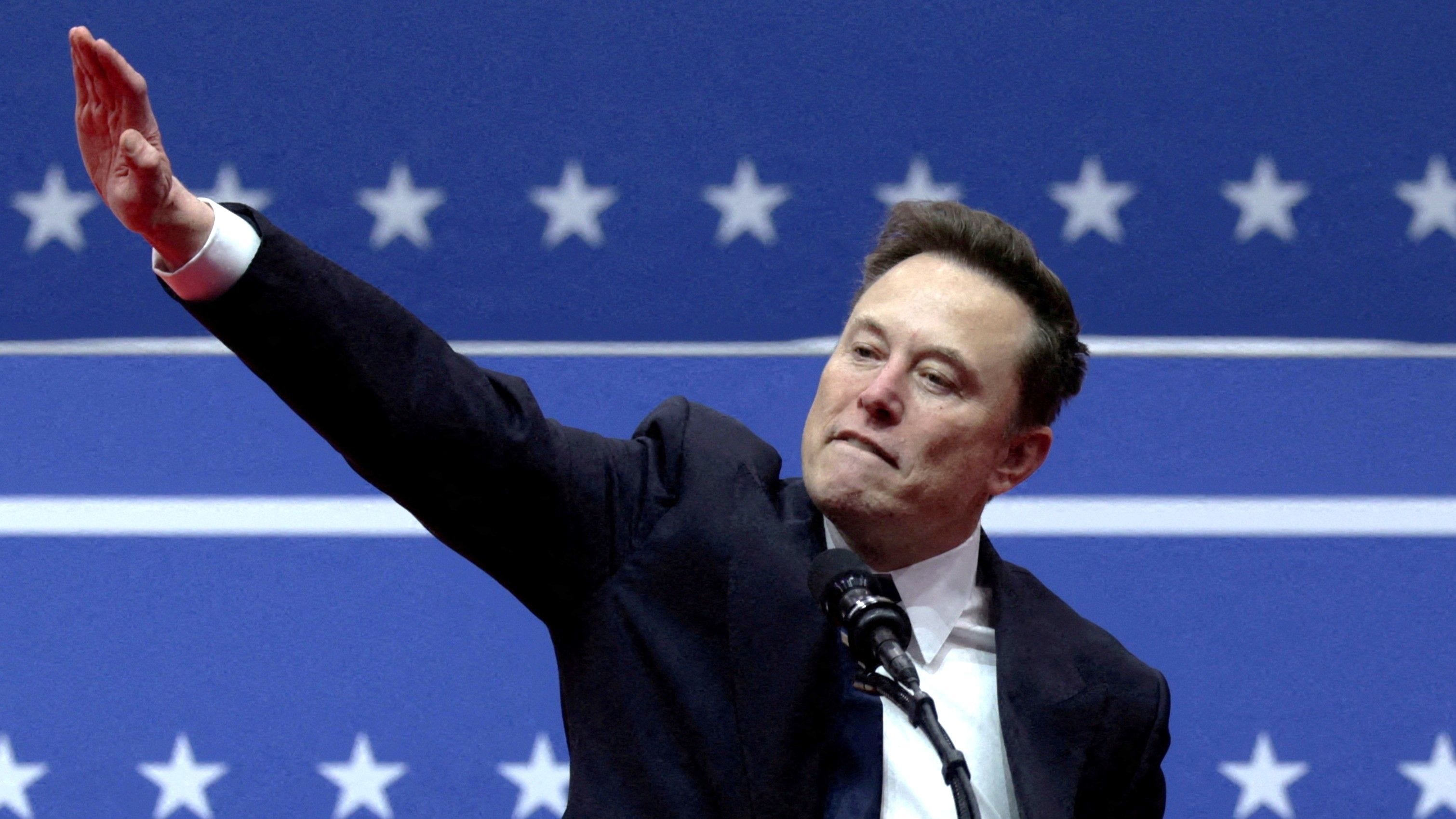
But what does it say about capitalism, when its greatest personal embodiment is a Nazi?