
A Prisoner's Dilemma
Game Theory can never account for life's many variables

Game Theory lives in the worlds of mathematics and logic—a demesne of known quantities and outcomes. The Prisoner’s Dilemma is a classic example of Game Theory in practice. In it, two “suspects” are held captive and their interests are pitted against each other, in order for the “dungeon master” to maximize likelihood of mutual incrimination. But that’s not how it is described to the prisoners.
Instead, the prisoners are told (separately) that if they incriminate the other, they will be freed. In the game model, both prisoners also know that if neither of them were to testify against the other, then neither can be held captive any longer.
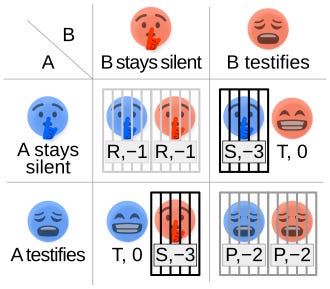
The “dilemma” is blind trust in another individual’s choice. When A and B have committed the crime—and know each other did—then the “safest” choice is to implicate the other. In the payoff matrix above, three of the four outcomes result in at least one prisoner remaining—the district attorney gets a conviction and is one step closer to re-election.
Is justice served? Only one of the three outcomes lands both perpetrators in jail, but by limiting information and demanding a Yes/No response, based on that limited information, the prisoners are more likely to implicate each other. That is, there is more than a 25% chance both will end up in prison; though that is only 1 of 4 possible outcomes.
However, the mathematical model requires eliminating a slew of information-related variables. If the prisoners enter their conspiracy with an agreement not to talk,
It's me and you hand-in-hand
I'm married to The Firm, boo, you got to understand.
I'll die for 'em.
Give me a chair, man, I'll fry for 'em.
And if I got to take the stand, I'm-a lie for 'em.
and keep to it, then the dungeon master’s game will result in both A and B’s freedom.
A prior agreement not to testify is just one potential external variable. The more frequently the prisoners experience this game, the more likely they will cooperate, having learned the “beat.” That is, they bring more information into the game than the game model presumes they have.
There are other, material and social, variables such as ability to pay high legal fees (and/or bribes), connections and influence with state officials, and the social class networks one belongs to are repeatedly shown to be more significant than whether one committed the crime.
But sometimes, even those are not enough.
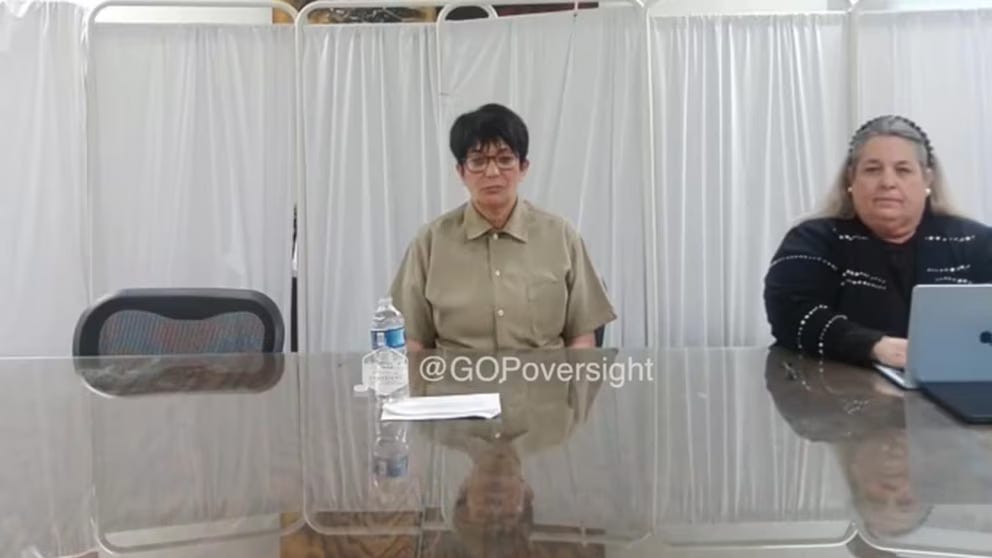
Ghislaine Maxwell has invited Donald Trump into something resembling a Prisoner’s Dilemma, by blackmailing him in the only way she can—through a passive-aggressive promise to keep his secrets if he frees her from prison.
Last summer, I noted:
In reality, Ghislaine Maxwell was more savvy than Jeffrey Epstein. She was on the lam for long enough to find a safe place to stash what she had secured from the island, and a safe person to trust with the dead man’s switch.

Maxwell’s attorney issued this statement on February 9, 2026:
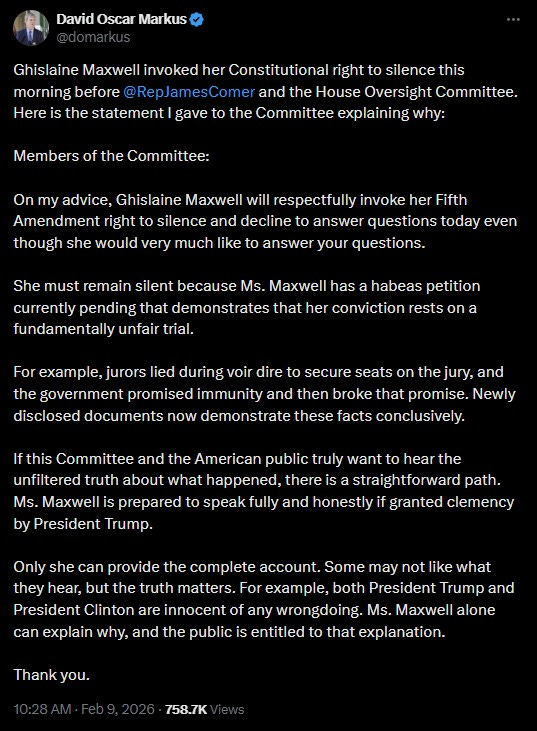
If this Committee and the American public truly want to hear the unfiltered truth about what happened, there is a straightforward path. Ms. Maxwell is prepared to speak fully and honestly if granted clemency by President Trump.
Only she can provide the complete account. Some may not like what they hear, but the truth matters. For example, both President Trump and President Clinton are innocent of any wrongdoing. Ms. Maxwell alone can explain why, and the public is entitled to that explanation.
Set her free, Donny-boy, and she will provide you the cover you want.
There are 38,000 mentions of Donald Trump in the Epstein files so far, and according to Congressman Jamie Raskin, there are at least 962,000 more. The files have been filtered and screened by FBI agents (assigned to obscure incriminating evidence—they have to read it, but they are only allowed to redact) in the President’s interests, for a full year.
Members of Congress who have been provided the scant means (4 computer terminals) to review the millions of documents, unredacted, report that even the “unredacted” versions have redactions on them—with the DOJ having replaced the originals.
The coverup continues.
Maxwell is walking the only path she sees available. Her attorney’s assertion that only she can clear Trump is Trumpian in both its claim of sole ability to do something and the absolutism promised in the outcome.
One can testify that one saw nothing, but that does not prove another’s innocence.
Proving innocence is also counter to the foundation of our legal system. Though Trump clearly approves of a presumption of guilt—the War on Immigrants is built upon it. By deporting all immigrants, we will deport those who are violent, as well as all those who may someday commit violence. They are all guilty, and unless they can prove their “innocence” ($5million for a Trump Gold Card fast-track to citizenship?) they have to go.
Maxwell’s offer Give me clemency (not a pardon which would force me to testify, and if caught in perjury, I go back to prison), and I will lie to clear your name is a fanciful promise, being made to a fanciful man. Stripped down to what is understood about both Trump and Maxwell, her offer becomes a threat:
I know what you did and if you don’t make your next offer better than the last (being moved from maximum security to a minimum security prison), I have evidence that is not found in the files.