
A Sentimental Journey
Justice is coming

I have been reticent to offer much credence to Emile Durkheim’s concept of the conscience collective as a driving social force. Epistemically, there is too much “magic” involved for me to be comfortable. This is not to say a collective comprehension of contexts-in-motion is not possible (there is a lot of evidence for it), but that Durkheim’s explication was missing material foundations of the social phenomenon.

What is the source? Is it language itself, in the way Chomsky described the paragraph as a fundamental linguistic/conceptual form? Is it a Weberian ideological force, like the philosophy of individualism that runs through Protestantism, universal and thus invisible in its own right? Or is it more like Frame Analysis, where we are constantly evaluating, combining, and disattending signs and symbols to discern meanings? Durkheim never grounded a principal concept of his social theory.
Why did so many of us immediately know the United Healthcare CEO was gunned down by a person who suffered from his corporation’s policies, days before the shooter was identified and the alleged “manifesto” explaining those were his motivations discovered?
I introduced the concept of social sentiment to explain the ideological shift needed as a precursor to marijuana policy reforms. Whereas the conscience collective applies to society as a whole—it is a source of social cohesion, of determining insider and outsider—social sentiment develops from material conflicts and is contested. At some points in history, subsets of persons who held pro-legalization interests (not just views), were able to publicize and advance a material counter-argument to the status quo of criminal prohibition.
A quick illustration: A pro-legalization view has been espoused by many public figures who themselves never used or planned to use marijuana—Jimmy Carter and George Will, for example. Pro-legalization interests emerge when the cop tells the driver to step out of the car because they “smell marijuana.”

Here is the lynchpin between opinion and call to action; something Americans will not pay much attention to, but should.
If a man attributes all or part of his own misfortunes and those of his country to the presence of Jewish elements in the community, if he proposes to remedy this state of affairs by depriving the Jews of certain of their rights, by keeping them out of certain social and economic activities, by expelling them from the country, by exterminating all of them, we say he has anti-Semitic opinions.
This word opinion makes us stop and think. It is the word a hostess uses to bring an end to a discussion that threatens to be acrimonious. It suggests that all points of view are equal; it reassures us, for it gives inoffensive appearance to ideas by reducing them to the level of tastes. All tastes are natural; all opinions are permitted. Tastes, colors, and opinions are not open to discussion. In the name of democratic institutions, in the name of freedom of opinion, the anti-Semite asserts the right to preach the anti-Jewish crusade everywhere.
—Jean-Paul Sartre (1976). Anti-Semite and Jew. Schocken Books: New York. Pp. 7-8.

While opinions have a role in shaping social policies, calls to action are what make them. Anti-Semitism, as understood by Sartre, is fundamentally a call to action, a call to invest oneself in a particular bad faith. What is excerpted above applies, of course, to the Palestinians who have been suffering an ethnic cleansing at the hands of Israel in the name of a Jewish ethno-state, as well as to Latino migrants in the U.S.
When a person claims their calls to action were merely opinions, they are speaking in bad faith, saying they were offering nothing of any more significance than saying they prefer chocolate to vanilla. A quick reflection of the results of having expressed those “opinions” however will demonstrate multiple and ongoing failed calls to action. The mea culpa not for the actions taken themselves, but for having the ideas and, well shucks, you cannot hold people responsible for their ideas, can you?
The response to “Project 2025,” which Trump distanced herself from during the election but has since been implementing at breakneck speed, is beginning en masse today, at noon, at state capitols. Aside from showing up and allowing numbers of people to represent degrees of displeasure, there is no theme, no focus, no shared symbol such as the pussy hats that flooded DC following the 2017 inauguration.
There is no clear organizer—thus my earlier discussion of conscience collective—Americans are quite displeased with the first two weeks of having the federal government dismantled and the Treasury robbed, but they do not know what to do.
Scratch that.
We all know what needs to be done. There was a reason the Wagner Group leader who almost took over Russia (which is a third-world nation—the nukes and vast natural resources under its own control make it unique in that way) was shot down (or blown up) while flying on a private plane. A governing body with a sense of self-preservation does not allow those who almost toppled them have a second chance to do so.
Looking at my Facebook Memories this morning, I am reminded of how Bernie Sanders won the Iowa caucuses (while Mayo Pete played the W. Bush game of prematurely declaring himself the victor). Joe Biden was running for the sixth time for the Democratic presidential nomination (his first was in 1988) and had never, ever won a single primary.
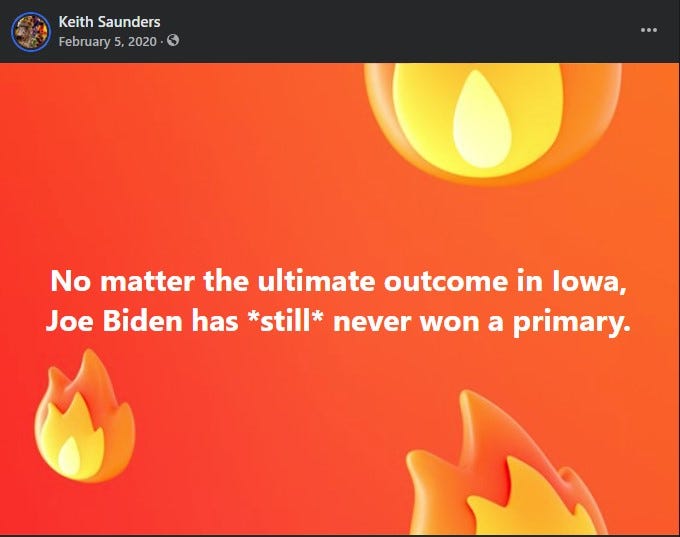
That all changed, come Super Tuesday, when Pete Buttigieg and Amy Klobuchar ducked out of the race with less than 48 hours to go. They spent millions upon millions of dollars on their Super Tuesday campaigns, only to tell their squads of volunteers and the folks who threw them large chunks of cash, Thanks, but no thanks.
If we consider the DNC’s move to install Joe Biden as their candidate in 2020 not as a way of keeping Donald Trump out of the White House, but instead Bernie Sanders, the past two presidential election cycles make a lot more sense.
The goal was to insulate Capital from an Executive who pledged to address economic inequality, and they got it. Biden also further bifurcated economic growth such that Capital had a good feeling about the future exploitation of laborers, so they threw tons of money into corporations—the stock markets BOOMED.

There was the explosion of Joe-Jobs (like a McJob, only under worse working conditions) where the “disruption” of traditional industry produced app-work, and where registering for income opportunities via Door Dash or Uber or social media platforms (such as Substack) is considered by the Department of Labor to be the same as a salaried position with benefits.
Trump and the Billionaires are merely the logical extension of the same ruling class that set up the past three presidential primaries and elections to ensure they retain full power, regardless of social sentiment. As a nation and as a social class, American workers are silently rooting for executions. Ultimately, the very wealthy rely on servants. They need someone to maintain and repair their vehicles, they need someone to prepare their food, they are exposed every day regardless of the number of bodyguards they employ.
It is not clear whether this can be fixed through institutional means. Everything I have seen tells me that Trump is going to ignore court rulings against what she is doing, with the knowledge her Supreme Court has granted her full criminal immunity. Republicans will not stop her and the Democrats are content to wring their hands and fret for a few years, perhaps yelling loudly into the sky and never wondering why they hear no echo.
Justice is coming.