
Automations
Whether women's work or men's, time-saving devices have yet to save workers any time

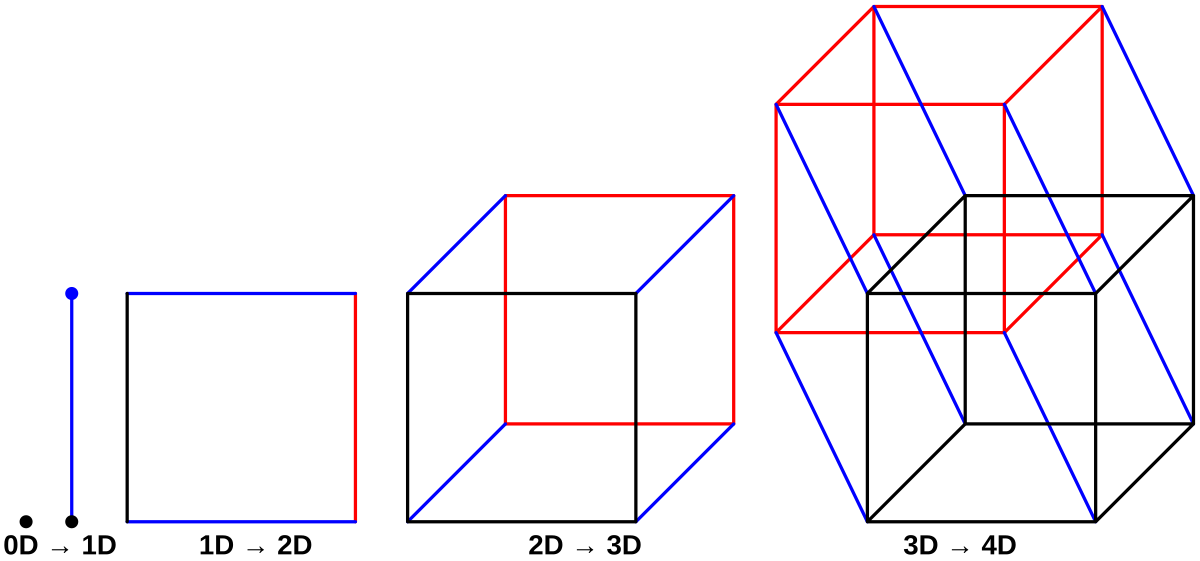
A sphere—a 3-dimensional object—passing through a 2-dimensional universe will appear first as a point, then it will become a line that grows and then contracts, back to a point. Then it will disappear.
Theoretically, a 4-dimensional hyperobject passing through our 3-dimensional universe will appear as a 3-dimensional object. Will it grow and shrink? We might expect it to. Regardless of whether it does, when it passes through our universe, it will disappear.
We have long been utilizing technology to overcome constraints of time and space. Aside from the globalization of tobacco smoking, the 20th century’s landmark human achievement was mass distribution of time-saving technologies and techniques. Assembly line production itself both accelerated productivity and made possible the range of time-saving consumer goods of the 20th century.
In a society with fairer distribution of resources, all this newly-freed time would add up to a copious amount of leisure. In much of Europe, this indeed became the case, but not so for Americans.
20th century popular consumer devices saved time:
Washers & Dryer: 4 hours per load, 1200 hours per year.
Dishwasher: 15 minutes per day, 91 hours per year.
Microwave Oven: Unknown minutes per meal microwaved; energy savings.
Refrigerator & Freezer: Reduce food shopping time.
Automobile: Reduce travel time.
These were widely adopted alongside time-saving techniques, featured in lifestyle magazines. The 21st century version is a Google search:
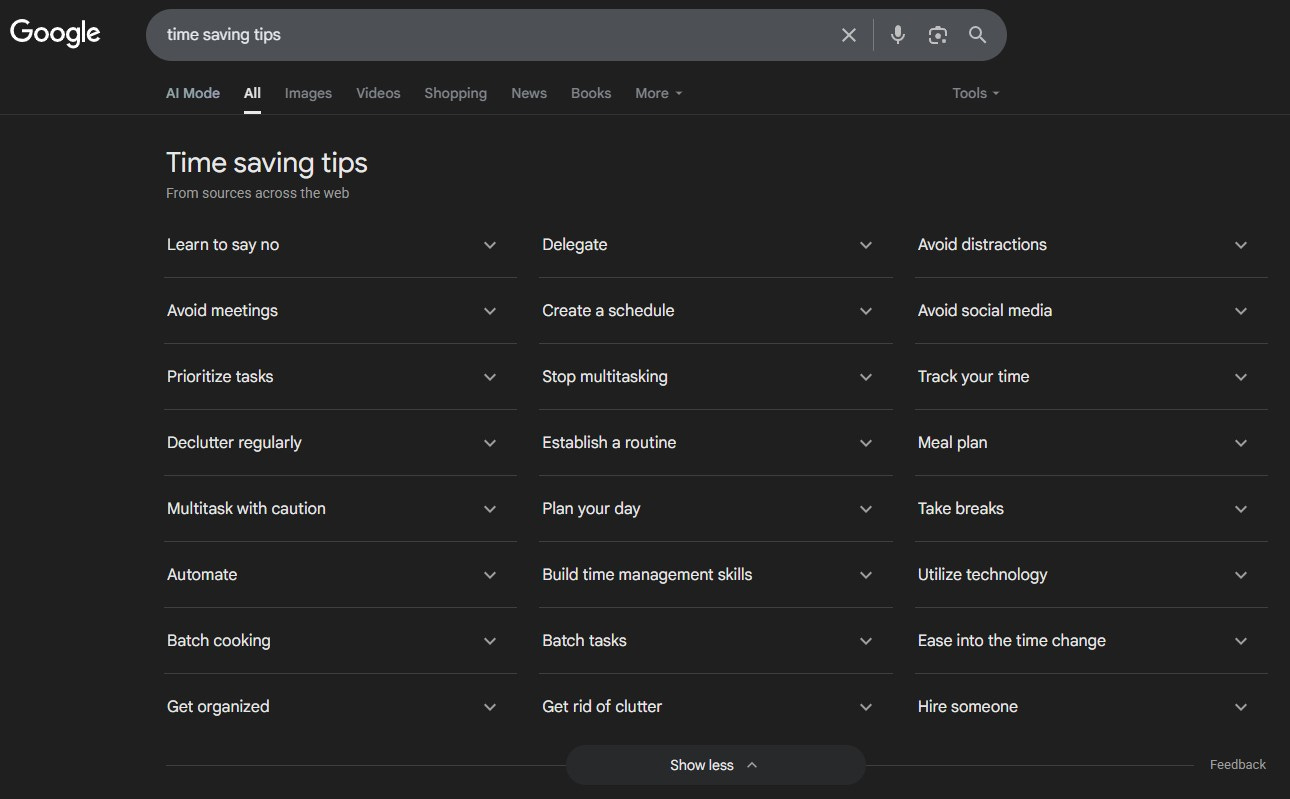
With all this time having already been saved, and with so many different suggestions as to how one may further “save time,” an outside observer might expect most Americans to share an abundance of leisure.
Instead, some politicians seek to raise retirement age, reduce child labor restrictions, and will absolutely refuse to raise the federal minimum wage. Despite thousands of hours of reproductive labor (unpaid work done in the home that makes work outside the home possible) being saved via electronic appliances, we did not see an increase in domestic leisure time. Instead, middle class women were drawn into the paid labor force.
[n.b.: Working class women have always worked outside the home for money. They did not “break barriers” to employment as domestic servants, hairdressers, seamstresses, waitresses, secretaries, nannies, etc.]

It was post-WWII middle class men—those who held jobs that could cover all household expenses and provide a surplus—who saw women entering professional and managerial positions in growing numbers, to compete with them for jobs. Sex desegregation in employment has been a multi-generational and ongoing political matter. Women still carry cultural yokes of responsibility for the home and family that are never laid upon men.
Outside the home, productivity has close to doubled since 1950, thanks to various task automations, electronic communications, and a shift to a post-industrial economic form. The average American worker produces as much Absolute Value in about twenty-two hours today as they did in forty hours hours, 75 years ago.
Bring on the 24-hour workweek! Four days, six hours a day. Every weekend is a long weekend, or—better—do the American Grind and put in 48 hours over five days and get the next NINE DAYS OFF.
It’s the same amount of productivity.
But, no, we have an economy that requires perpetual expansion without surcease, so there can be no such thing as “free time” that comes from “producing enough.” Where does anyone get the impression that time-saving devices save working people from having to work? They make them more productive.
This is why I say the promise/threat of AI to eliminate the need for human labor is bullshit. It’s a washer/dryer combo, on stage at The Price is Right and all the folks watching can do is imagine how much easier their domestic chores will be, when the machines do all the work.
Automatons make for poor consumers, and without demand, no value can be realized (made real). Machines do not have social needs. All economic activity, at root, involves the transformation of natural resources for social purposes. There is no way to automate beyond economy or beyond society.

Illusions to the contrary, computers are not social beings.