
Bomb Control
Guns threaten individuals, bombs threaten social orders

In mid-October, a disaster at a Tennessee explosives manufacturer killed 16 people. So far, it appears to have been accidentally triggered. It was an unusually-large number of people to have died by explosion, which is a relative rarity in the U.S., when compared to firearms.
From time to time, people in America “debate” gun control (the “more guns are needed” side always wins), but no one thinks about our bomb control policies, and what they show us.
Explosives are both highly regulated and used on a daily basis, across the country.


Explosives are a means of causing mass deaths, as well as targeted ones, and have been used for both these purposes.


Two of the most deadly terror attacks on the U.S. involved explosives in rental trucks, but we still rent trucks, and we still sell materials that can be used to make truck bombs.


In fact, the information needed to make these devices can be found on the internet—and not even the dark web.

If everyone who builds an unlicensed explosive device is considered a criminal, and they are, only criminals have unlicensed explosive devices.
No one would think the way to make society safer, while not infringing on our second amendment rights, is for everyone to carry an explosive device.
It seems that several of the premises dismissing gun control as potentially effective are disproven by the effectiveness of our bomb control policies. They are far from perfect, and we see a fair amount of people intentionally injured and killed by explosives each year, but the numbers are miniscule fractions of the number of people harmed or killed with firearms.
From the NIH:
We conducted a retrospective analysis of the number of incidents, injuries, and deaths because of explosive, incendiary, premature, and attempted bombings from January 1983 to December 2002. Morbidity and mortality by motives, target locations, and materials used were evaluated.
In the United States, 36,110 bombing incidents, 5,931 injuries, and 699 deaths were reported. There were 21,237 (58.8%) explosive bombings, 6,185 (17.1%) incendiary bombings, 1,107 (3.1%) premature bombings, and 7,581 (21.0%) attempted bombings. For explosive bombings with known motives, 72.9% of injuries and 73.8% of deaths were because of homicide. For incendiary bombings with known motives, 68.2% of injuries were because of extortion and revenge, and 53.5% of deaths were due to homicide. Private residences accounted for 29.0% of incidents, 31.5% of injuries, and 55.5% of deaths. Government installations accounted for 4.4% of incidents but were the site of 12.7% of injuries and 25.5% of deaths. In bombings with known materials, nitrate-based fertilizers accounted for 36.2% of injuries and 30.4% of deaths, and smokeless powder and black powder accounted for 33.2% of injuries and 27.1% of deaths.
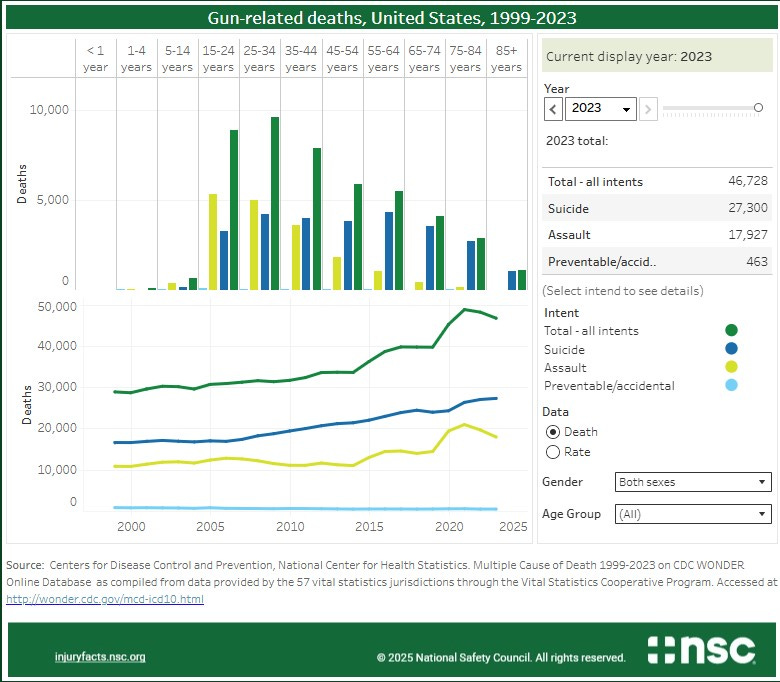
There were 10,828 U.S. gun homicides in 1999, or 208.2 per week on average. It took less than a month of 1999 to match the 20-year tally of 699 bombing deaths. In 2023, when there were 17,927 U.S. gun homicides (344.75 per week), the 20-year total for bombing deaths was achieved in less than 21 days.
Suicides by firearms are not included in the prior calculations if we count the 46,728 total firearms deaths in the U.S. in 2023, the 20-year total for bombing deaths was achieved in less than 5.5 days.
The largest bombing in the United States in our lifetime was on 9/11, when airliners were used as the explosive. All of us who can recall flying before and after 9/11 can attest to the bomb control measures that were immediately put into place.
We saw just under 3,000 people killed in one morning, one time. That is less than 9 weeks of gun homicides in the United States, ongoing.

Speaking of bombs, today is Guy Fawkes day. Never forget that he failed.