
Chronocentrism
What a time to be alive

CHRONOCENTRISM is like Ethnocentrism, only instead of peoples and customs, it is about eras. The concept was first put forth by sociologist Jib Fowles (1974) who wrote:
Given the present-day sensitivity to ethnocentrism, then, it is curious that there is no recognition of the identical error when it pertains to another dimension, that of time. The idea that our era is more significant than others provokes no chagrin; at worst, it is considered platitudinous. The immensity of the deception goes unnoticed.
Chronocentrism—to give a name to the misconception--is the belief that one’s times are paramount, that other periods pale in comparison. It is a faith in the historical importance of the present. As such, it suggests a slighting of the past and future.
We have the tendency to believe that THIS TIME, while we are living, in the location we are living, is THE BEST there ever was. Modern Positivism goes further; that we are on an UPSWING, and that the best time to be alive after RIGHT NOW will forever be into the COMING FUTURE.

Modernity also sticks us with secularism, empiricism, and other atheistic philosophies that kill thoughts of reincarnation. The Abrahamic religions’ promises of reincarnation (an “afterlife,” that is also lived) take place in a different dimension. There is no next time for adherents, here on Earth.
Of course, no one has a choice as to when we exist. Ultimately this is both the best time for us to be alive AND the worst time, as qualitatively, there can be no OTHER time. In sum, therefore, it's a NEUTRAL PROPOSITION. We cannot judge the value of our time relative to those others we know of, from within our time. Like with General Relativity, accurate measurement of an object in motion from another object in motion becomes impossible.
Which leads to the logical conclusion that odds are this is NOT THE BEST era in which to live. In the entirety of the human condition—from all that was to all that will ever be—chances are extremely good that SOME OTHER ERA offers a qualitatively better existence for humanity. Maybe it was as hunter-gatherers, or when we developed agriculture for the first time, or maybe it will be at a point in the distant future.
At some moment, humanity will be at its qualitative peak, but it's silly to think it would be THIS MOMENT. Chances are, we are in the first standard deviation from the mean. That is far, far from the optimum positive deviation.
A lot of social hegemony rests on the idea that our existence is the ever-cresting pinnacle of human achievement, and that every day, in every way, we keep getting better and better.
That sounds a whole lot more like ego than a dispassionate calculus.
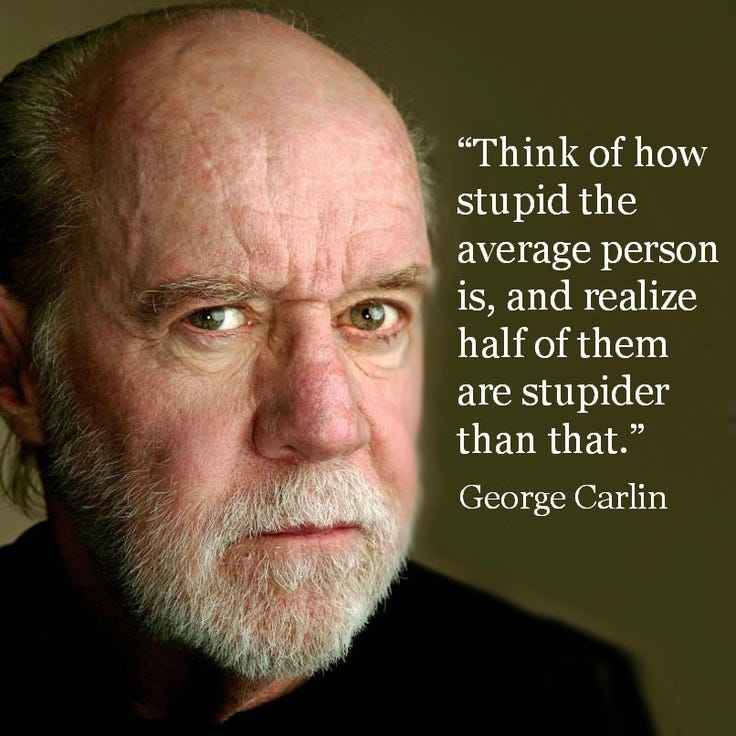
“Think of how stupid the average American is, and realize that half the population is stupider than that.” — George Carlin.
Averages are funny things. No one cared about applying them to humans very much, until we reached Modernity. There is something about the Popular and the Mass that calls us to conceptually homogenize them. Then to treat deviations from this concept as “differentness,” in either a positive or negative direction from the norm.
We use statistical measurements of behaviors to categorize geographies; to claim that one city is “safer” than another because of differences in the homicide rate; to say that Massachusetts is a “Democratic” state because the largest plurality of voting-eligible residents vote for Democratic candidates; to say that “America wants” universal health care, better gun control, and a higher tax rate on the wealthiest because more than 50% (typically, more than 70%) of Americans polled agree with these propositions.
Statistical outcomes are not themselves cases. The apocryphal American family has “2.2” children, but no one can be two-tenths a child. [Is it merely coincidence that 8 weeks is 20% of average human gestation, and that’s a common cutoff for states with abortion bans?] Statistics are measurements of the past, and every day that goes by after they have been taken, those measurements become less and less applicable. Yet we talk about statistical measurements as if they are telling us about individual cases in the present.

Statistically, any human performance can be measured over a career of such performances and we can expect there to be at least one discernible peak performance. Perhaps there are many, or perhaps once a peak has been achieved there is no means or method to improve, and so the person stays at peak butt-wiping ability for what might seem a lifetime.
For many things, however, people will seldom issue their peak performance, no matter how much they practice. They simply, statistically, cannot. For some (e.g., Olympians, fighter pilots) the opportunity is rare, while others (singers, comedians) will see the more opportunities they receive, the greater the variance in performance.
With physical activities, the window for optimum performance is narrowed by biological and biographical factors. When achieved, peak performance is seen in retrospect, and becomes clear.
Athletes in physically-contested sports (as opposed to judged sports) reach their peaks somewhere between the time they stop maturing and their early thirties. Most will desist competing, in part due to lack of opportunities afforded to sub-elite athletes of a certain age, before they reach their full potential. There are many former high school football and baseball players who never reached their personal peak because opportunities for them to play beyond high school did not exist.
The same situation exists for intellectual human pursuits: from artistic expression to mathematical formulation to social theorizing. We have a world of human potential we all might benefit from, if we were wise enough to give each other opportunities to practice. Not because of peak performances alone (we fetishize these, to our detriment) but because with more practice we elevate mean performance. We improve the General Welfare.
We have no means of determining the quality of the era in which we live, but statistically speaking, we stand the best chance to generally improve it by maximizing opportunities for all people to make and do.