
Class Anxiety
The political spectrum is actually vertical

Capital that is not in motion becomes less valuable, by design. The more actively in motion, the greater the economic stratification that will result. Thus for the majority of people the mode and relations of production produce a lifelong social class anxiety—a fear of falling.

This manifests among those in the most precarious of class locations as conspicuous consumption—a concern with the status conferred by both necessary (food, clothing, transportation, housing) and optional (vacations, college or university attended, leisure activities) items purchased. Similarly, an economic cost-benefit analysis comes to be applied to social relations and interactions. It becomes appealing to join social clubs where proper class location is a prerequisite and the cost of initiation fees and annual dues indicate the degree of surplus income the members share.
For the suburban managerial and professional “middle class”—those with an annual surplus income that has been traditionally used to secure residential real estate, along with returning to motion as capital via “investment”—there are thousands of social clubs organized around leisure activities such as golfing, tennis, or sailing. Fraternities and sororities fill a similar role on college campuses, with undergraduate education historically having served as a class filter, itself.
Privatization appeals to those with a fear of downward social class mobility, as the “public option” is denigrated by those who create and benefit from social class stratification itself. It works much the same way in any segregated social system—a more powerful group isolates itself and characterize the effects of their self-isolation as an inherent trait of those who suffer from the more powerful group’s actions.
Does America have poor neighborhoods because all the poor people have decided to live in the same place? Nope. In fact, it’s because the rich people have done so.
Sociology is the demystification of social life.
One of the best online resources about social class stratification and power has been compiled by my colleague William Domhoff, a website titled “Who Rules America?”

Domhoff made his critical ethnographic bones with his late-1960’s study of the Bohemian Grove, an annual gathering of several dozens of the wealthiest and most powerful political and business barons, all men, and mostly from within the United States; though not exclusively. Special guests—again, men only—of requisite social class (economic or cultural) are welcomed each year.
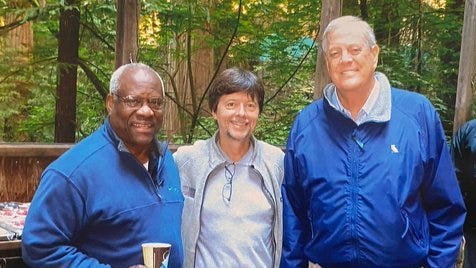
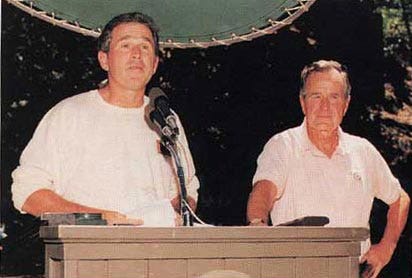
George H.W. Bush famously held his son’s national political coming out party at the Bohemian Grove.
“In 1995, House Speaker Newt Gingrich delivered the Lakeside Talk on the middle Saturday of the encampment, and former President Bush had his turn on the final Saturday. He used the occasion to say that his son George W. Bush would make a great president someday.” —https://whorulesamerica.ucsc.edu/power/bohemian_grove.html
Domhoff’s work draws attention to the social networks formed by the American and global ruling class. By and large, these people cooperate to keep the economic, political, and cultural hegemonies in place, so that they may compete amongst themselves for shares of the spoils. They hold unquestioned “right” to controlling interests in capital, and have used the combination of ownership and the concept of rights to dictate social orders.
This is a conspiracy, though not of the secret, theoretical kind. It is a conspiracy of material interests, out in the open, and it is becoming more apparent. The old, aspirational American Dream embodied by a middle class that mimicked the Bourgeoisie is over. People will continue to segregate themselves by social class, but the means to stave off the fear of falling will not themselves prevent the fall.
Social class mobility works in two directions, and historically, upward mobility is the exception that proves the rule. When a professional and managerial middle class proves to be less-profitable than alternatives, it will be abandoned.