
Cleaning Elections
All politics is local, so get smaller.

To effectively stave off Fascism, we are going to have to improve our democracy. It is not a matter of defeating Fascists at the polls, for their attack is on the polls themselves, and should they take control they will eliminate elections. There are measures we can implement that do not require a constitutional amendment or a constitutional convention (though there are some that would, and that we would benefit from).
We need a more direct democracy, and technology has made this practical. We will not prevent gerrymandering by outlawing gerrymandering—it is already against the law. We prevent gerrymandering by rendering districts too small to effectively manipulate, and the simplest way is by increasing the number of representatives, by reducing the average number of constituents.

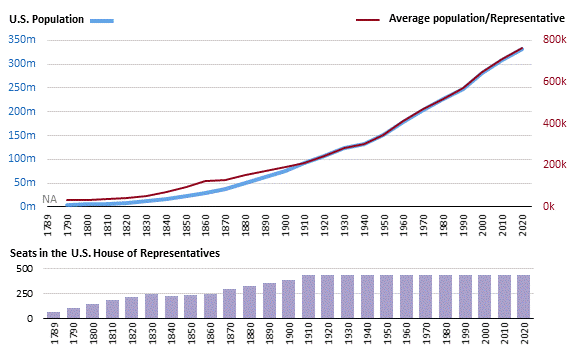
As it stands the proposed “Wyoming Rule” would set the standard Congressional representative district at the same population as the least-populated state. This itself would increase the number of representatives in Congress, and grant more proportionate representation across districts. As it stands the most populated Congressional district in 2024 was Delaware’s at-large district with 1,051,917 residents, the least populated Congressional district in 2024 was Wyoming’s with 587,618 residents. Wyoming and Delaware residents each get just one Representative, but a single Wyoming vote carries almost twice the weight as a vote in Delaware, for representation in Congress
.
Rather than hundreds of thousands (up to a million) per Representative district at the federal level, make Congressional districts represent no more than 50,000 people. The chart above illustrates it was once the case that representative districts were smaller than 50,000 people, every year prior to 1840.
The 2024 U.S. population was 340,110,988 People / 435 Reps. = 781,864 people per district, by average.
To return to 50,000-constituent Congressional districting means increasing the size of Congress to 6,700 members.
But how would they ever meet? Online, mostly. We would no longer have use for the Capitol building, which has for years been used to constrain our democracy by physically limiting the size of the assembled body. Sorry, American democracy failed because our building was too small! Is that any way for an Empire to go out?

Get rid of the Congressional physical plant, save on operational costs. Leave it open for tourists and ceremonies (we can still do the inaugurations on the Capitol steps), convert some of it into part of the Smithsonian. Put a ceramic turd on Nancy Pelosi’s desk to commemorate January 6. Never Forget!
With smaller districts, we will have better sampling. Elections are surveys, they follow the same rules and have the same limitations as surveys (ask Al Gore what a “margin of error” means to divining survey results). Surveys are not a census, which attempts to measure every case.
Voters themselves STAND IN for those who cannot vote, whether it be because they are minors, or have lost their suffrage, or are not citizens. Representatives stand in for voters on Congressional votes on Bills and other matters. By reducing the ratio of voters to stand-ins, we will produce more accurate measurements.
Better sampling will produce a more diverse array of opinions (election results), with opinions that were once stifled due to being in the slim minority (Green/Libertarian/Democratic Socialist/Constitutionalist candidates) becoming represented as ideological enclaves emerge. The suppression of the majority made possible via gerrymandering could still occur in selected samples (districts), but system-wide the ability to manipulate samples would be eliminated by the volume of them.
Smaller districts will reduce the relative power of the Corporate parties. Democrats and Republicans have uniformly agreed private corporations and wealthy individuals should exert the majority of influence on policy-making more than fifty years. The costs of establishing one’s reputation among a populous of 50,000 and campaigning to represent them need not total in the millions of dollars, each election cycle. Lower the costs of entry and more people can afford to join the club—and in a democracy, everyone is supposed to be a member.
How are we to conduct votes, you ask? The September 29, 2025 (7 a.m EDT), estimated global value of Bitcon is $2.17 trillion dollars. This value and a whole lot more of it, is transferred between buyers and sellers, constantly, around the globe. When a global CEO is given tens of millions of dollars in stock as part of their compensation, that value moves in the same manner. If the oligarchs trust blockchain with moving their money around, shouldn’t that same degree of security be sufficient for casting ballots? A guarantee that a vote may only be cast from one account, and that only one vote may be cast from any account.
This not only would work well for the expanded Congress as a body, it would also make possible greater election security, seeing as Republicans are so concerned about voter fraud. Each vote must be cast and recorded individually, there can be no ballot box stuffing, and a record would be kept of who voted. We can anonymize tallies for public elections, because we will know the tallies cannot be added to or subtracted from by unscrupulous accounting at the state level. I need you to find me…11,780 votes.
Uniform state representation in the Senate causes problems in terms of disproportionate inputs by individual voters (Wyoming has 587,618 residents and two Senators; California has 39.43 million residents and two Senators). Without affecting equal Senatorial representation by all states, we could double or quadruple the number of Senators, to 4 or 8 per state. This would serve to open the field for more direct representation of the People’s will, while preserving the uniformity of state power in the Senate.

One last thing for now: Lower the voting age. This further reduces the ratio of voters to stand-ins. We establish mens rea at age 7; that is the age where one may be held criminally liable for one’s actions. It is not close to any recognized age of consent or maturity. Conferring criminal liability—or suffrage—to minors does not make them legal adults. If we can hold a young child criminally liable then we are acknowledging they can make informed choices, and that is all a vote is, at best. Undoubtedly there are ignorant ballots cast, where the voter misunderstands or simply does not know the candidate(s) they are voting for.
Seven years may be too young, but 14 is not. Republicans are seeking to lower the age of adult criminality to 14 in DC, wanting teens to be held to full adult standards while not allowing them to vote because they are “too young.” We provide 14-year-olds all sorts of opportunities to make consumer decisions and do not think them incapable. When schoolkids get to vote, our public schools will improve as the stakeholders will finally have a say.
Originally Drafted: September 28, 2022.
One of your best posts yet.