
Congratulations Graduates!
Finding a long-term gift in a short-term culture

Until this past month, I had not had a reason to buy a high school graduate a gift in quite a long time. Earlier this year I began to consider what to get my son to mark this milestone.
There’s a smorgasbord of Congratulations Graduate and Class of 2026 -themed gifts; T-shirts durable enough to be worn once but not durable enough to survive multiple washings; tchotchkes that will be tossed away by the end of the summer; and embossed beer mugs and shot glasses.

I am of the mind that graduation gifts should be of use to the recipient. They are already receiving a memento of their achievement; they do not need something else to collect dust. Better still, if the gift should have some relation to the next phase of their career. They should be something the recipient will be find value in immediately (no savings bonds), and that they might still use, in years to come.
I thought of gifts I received, when I graduated high school, forty years ago. These high school graduation gifts were rooted deeply enough in American culture and tradition that merely mentioning the brand names tells people my age what the gifts were:
Miriam-Webster, Roget’s, Smith-Corona, Texas Instruments, Barney’s New York.
A dictionary, a thesaurus, a typewriter, a scientific calculator, a necktie. Equipment for my next life-stage, college, and beyond.
Today, high school graduates carry four of these in their pocket, and the fifth went out of style in the era they were born, the Great Recession. Most men stopped wearing long, cloth ornamentation around their necks, as a reflection of a large economic change. Working with an open collar became a symbolic representation of the final collapse of the American Dream. Why dress in the manner of the professional class, when that class position is no longer achievable? Obama bailed out Capital, let the workers eat the personal bankruptcies and foreclosures, and watered the seed of MAGA.
In a world of portable data and open collars, what is left to give as a graduation gift? What is designed to have decades of durability, anymore?
He already has a phone, a laptop, and a desktop computer. Besides, every technology is at risk of being supplanted by something “superior.” I remember the time when having a pager (and then a Blackberry) meant you were the shit.
A streaming subscription does not have the staying power I was looking for. Similarly, while travel can be unforgettable, it is that way because experiences are fleeting and rare. We have all traveled to where we presently live—it’s just that we stopped considering ourselves “new” to the area, as we repeated behavioral patterns and otherwise made it our “home.” What we value about travel is the novelty we are forced to encounter. I wanted to give my son something less ephemeral.
So much of what is around us is no longer of real permanence. What’s more, we are less and less grounded in our locality, as we engage in a virtual, global economy. The Class of 2026-themed gifts are physical representations of this placelessness—ordered via satellite transmission from wherever the manufacturing process may be done at lowest labor cost, to be delivered to your doorstep.
The qualities I did not want in the gift narrowed the field so much, I wondered if such a thing could possibly still exist. I figured it out. It was not an “aha!” moment or a revelation, there was no song lyric that triggered the idea. One morning, I realized what it could be.
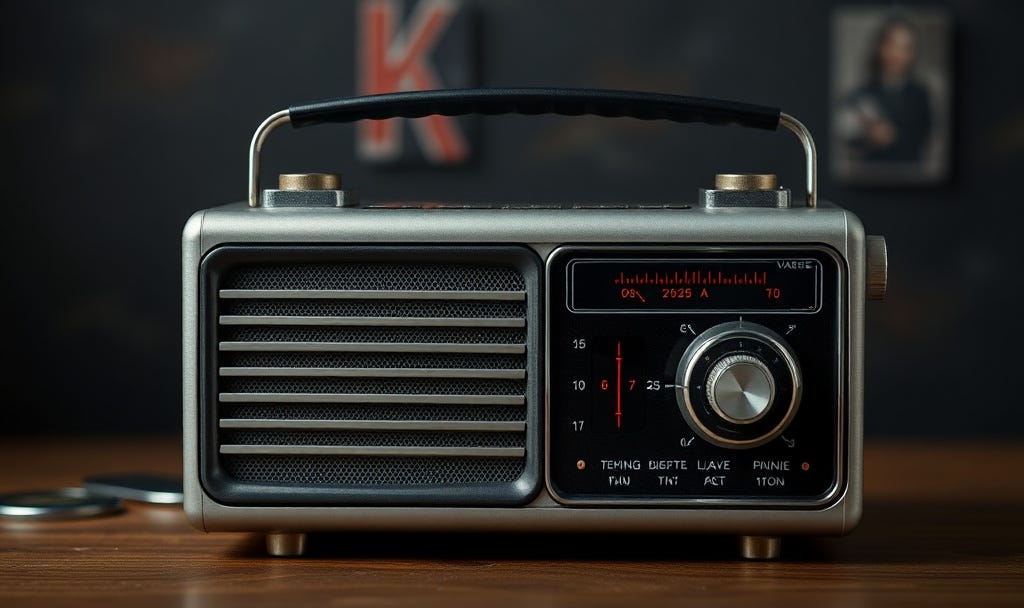
A transistor radio. Battery-powered, so that when the internet goes down with the power, it still works. Localized to terrestrial broadcast—perhaps 200 miles on the AM under ideal conditions, less than 100 on the FM. Terrestrial radio is paid for by local advertising. There are no subscription fees. With only two dials (Tuning & Volume) there are few moving parts to worry about, and there are no software updates required, ever.
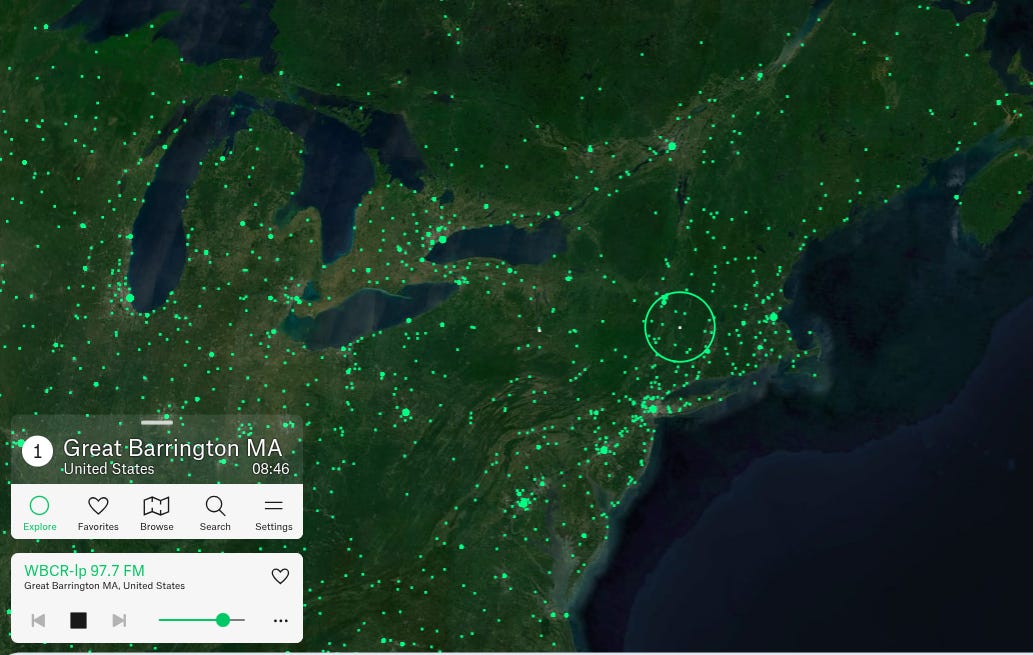
Terrestrial radio is available via the internet—there are apps that allow one to tune into real-time broadcasts from stations around the world (I recommend Radio Garden). However, when a terrestrial station is broadcasting certain, licensed content, without streaming rights, they cannot put it online. One cannot listen to a New England Patriots game, for example, via their radio broadcaster’s internet stream. Increasingly, one cannot watch professional sporting events on broadcast television. This year’s was the first Super Bowl only available in the U.S. as paid programming.
For the time being, professional sports teams continue to rely on terrestrial radio—not just for tradition’s sake, but because the model fits very well with the localized fan markets. By naming themselves after cities and regions (as did print newspapers) professional sports teams anchor themselves to territory, using it to market their product.
Internet platforms, devised under capitalism to fit the demands of that particular economic form, are designed to exceed existing markets. The monopolies that are commanding the largest shares of data-transfer cannot be limited to fit on a human-scaled geography, like broadcast media must.
I hope he finds it useful.