
Consensual Deviance
Collective rule-breaking challenges enforcers' legitimacy

Concurrent with my work with marijuana policy reformers, I developed a parallel interest in what I came to term consensual deviance. Like the marijuana consumers and their suppliers, other consensual deviants engaged in cooperative activities that violated mores or laws, but that in themselves produced no unwilling victims.

Consensual deviants I have had extended field encounters with have included:
Marijuana users, sellers, and growers;
Underage alcohol and tobacco users;
Gamblers in unlicensed gaming parlors;
Undocumented laborers and their employers;
Polycules and people in open relationships;
Fetishists and kinksters;
Yippies and other street theater activists.
Other than the Yippies, most consensual deviants I observed collaborated to keep their deviance secret. The Yippies were proud deviants (this element of consensual deviance is why we have PRIDE parades today), who sought to “freak out the squares” by practicing street theater breaches.
“Breaching experiments” originated in the field of Ethnomethodology, pioneered by Harold Garfinkle, and tied largely to Symbolic Interactionism. To Symbolic Interactionists, social life is understood as an exchange of signs and symbols, and disrupting the normative pattern of exchange through breaching was thought to expose assumptions and shared understandings; the culture, in a way.
Breaching experiments involve violating a social norm. One example would be to stand perfectly still for three minutes in a busy space, without doing anything—specifically not engaging in “waiting behavior” like looking at a watch, texting, or searching for a missing companion.
Breaching experiments can be very difficult to conduct, often causing the experimenter to default to a self-consciousness that makes them feel they must repair the breach. Our sociality makes us want our symbolic exchanges to go smoothly, and when the exchange is jarred by a lack of reciprocity in some form, we attempt to fix it.
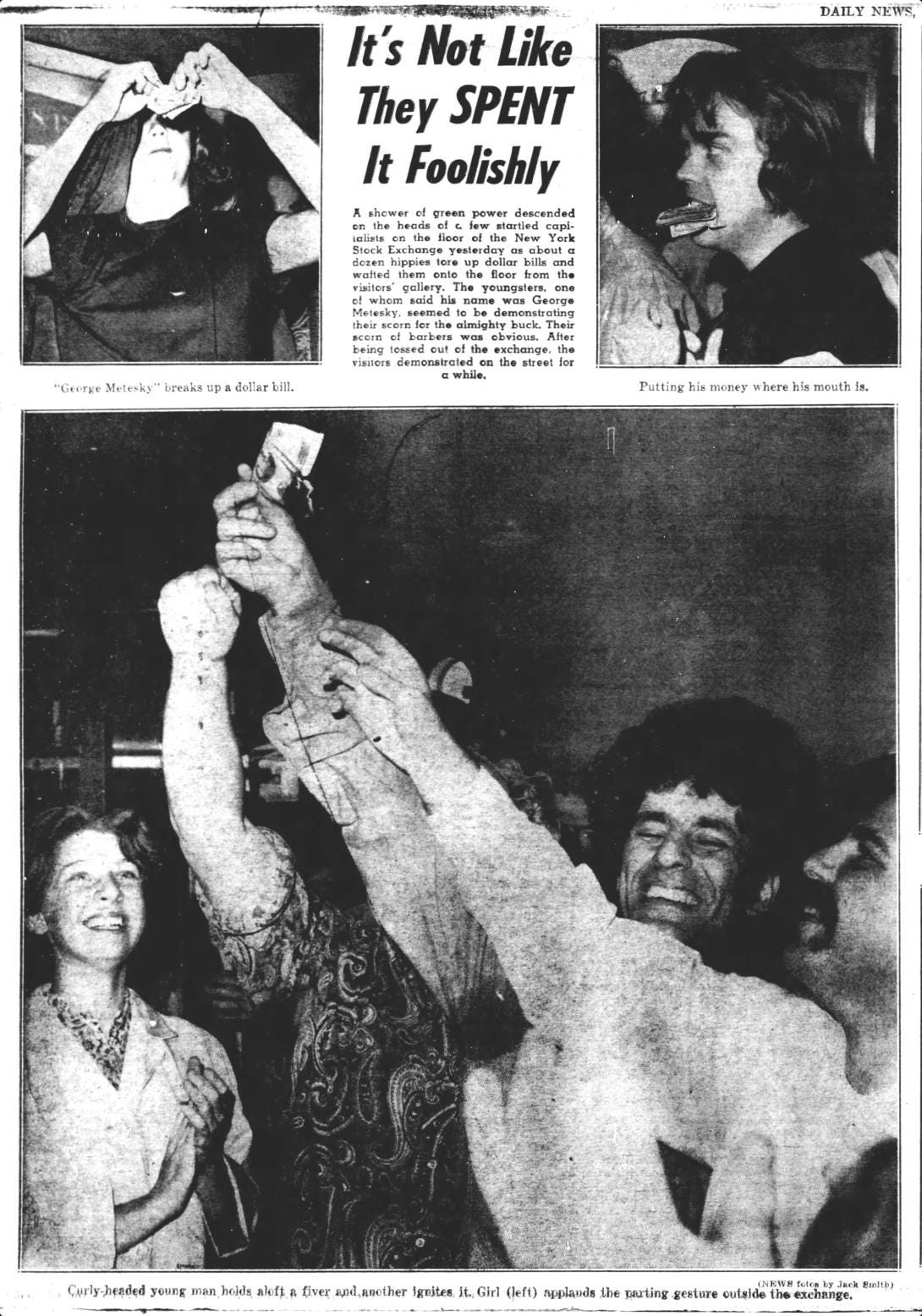
The Yippies believed they could showcase the existential silliness of war or capitalism, by levitating the Pentagon (the government claims it never happened) or tossing $1 bills onto the floor of the New York Stock Exchange to watch traders stop trading for the sake of a few singles.
Marijuana reformers, tracing their roots directly to the Yippies, bridged the gap between proud and closeted deviants. While under criminal prohibition, very few marijuana users were willing to speak publicly in favor of reform, and even fewer of them were willing to make a public display of their use. Advocating for oneself as a marijuana consumer was most often done in the (wink-wink) hypothetical.
A Researcher’s Note: When polling about consensual deviance, do not ask respondents if they have engaged in the deviant act. Instead, ask if they have ever been in a room when another person has engaged in the deviant act.
Consensual deviants form networks out of necessity—because they require others, in order to commit their deviant acts. These networks can become elemental to normalizing the deviant behaviors. Affinity networks and affective alliances move easily between the “back places” where deviants carve out spaces, into public advocacy groups.
Two of the more popular forms of criminalized consensual deviance—homosexual acts and marijuana use—were both positively medicalized, and largely decriminalized in the first two decades of the 21st century. Adult sexuality became recognized as ascribed and was morally equalized, and marijuana was discursively turned into medicine. It should be unsurprising that both these social movements were among the most skilled at using the internet as a resource, in its earlier days.
Due to elemental social networks and the lack of direct victims from their behavior, consensual deviants have certain advantages toward being normalized that individual deviance and victimizing deviance lack.