
Current American Birth Cohorts
In democracy, your density is your destiny

My research on popular marijuana culture called my attention to birth cohort density in America. Examining marijuana use rates over time, from 1964 onward, I could see that first-time marijuana use rose at a near-exponential rate, from the mid-1960’s through the early 1970’s, plateauing at around 2.5 million annual initiates through the 70’s. Numerical initiates began to decline slightly nearing the end of the decade, and then more steadily, beginning in 1980.
Measuring initiation rates is not the same as measuring use rates. Part of the reason is that one may only initiate marijuana use once in their lifetime. Thus a 1976 initiate can be a current marijuana user in 1980, but will not be counted among 1980 initiates. Use rates include initiates, persistent users, and re-integrators (those who initiated in a preceding year, but did not persist with use at the rate being measured). Rising use rates do not themselves indicate a rise in initiates, though these two variables have been closely related.
Marijuana initiates and use rates began falling in 1980. By the time Ronald Reagan brought out his charts projecting the decline in “drug [sic] use” from his new War on Drugs (Nixon’s was a “War on Drug Abuse”), we had seen four years of declines. Reagan’s promise was the new authoritarian crackdown would produce declines at a rate that matched the trend of recent years. In other words, it was to achieve what the lack of any particular focus on drug prohibition enforcement had already shown to be happening.
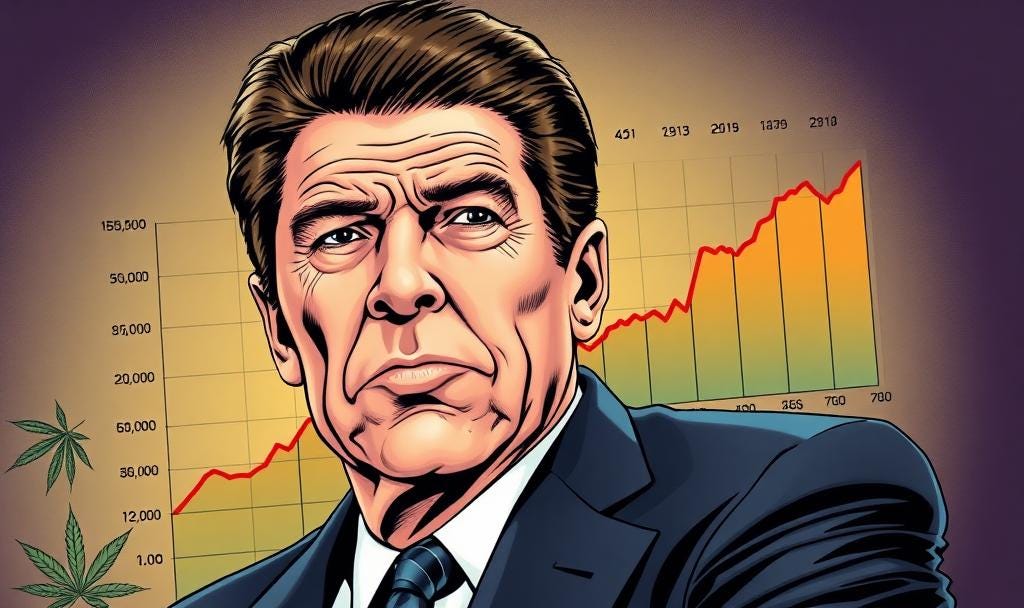
It was a case of identifying a social trend, projecting it into the future, and promising that what could be expected to happen anyway will happen because of the “new” policy.
Over the next fifteen years, we will see end-of-life and funerary services find ever-increasing demand. Perhaps an elected official would like to propose a social policy whose success will be measured by the number of people dying over the next decade-and-a-half. A citizenry unattuned to population trends might conclude that the policy is what is producing a persistent rise in the raw number of people dying, through 2040.
As with marijuana use initiation, death occurs just once in a lifetime.
Looking at marijuana initiation and use rates from the 1960’s through the 1990’s, a pattern became noticeable. From 1980 - 1991 use rates declines, but starting in 1992 they plateaued for a couple years and then began a rising trend. Use would not approach the rates of the later 1970’s, but it was decidedly ensconced in American culture, despite more than a decade of a Drug War that literally set as one of its goals cannabis genocide in the United States.
One of my students from the mid-1990’s became a DEA officer. He contacted me a couple years after graduation and told me about his annual assignment doing helicopter flyovers in Illinois, Indiana, and Michigan in October, identifying feral hemp so that ground crews could eradicate it.
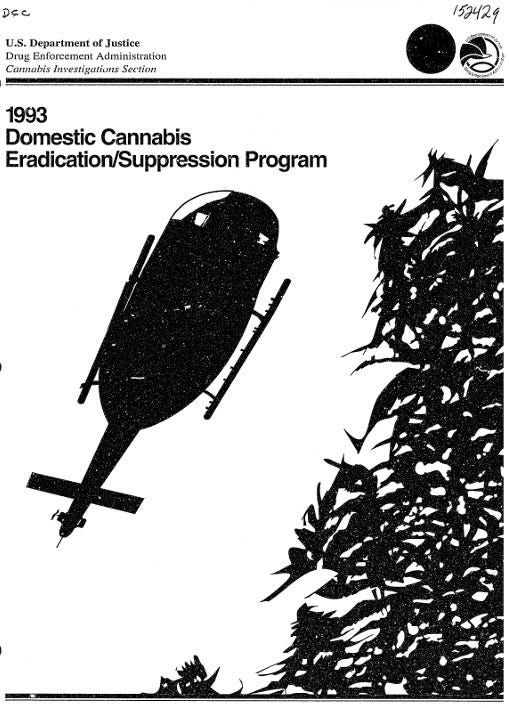
In three years he had identified one cultivated patch with more than 100 plants—a federal case kicks in at 100 plants.
Nevertheless, the trend was clear to me: Use rates climbed after more than 25 years of the Marihuana Tax Act being enforced, they grew quickly and then began to decline in 1980, without any particular attention being brought to marijuana prohibition. The later 1970’s was a time when decriminalization became policy in a handful of states, Alaska’s Supreme Court ruled people could personally cultivate a small number of plants without creating probable cause (Alaska remains the only state with a constitutionally-recognized Right to Privacy), and Jimmy Carter’s winning 1976 platform included federal decriminalization. Despite the apparent leeway being afforded marijuana use, rates declined.
David Lenson (1997) wrote about the relationship between temperance movements and the behaviors they seek to control in The New Temperance: The American Obsession with Sin and Vice, noting that temperance movements gain cultural traction and presence as the behaviors they target have already begun declining.
Recreational use of unregulated drugs has been most prevalent among young adults, dropping into the late teens from time to time. The key age range for marijuana was between 15 - 25 years of age. People in general were likely to initiate and desist marijuana use within this decade of their lives.
What I saw from use rate and birth cohort data was that when there was a larger percentage of the population aged 15 - 25, after WWII, marijuana use rates climbed. As that cohort aged past 25, use rates dropped, when there was insufficient replacement at the younger end. It makes sense, if we think of how illegal marijuana markets must operate—through social networks of producers, distributors, and purchasers. By simply having more people in the “sweet spot” for participation in the marketplace, there will be more opportunities for anyone to be exposed to use (the actual first requirement to becoming a marijuana user, though Howard Becker stepped past it) and to thus be able to find a supply (what Becker identified as the first “barrier” to use).
Having more peers who are more likely to have used marijuana increases the likelihood that one will also initiate marijuana use. The cultural repercussions were an exponential shift in illicit marijuana-knowledge that challenged the foundations of criminal prohibition itself. Support for ending criminal prohibition began to grow, even though those most likely to support it held little social power, due to their age cohort, despite having seen suffrage expanded to those 18 and over during this same era.
Rising use rates through the later 1990’s and into the 2000’s were predictable, as the Millennials—the new largest generation in American history—aged through the 15-to-25 year-old range. Then we saw widespread medicinal cannabis programs and state legalizations in the 2010’s, along with the Farm Bill no longer prohibiting hemp cannabis, and the discovery of how to isomerize cannabidiol (CBD) to render it into quasi-legal forms of THC. Changes in the sourcing, availability, and policies will undoubtedly affect use rates, and the trend I had identified 25 years ago likely no longer holds true. Not in small part because Boomers have had an historically-unprecedented return to cannabis consumption.
As is so often the case, more study is needed.
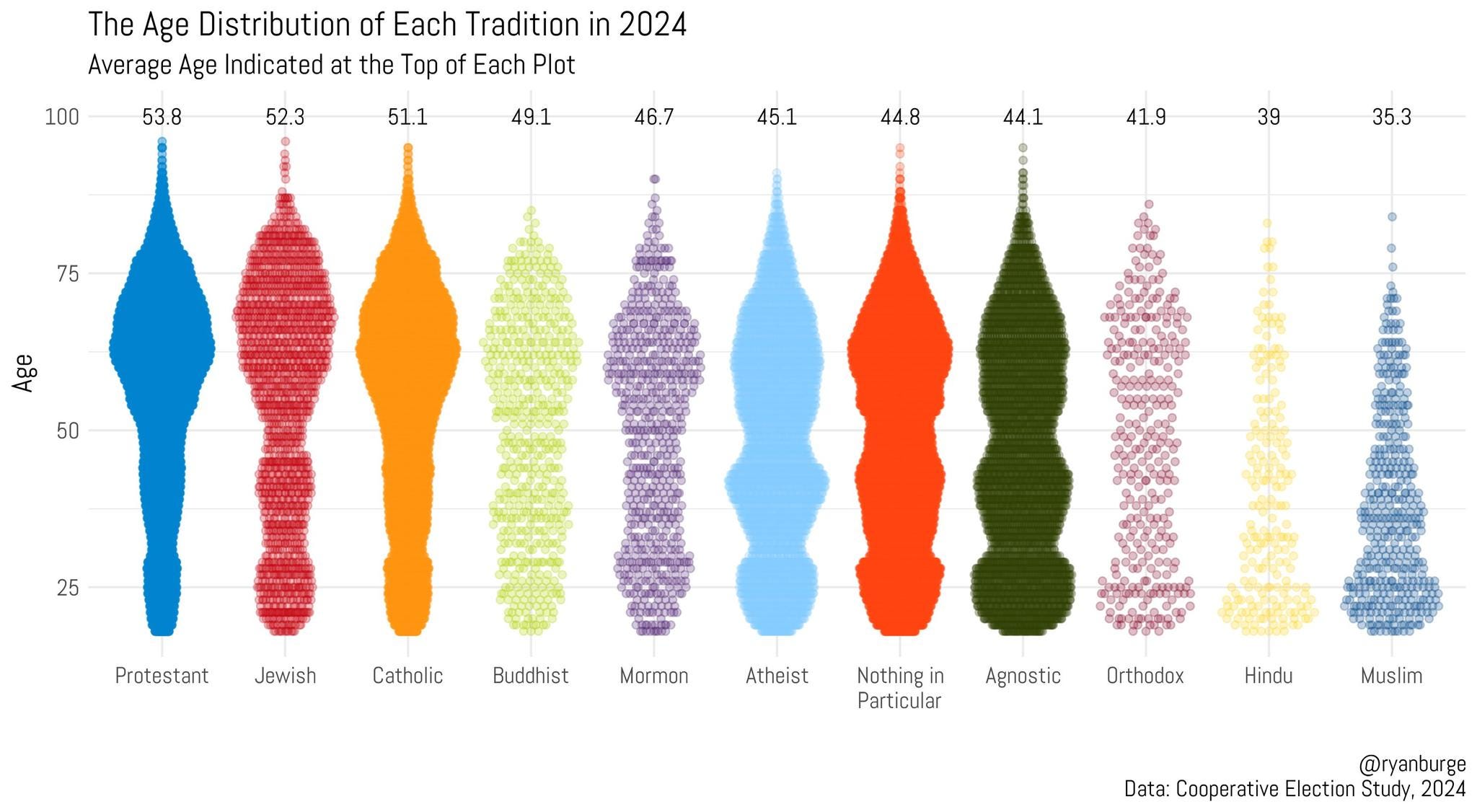
This is the graph that got me thinking about birth cohort density. As you can see, the Boomers are bulges, and Generation X starts as those budges narrow. Where they start to expand again, those are the Millennials. In terms of pure political power in a democracy and financial power in a market, we can see why Gen X has been a neglected cohort, despite being the generation that kept marijuana use popular while the Boomers desisted and the ones responsible for making weed really fucking good. Props to Subcool, ChemDog, Danny Danko, Kyle Kushman, and the other Gen X American breeders who brought us something really special while risking (and sometimes suffering) imprisonment.