
Devo-graphics
Living in the contradiction of Capital

In 2025, the median age (one half of the population is older, one half is younger) of the United States is 38.7 years. This is an aggregated estimate, based on 2019 - 2023 data. For the purpose of discussion, let’s call it 39.
2025 - 39 = 1986
Half of today’s population was yet to be born, the year I graduated high school. Another way of looking at it: Close to half the people who were alive when my classmates and I were sitting in a sweltering gymnasium in our caps and gowns are no longer living.
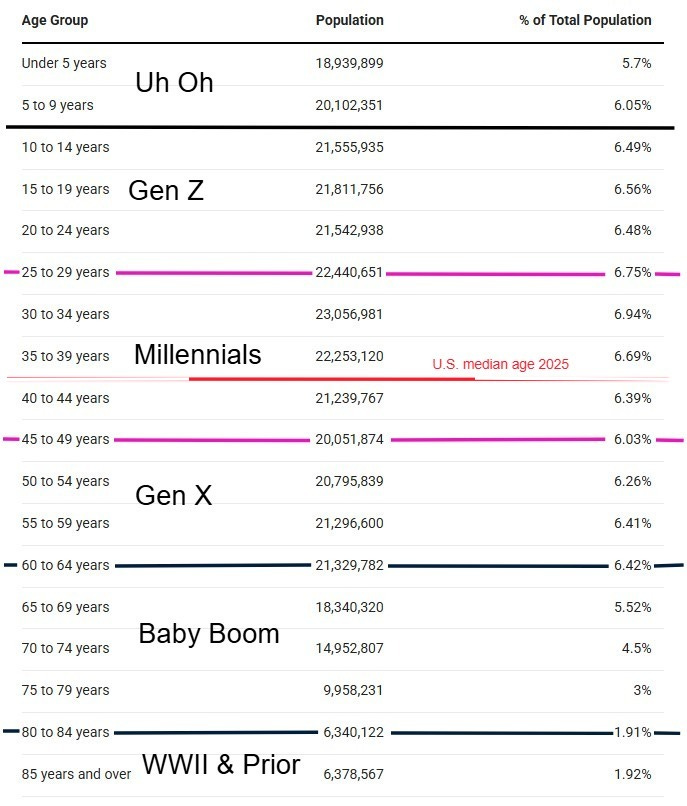
The two largest birth cohorts in American history were the Baby Boomers and Millennials, as can be seen from the chart above. The eldest of the Boomers (b. 1946 - 1964) have been aging through their 70’s for a decade, and their current population reflects the higher mortality rates that come with advanced age.
Gen X (1965 - 1980) just started turning 60 this year. You may note that the 60 - 64 cohort’s 6.42% of the total population is the densest cohort until we reach those who are 35 - 39, at 6.69%. The steadily-decreasing cohort densities between 59 and 45 years ago, combined with the shortened generational term—the increased birth cohort density of the Boomers and Millennials stretched over 20 years, the Gen X decline lasted 15 years—meant Gen X would have a lesser effect on U.S. markets and politics, as a generation.
The population in the U.S., until very recently, has grown with every generation; even those with less birth cohort density than the prior one added to the total population.
Unlike the second half of the 1940’s or the 1980’s, the United States did not come out of a 15-year period of decreasing birth cohort density to see the next largest generation in American history come to be born. Quite the opposite. Starting in 2015, the birth rate in the United States has fallen even further. The 6.05% of the total population represented by 5 - 9 year-olds is the smallest cohort since the end of Gen X (1975 - 1979). It is followed by the smallest birth cohort on the chart (5.7%), between birth and 5 years old. While the age cohorts of those 65 and older are less than 5.7% today, they were all larger, years ago.

While there is not necessarily anything wrong with having a declining national population—smaller populations expend fewer non-renewable resources, produce less waste, and consume less overall, which reduces human demands on the environment—it’s not good for Capital. Not only will it become a challenge to continue increasing productivity, labor will become more expensive as the supply is constrained, and demand for goods and services will drop.
Call it a “Contradiction of Capital,” the need for ever-growing profits resulted in starving Labor for cash (1973 - present).
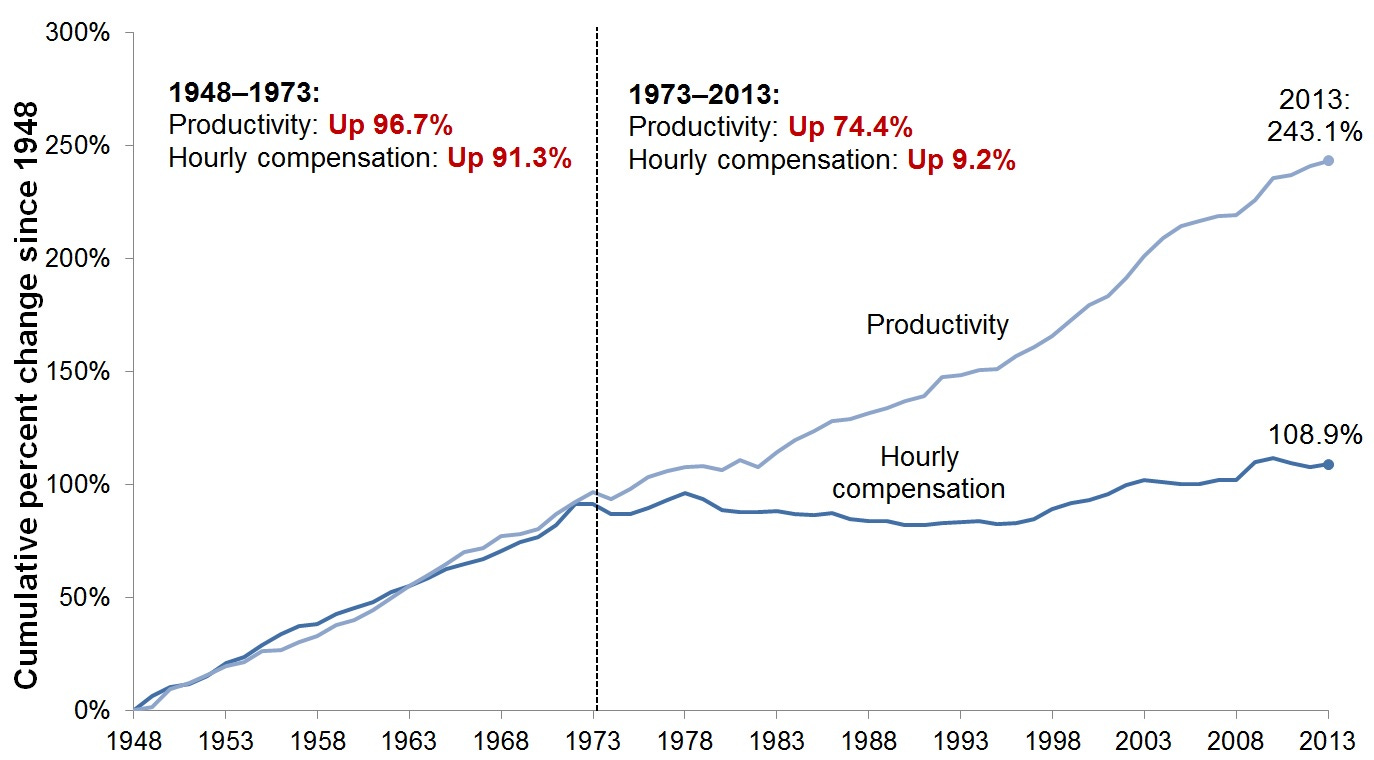
The social class then stops reproducing itself due to financial constraints. It took forty years for the fallout, but starting in the mid-2010’s Americans who in the past would have been having babies, did not. One way to fix the declining domestic fertility rate would be to welcome new immigrants, who both tend to be younger and have higher fertility rates than born-Americans. In this case, Capital should be demanding more immigration, as it did from 1870 - 1910. This is where Elon Musk first started to peel out of Trump’s orbit, on immigrant labor.
One effect of this will be an outsized Millennial influence over American culture and politics (in whatever form they may take), for the remainder of their lives. Unlike the Boomers, who were met and have been exceeded by Millennials’ birth cohort density as adults, Millennials will not have the next-largest-generation-in-American-history to contend with.
Most Millennials were born after 1986.