
Dictating the Narrative
Pay no attention to those bots behind the curtain!

The common interpretation of the leading characters in our popular mythologies often ignore or obfuscate the place of the character in the narrative of the story itself.
In Chuck Palahniuk’s Fight Club, Tyler Durden, the alter-ego of the unnamed lead, is thought by many (especially cis males) to represent an iconic masculinity to be admired and aspired to. In patriarchal culture, men act; women appear, noted John Berger. What could be more masculine than acting upon other men and triumphing, despite their resistance? Having then vanquished all opponents, whatever is most pleasing in appearance: the car, the gold, the girl, is there for the taking.
From the text (and film), however, the dispassionate reader/viewer comes to understand the criticism of consumerism coming from Durden is being channeled into hypermasculinity. The search for an alternative to soulless consumption is offered in two forms: Group therapy, which offers the chance to feel internally, and Fight Club, which offers the chance to feel externally. The world becomes objects to be taken, even as Durden (who the readers comes to find is one-and-the-same as the unnamed protagonist) rails against a commodified, material culture.


Left: Advertising has us chasing cars and clothes, working jobs we hate so we can buy shit we don’t need.
Right: We buy things we don’t need with money we don’t have, to impress people we don’t like.
The leading character of the Hebrew Bible is the type of tyrant one might expect from a narrative forged among slaves, thousands of years ago. The character “God” is all-powerful, yet fealty to any other god is treated as a threat. The character is also singular and eternal yet takes a decidedly male form, as if its kind would need to reproduce. When deciding to create life it chose qualities opposite its own, rather than actually create any form in its own image, as alleged—there are no immortal creatures, all suffer limited and categorical abilities to act upon the world, and spontaneous progenation has never been established to happen with humans (though this is literally the foundation for the sequel).
As is so often the case, the sequel takes the story into a new direction that the fans of the original do not find appealing. Now the lead character takes on the form of one of his truncated replicas and, having experienced the simulation from the inside, comes out with a slew of new instructions. To the fans of the original, this new character is just another prophet in a line of them. But there was a global marketing push and in just a few centuries, the sequel overtook the original; “old” is what they renamed it. The “new” version is actually a collection of flashback narratives—as with Fight Club, the reader is to treat the alter-ego as independent of the narrators.
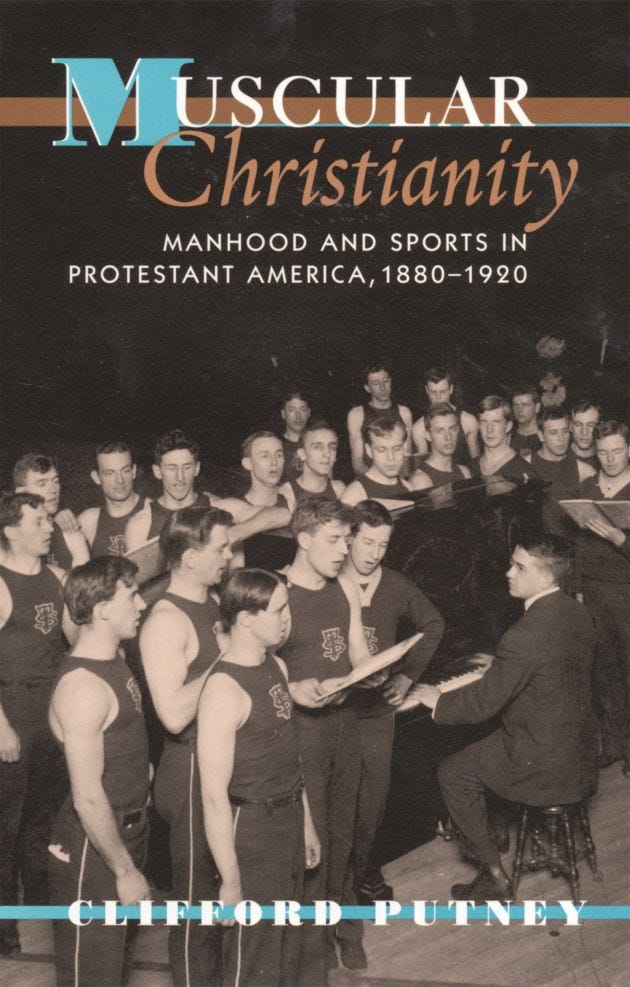
Today’s is not the first American re-casting of the Christ figure into something more befitting the politics of a nation-state. Muscular Christianity tied physical activity to faith, bringing a new discipline to American boyhood and masculinity (we see the popularization of team sports and concern over national physical fitness both emerge in the earliest era) while adapting the Christian biblical narrative to embrace a Jesus that could kick your ass, but chooses not to.
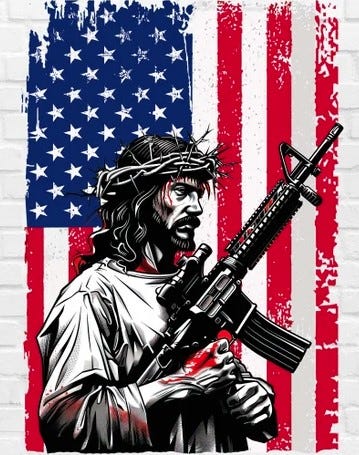
Christian doctrine is based on hearsay. Christ left no recorded works of his own and the gospels have been rewritten dozens of times. Perhaps this is why the belief system has proven so malleable, across cultures and eras. It is not an aberration at all, for American Evangelicals in the present to believe Christ was “too woke,” in his teaching of empathy for immigrants and the poor.
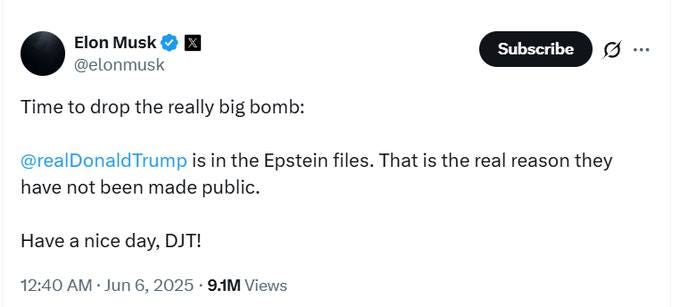
Concurrent with the vote to release the Epstein files, a move so popular Trump had to flip his stance so as not to be Nixon’ed out of office through revelation he had no support, Trump and Elon Musk appeared to have stopped feuding.
You may recall their spat this past spring. As the time limit for his DOGE appointment approached, Elon’s regular Ketamine use was reported by White House insiders. It looks like that prompted Elon to quit cold-turkey, because about 72 hours later—as a near-daily user’s dopamine crash would be at its worst—he posted the tweet that got the conspiracist MAGA wing all wound up for months to follow.
We know from election results earlier this month that Trump in office once again proving to be poisonous to Republicans (and Andrew Cuomo). Since Musk’s departure, there have been two mass “No Kings” protests, drawing millions of people into public demonstrations against Trump. Civil rights abuses stemming from draconian immigration policy enforcement have led to ongoing protests outside ICE facilities across the nation.

The 10 - 40% federal consumption tax on imported goods were arbitrarily assigned with no clear goals and no end in sight, save for their being declared illegal by the Supreme Court. Tariffs have irritated pro-business Republicans and fiscal conservatives because they introduced additional, artificial inflation, to an economy that was already suffering it.
Charlie Kirk’s assassination opened a power vacuum among the MAGA influencer class, with Nativists shuffling alliances. Tucker Carlson cozied up with Nick Fuentes—both received criticism, neither has backed away from the other.
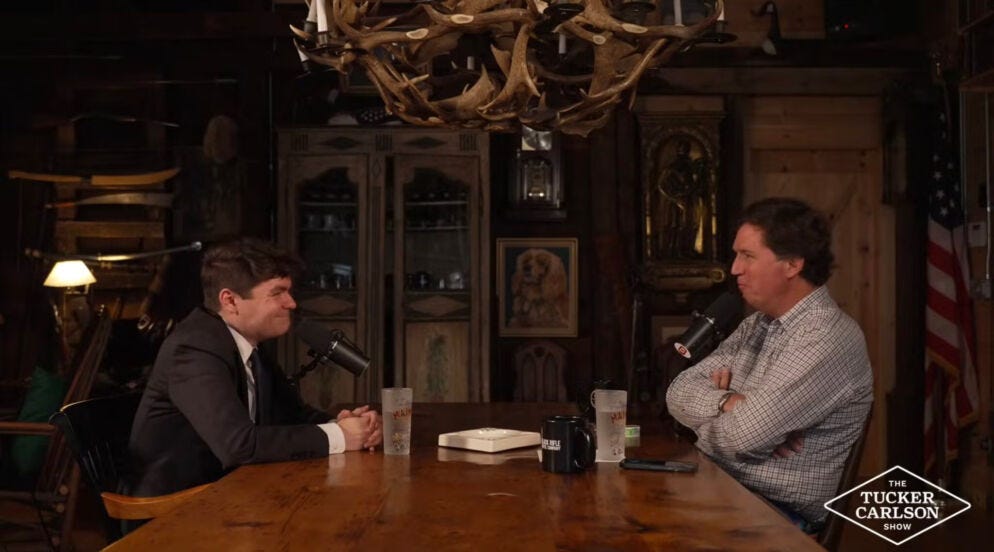
While Vice-president JD Vance assumed Charlie Kirk’s podcast seat (and possibly other positions) at the behest of the Widow Kirk.
And then, for a moment the other day, Elon Musk released a new feature on the Propaganda Machine Formerly Known as Twitter, that listed the nation of origin for user accounts.
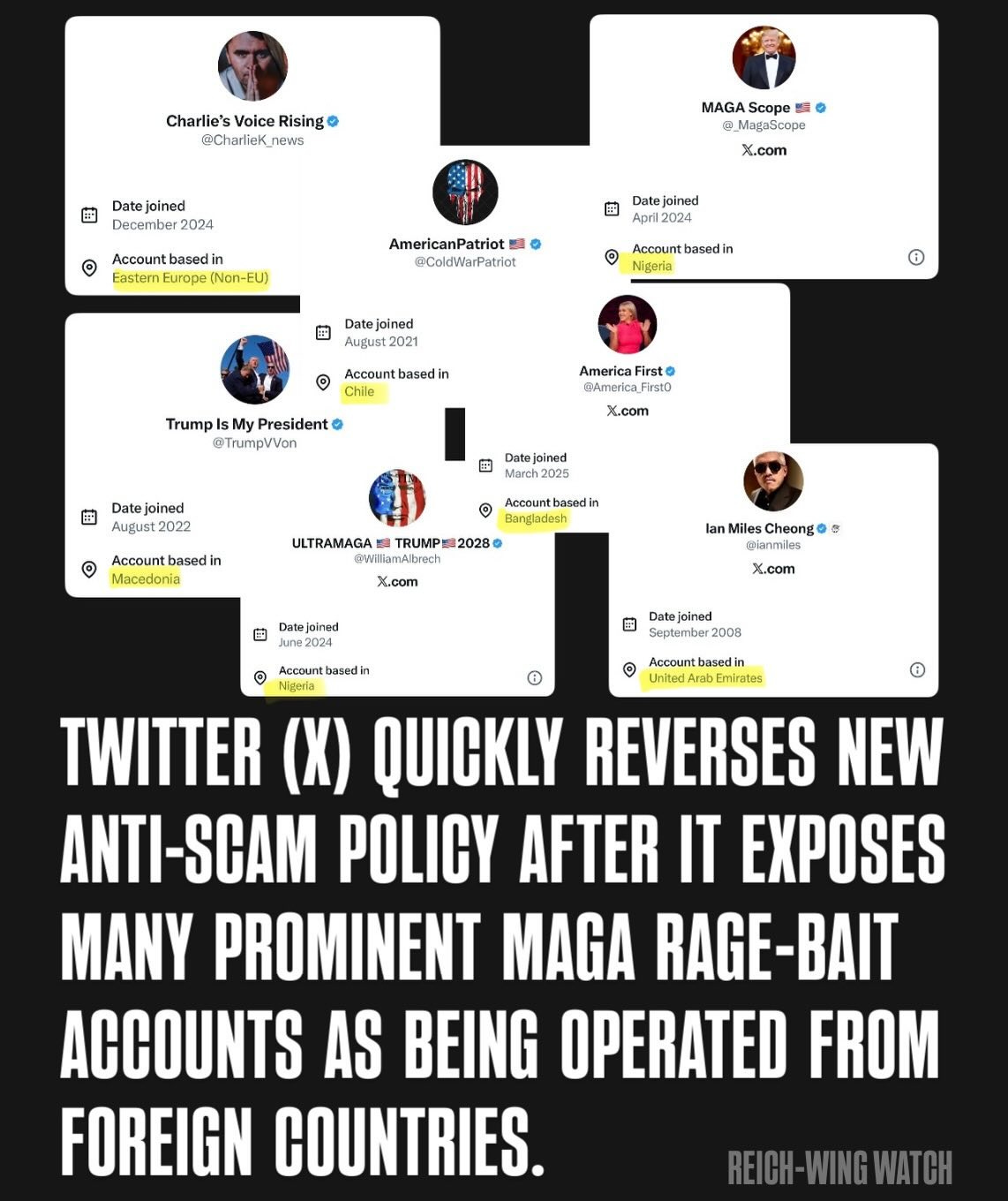
For the unaware, those in charge knew this information before it was released. It was not a secret—anyone on the inside of the operation had access to it. Place of origin for user accounts was only a new feature to the public. The alleged reason to introduce the feature was to help prevent scams.
A substantial amount of pro-MAGA accounts were found to have originated in other nations. These are bots, and illustrate how easy it is to create fictitious support that is indiscernible from legitimate support. We call them “sock puppets” when an individual manages their own fan account(s) that heap praise on and promote them. When the operation is automated and there are 2,000 or 20,000 of them, this artificial popularity reads exactly the same as organic, to the algorithm.

Trump’s global operatives are fixing the game, making MAGA seem more appealing than it is. In reality, there is not much left of MAGA, beyond the members in the cult of personality and those folks who root Republican—whoever is wearing the uniform—because they hate the opposition.
I suspect that is why Musk revealed the truth. Remember, neither Trump nor Musk have any friends—every relationship they have is transactional, and once you are no longer useful to either of them, you might as well be dead.