
Disclosure Day
Information control is part of everyday life

The recent heat wave chased me and a friend into a movie theater for an Independence Day screening of the film Disclosure Day. It’s a Spielberg summer film, so it’s fantastical and as family-friendly as the story of a failed conspiracy to hide contact with intelligent alien life can be.
The film is a story of two unsuspecting beneficiaries of alien intervention, touching (lightly) upon concerns over privatization, data collection, religious ontology, conspiracy, and information control. Unfortunately, the choice to maximize breadth of appeal limited the depth of consideration for these matters and resolved them either by cliche or Deus ex machina.
When a female supporting character who once lived in a cloister but lost her calling wonders about God’s promise to man, her most-trusted Sister in the convent assuages her anxiety by completing the Biblical verse she had been truncating. It turns out that extraterrestrials are also the Catholic God’s children.
The cheesiness of the conversation and the eventual import of the character getting over this ontological barrier causes me to wonder if Spielberg is making a living metaphor out of his audience. If we accept the prima facie description of a phenomenon as proof, then all descriptions can be equally valid—this movie is but one translation of what we now know to have been a decades-long conspiracy to hide information from the world.
If a viewer is experiencing an ontological crisis from the disclosure that there are intelligent life forms that seem to have extraterrestrial origins, the solution would be to find a translation that makes this new operational framework digestible. If so, Disclosure Day may be Dr. Spielberg’s prescription.
Spielberg has not shied from addressing important historical events, but studio execs see aliens and think, Summer Blockbuster. Disclosure Day would have been a very different movie if it was designed to have been released in December, with eyes set on winning Oscars. As it stands, this film is no better than a low-second tier Spielberg summer film, ranking far below Jaws, Raiders of the Lost Ark, or what could have been Disclosure Day’s prequel, Close Encounters of the Third Kind.
The in-film metaphors are pre-chewed. The aliens seek to pass on “the universal language” (it turns out it’s math, and they gave it to the chosen male) and deep empathy to the point of clairvoyance (they gave that superpower to the chosen female). It is doubtlessly reassuring to many viewers that aliens recognize binary gender construction and the Western stereotypes applied to it. These are Adam and Eve—but without the mandate to reproduce.
The film relies heavily on "“woo-woo.” What seem to be astral projections have been made possible through a uniquely-shaped, thus patentable and marketable, stick (think Harry Potter toy wands) that can be used to control others’ sensory inputs and physical actions. Caribbean Santaria require a physical representation—some hair or toenail clippings—for their cures and curses to work, Spock the Vulcan needed physical contact, but this alien voodoo requires mere video representation and a magic wand, to make a mind-meld possible.
![r/Poetry - [POEM] always by Charles Bukowski](https://substackcdn.com/image/fetch/$s_!wak9!,f_auto,q_auto:good,fl_progressive:steep/https%3A%2F%2Fsubstack-post-media.s3.amazonaws.com%2Fpublic%2Fimages%2Fa6d349b0-0f31-4c00-984a-f0bd86c92d49_640x634.jpeg "r/Poetry - [POEM] always by Charles Bukowski")
                                                                         always

                                                               the important
                                                               thing
                                                               is
                                                               the obvious
                                                               thing
                                                               that
                                                               nobody
                                                               is
                                                               saying.
The UFO conspiracy began on April 7, 1947, when an unidentified object crashed in Roswell, New Mexico. The Roswell Daily Record reported news of a “flying saucer” over the area in its April 8 edition. It was not the first record of a unidentified flying object, but it was the one selected by a small collection of Americans as the triggering event for the formation of Area 51, where the alien craft and its occupants would be examined.
While Area 51 was created for developing the U-2 spy plane, the secrecy shrouding that aircraft did nothing to dispel growing speculation that: 1. The military base existed; 2. It was created for UFO research and reverse-engineering flying saucers; and, 3. The government is actively suppressing information.
For what it’s worth, the third point was spot-on. It also shows us the cultural nature of conspiracy theorizing. Getting thousands of people to successfully keep a secret of great import is impossible, but the attempt was made. The conspiracy of silence fails, and in its failure the conspiracy theory is born. Others’ lack of faith in the details being hidden and their unwillingness to see the truth is the theorist’s lament.
Information of a secret government UFO program had bled into the popular culture by the 1970’s, enough that details from the failed conspiracy of silence could be commercialized. The Roswell sighting and other UFO reports were featured on episodes of the mid-1970’s TV show In Search Of…, hosted by Spock himself, Leonard Nimoy. Repo Man, released in 1984, features the UFO conspiracy as a central plot point. Repo men race each other to find a 1964 Chevy Malibu with a ridiculously high bounty due to the alien bodies stashed in the trunk.
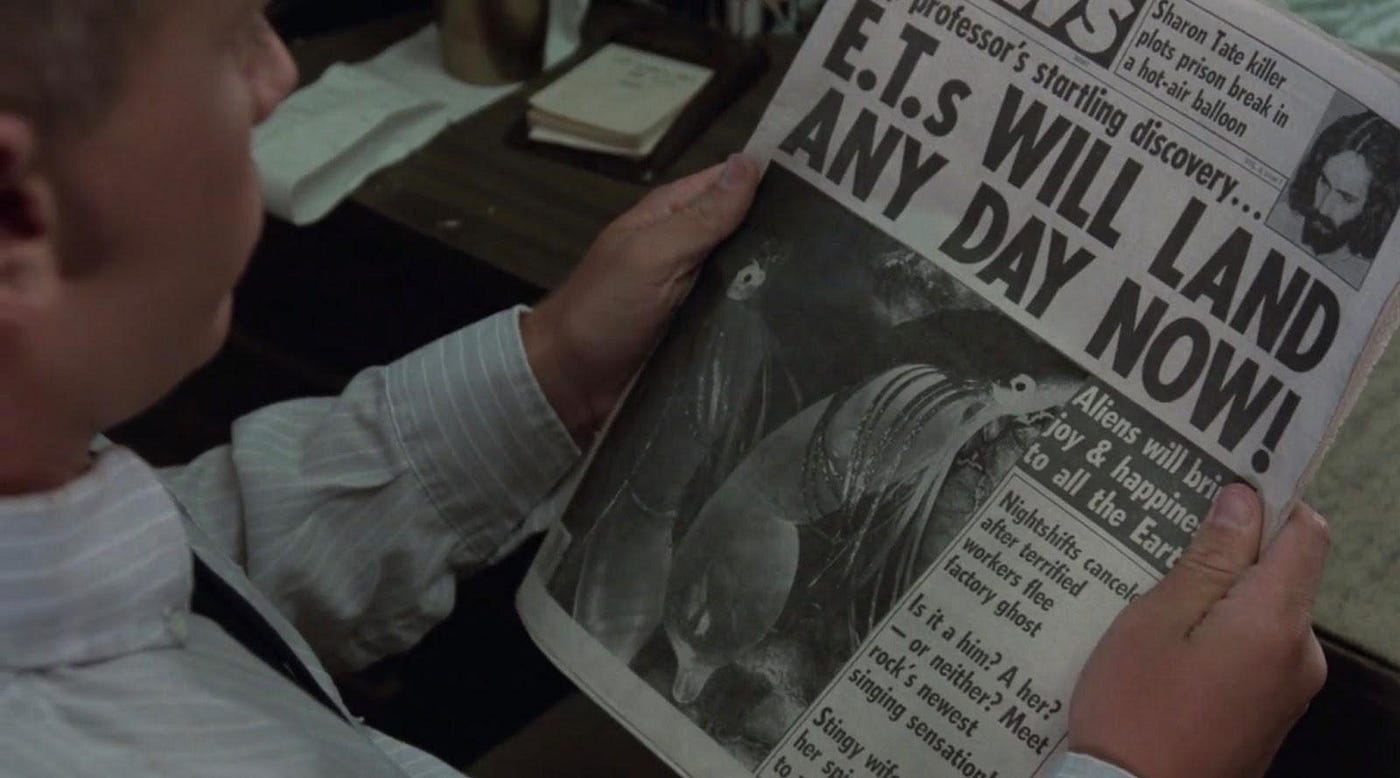
In keeping with the times, Disclosure Day has privatized the UFO program, having turned operations over to a Blackwater-type paramilitary organization. The main antagonist is an unusually hands-on billionaire (he seems quite practiced at astral projection) who employs a private commando squad ready to take out power stations on less than an hour’s notice, without any prior planning. The protagonists seem just as facile with their newly-discovered powers, suddenly becoming masters like Neo in The Matrix.
The film also features the “Magical Negro” trope that Spike Lee identified in 2001.

The term was popularized in 2001 by film director Spike Lee during a lecture tour of college campuses, in which he expressed his dismay that Hollywood continued to employ this premise. He specially noted the films The Green Mile and The Legend of Bagger Vance, which featured "super-duper magical Negro" characters
The Magical Negro appears when a Black supporting character with special abilities becomes a plot device to serve the purposes of the white main characters in the film. Disclosure Day’s magic comes in the form of re-creating a lead character’s childhood home so that she might better recover her memories. Do not ask how this stranger would know the decor of that little girl’s bedroom, thirty years earlier.
Disclosure Day suffers from what it could have been; a fictionalized treatment of the actual failure of the UFO/UAP (Unidentified Arial Phenomenon) conspiracy of silence, and what that means to those of us living during the ongoing Epstein files conspiracy.
The film correctly implies that once the choice to keep a Large Truth from the public has been made, it will bifurcate the future between those who will know and must do the ongoing work to keep the secret, and those who do not know and are kept ignorant. It will attempt to create and maintain two parallel living histories that will inevitably contradict and come into conflict.