
Dissection
The WSJ serves us a hegemony so rich and creamy, we can cut it with a fork.

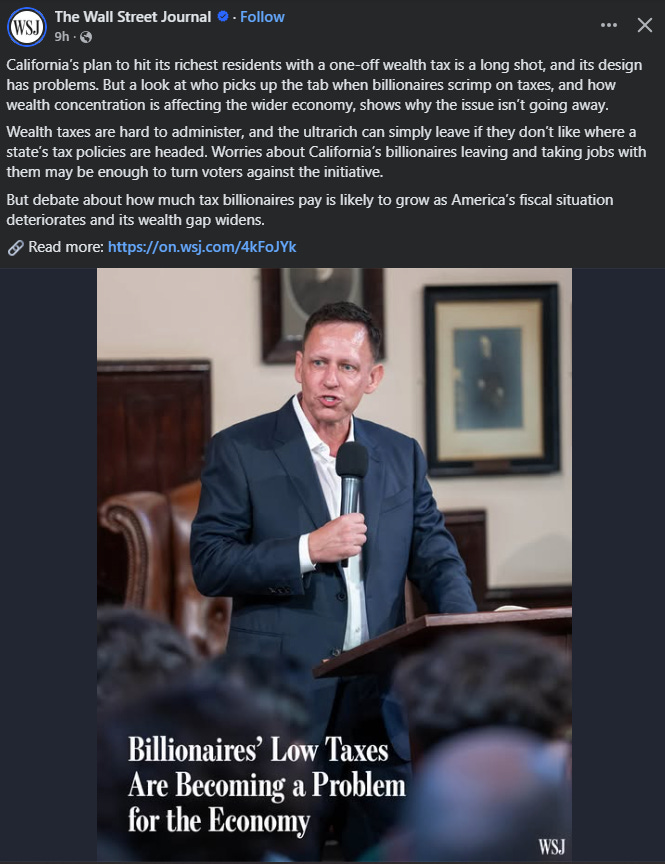
Billionaires’ Low Taxes Are Becoming a Problem for the Economy
The Wall Street Journal
California’s plan to hit its richest residents with a one-off wealth tax is a long shot, and its design has problems. But a look at who picks up the tab when billionaires scrimp on taxes, and how wealth concentration is affecting the wider economy, shows why the issue isn’t going away.Wealth taxes are hard to administer, and the ultrarich can simply leave if they don’t like where a state’s tax policies are headed. Worries about California’s billionaires leaving and taking jobs with them may be enough to turn voters against the initiative.
But debate about how much tax billionaires pay is likely to grow as America’s fiscal situation deteriorates and its wealth gap widens.
When I was teaching undergraduate Intro to Sociology, I would occasionally include an exercise on dissecting hegemony. I used newspaper articles for source material and had students identify the unspoken understandings and assumption between the writer/publisher and the reader, what cultural operational framework contextualized the subject matter, and how is social class conflict obfuscated or deflected.
Earlier, the above advertisement for the Wall Street Journal appeared in my Facebook feed. It is a teaching opportunity.
From the headline, “Becoming” and “the Economy” are flashing indicators of how the WSJ frames reality for its readership. The headline makes perfect sense if one believes low taxes are inherently good, and some other force is causing low taxation to now become a problem. What force from outside the state and the economy could be causing this new and developing effect? They will never identify it, because there is no extraneous force that has recently changed the relationship between taxation and “the Economy.”
This brings us to the second indicator of the WSJ’s hegemony: by “the Economy” the WSJ means “society.” To Wall Street, perhaps there is no society absent the Economy (which is rather Marxist of them, if you think for a moment), and a cultural dissection of hegemonic messaging through corporate media is certainly not a step away from that perspective.
But I will remind readers there are elements of social life that exist outside social relations of production—our sociality itself, for example—that are not themselves economic. Military Basic Training, fraternities, and cults all operate in realms where group identity is forged through shared suffering of physical and psychological trials, not through production and exchange. Recruits, rookies, and pledges are routinely stripped of personal belongings and identifiers (such as hairstyle) as a fundamental element of their resocialization process.
Uncontested Neoliberal Policies Starve a Growing Number of Americans for Cash; Redistributing Value Through Taxation an Obvious Solution, But Why Do That?
Fixed the headline.
While not an article, the ad copy exposes the operational framework of the article it is promoting. Readers are informed in the first sentence of copy that California’s planned “Billionaires’ Tax” is “a long-shot” and “its design has problems.” How can taxation be “a long-shot”? A long-shot implies there is a risk—that the chances are better than not that something will fail. Fail how? Failure to collect the tax because billionaires “scrimp”?
That’s a cute way of saying they normally avoid their fair share or evade their legal share.
The last sentence of the first paragraph is also laden with unspoken understandings of what not to take into consideration:
how wealth concentration is affecting the wider economy, shows why the issue isn’t going away.
Again, the WSJ really means “society” when they use economy, because our value-distribution crisis affects everyone—especially those with the least amount of economic activity, those on fixed incomes, children, and the lumpenproletariat.
The “issue” is the relations of production themselves, which are not an “issue” in the way that abortion or capital punishment or taxation rates are issues. But to the WSJ, these are an “issue” because capitalism may never be problematized, outside the parameters of its operation. The difference between Political Economists and Economists, is the former take a critical approach to understanding economy, while the latter largely teach practical capitalism.
Wealth taxes are hard to administer, and the ultrarich can simply leave if they don’t like where a state’s tax policies are headed. Worries about California’s billionaires leaving and taking jobs with them may be enough to turn voters against the initiative.
Perhaps the reason California’s tax plan is a “long-shot” is because “Wealth taxes are hard to administer.” Really? What makes it harder to administer a wealth tax than, say, an automotive excise tax—which is a wealth tax? Could it be that assets are being stashed away in Panama and elsewhere?
“The ultrarich can simply leave” is a classic threat. It rests on the same assumptions that have led to Pete Theil and others to build Doomsday compounds. Their accumulation has so badly divorced them from society that they believe they can survive without the rest of us. They have stopped seeing the people they rely on for their food, security, and increasing portfolios as being essential for their own survival.
If I was a psychologist, I might label their affliction Howard Hughes Disease—a sociopathy caused by over-accumulation, leading to self-isolation. They will survive in their compounds for as long as their humans choose to serve them, and no longer.
It works the same way with social classes.
The WSJ goes further with its canard that the Bourgeois are the source of labor: California’s billionaires leaving and taking jobs with them may be enough to turn voters against the initiative.
But look at the quality of jobs being created by California tech companies—not within the base, but around the globe, where the app-assisted piecework and gig work is being done. The Biden Administration crowed about these jobs, but just because a new Social Security payment line was created does not mean the “job” is any good.
This is a large part of the problem—the jobs billionaires “create” serve to make them wealthier, more than make it possible for those who work to improve their quality of life. The wealth is being redistributed from those who produce it to those who merely lay claim to it, and the California tax proposal is to address that redistribution so that it is less harmful to society.
But debate about how much tax billionaires pay is likely to grow as America’s fiscal situation deteriorates and its wealth gap widens.
At the very end of the ad copy, the WSJ acknowledges the nation’s “fiscal situation deteriorates,” but frames what could be done about it as debatable.
Capitalism operates under the Dictatorship of the Bourgeois; what little relief liberal democracy has offered the dispossessed is under direct threat right now. If the debate is framed as tax rates upon the Bourgeois, the answer will never be directed at the source of the deterioration. The value distribution crisis is endemic, chronic, and grows exponentially in a “healthy” economy. The Wall Street Journal recognizes there are contradictory material interests between social classes, but frames the matter as resolvable by debating how much we might tax a reluctant and uncooperative ruling class, as they become more directly dictatorial.
That is why California’s proposed Billionaires’ Tax is a “long-shot.” It is only feasible for as long as the ruling class allows democracy.