
Epistemic Advantage
You don't know how it feels

All social research begins with the researcher answering the questions: What do you want to know? and Why do you want to know it?
An ontology is all that there is to know. An epistemology is how we know it. A social theory describes an ontological condition and the theory’s epistemic. An hypothesis is a testable proposition formulated within a theory. A social research method is a practice designed to test hypotheses and that becomes the divining method for the epistemology. Data are information that is produced via social research.
This forms a flowchart:
Ontology —> Epistemology —> Theory —> Hypothesis —> Methodology —> Data
Every one of those arrows represents decisions made to winnow the prior category down and more sharply define it. Every decision is executed in a social power matrix. Before we have any data there have been five separate circumstances where we have modified the conditions by which that data (or any data) may be produced.
Data is produced, before it may be gathered.
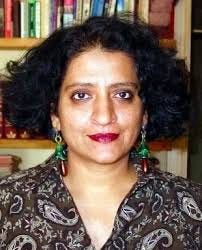
Philosopher Uma Narayan has theorized that women and other minority groups in society hold an epistemic advantage regarding understanding how power operates in a society.
While the dominant group understands the social order it creates and benefits from, to them the inequity is unremarkable, perhaps unnoticed. The quotidian experience of having privilege is normalized, such that when privilege is questioned or revoked, it is experienced as a loss. It feels unfair.
Sociologists speak of minorities and majorities in terms of power, more so than population numbers. Women are a numerical majority in the United States, but hold less social power than men. (This slight incursion on male privilege has sparked thoughts in male readers’ minds, checking for exceptions. Surely, the women on the Supreme Court must have more power than I do…).
One common response to statements confirming the privilege of one social group over others, from the members of the privileged group, is to attempt to find exceptions to the rule or to otherwise deny there are substantive, material differences from theirs in the lived experiences of minorities. The privileged may believe we would as a default be perfectly equal, but for particular characteristics of the minority groups (they lack discipline, they lack values, they lack intelligence, e.g.) that are baked into their identity, and that explain social inequalities. Other members of the privileged embrace inequalities such they envision egalitarian society as a violation of a “natural” order.
A politics of division harps on these differences and attributes them to personal or biological characteristics. This has been Trump and his acolytes’ stock-in-trade: They are eating the dogs. They are eating the cats.
Epistemic advantage allows those who suffer from the actions of the privileged to more fully understand what it is to live in such a society. The privileged write their own history, and always fail to capture the human experience of having been subjected to their dominance. Historian Howard Zinn attempted, with A People’s History of the United States, to tell some of the story from the perspective of the oppressed. When I was researching the marijuana policy reform movement—I also was consciously trying to tell “the stoners’ side of the story,” while they were trying to end criminal prohibition.
The worst label a nation-state can apply to its citizens is “criminal,” for it allows the suspension of rights and freedoms, leads to forced labor, and can ultimately be used as justification for executing that citizen. One part of the defense offered by George Floyd’s murderer and accomplices was that Floyd was a criminal. When a politician talks about fighting crime, what they are saying is they want to discipline the citizenry.
Crime is socially constructed, so we can make it appear and/or cause it to grow, with just words on paper. The term “victimless crime” denotes a fictional offense—one that could not exist without a story behind the incriminating object (marijuana) or action (sodomy). When we dedicate more resources to surveillance, we will find more of the offending behaviors.
The marijuana-users knew this—the DEA did, too. But from the DEA’s perspective, the mere presence of marijuana in the U.S. indicated a crime wave. The power of the state and certain agencies to name “the problem” and make it real then justified the corporeal controls placed upon those caught violating the law.
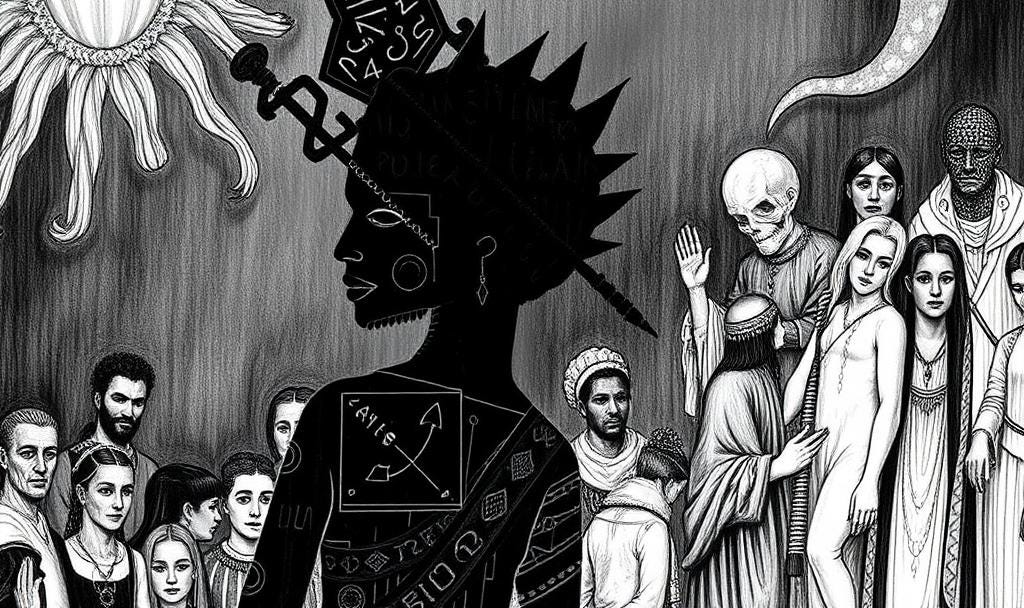
Liberation will not be coming from those who benefit from existing power structures; it can only come from those who have suffered from them. Marginalization also served the purpose of discrediting the marginalized a priori.
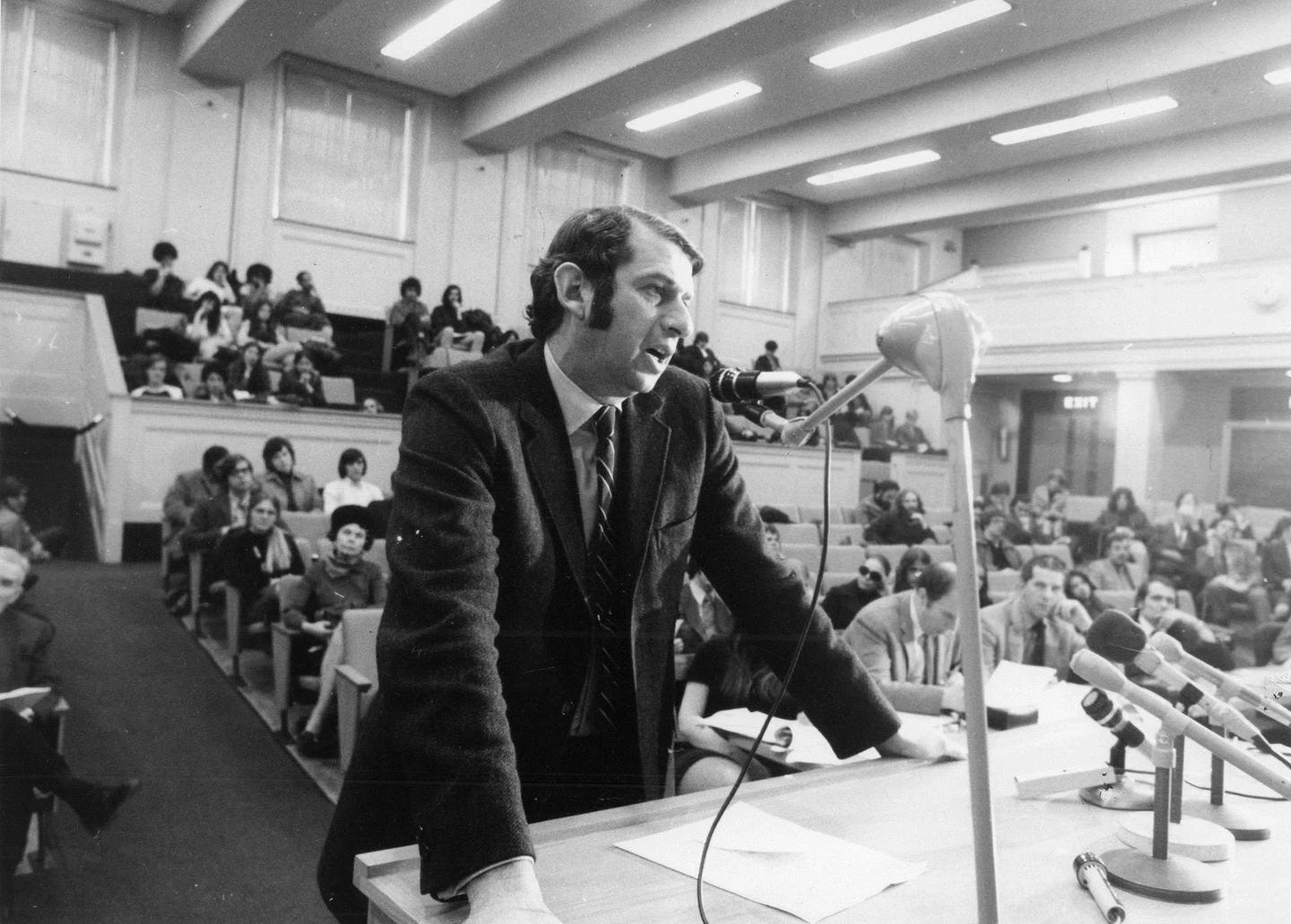
Marijuana reform champion Dr. Lester Grinspoon was once asked while testifying before the Senate, whether he was a marijuana user. He replied, “Senator...I would be glad to answer that question if you could tell me that if I gave you an affirmative answer would it make you more sympathetic to my answer or less?”
Women can explain the effects of patriarchy in ways no man could, racial minorities can explain racism in ways the majority cannot understand from lived experience, only the working class knows how hegemony is manufactured on the shop floor. The dominant groups in society know none of it.
One of the required steps for individual social class mobility in America is rejection of the values one was raised with. There is no upward mobility without mentorship where the acolyte demonstrates the ability to adopt the new way of living in and understanding the world. Oliver Stone’s original Wall Street (1987) was this very story.
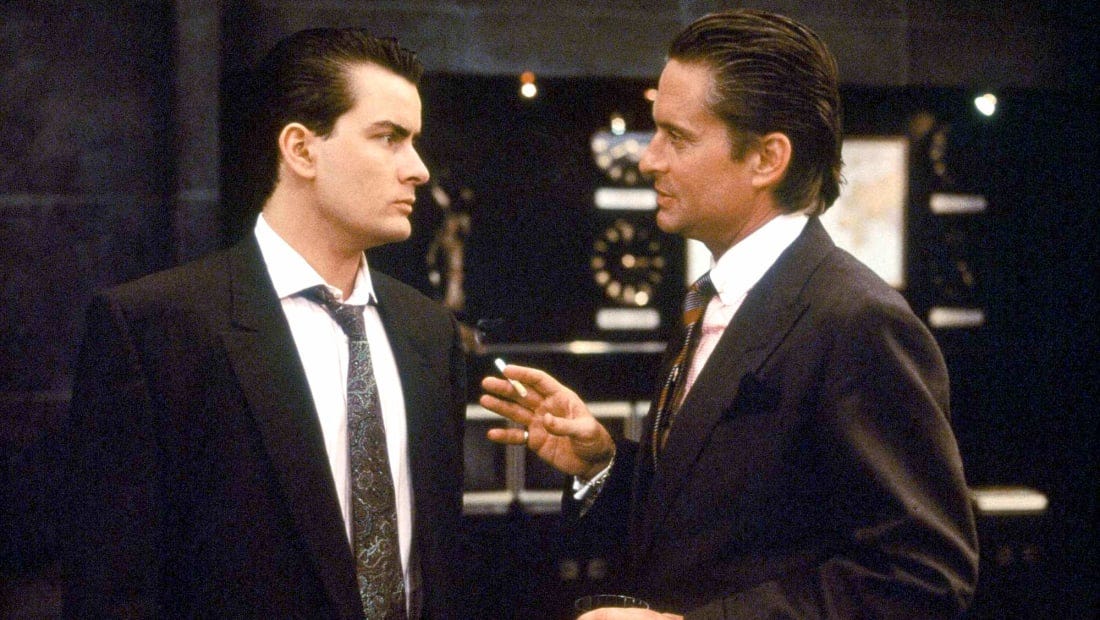
As the character Bud Fox aspires to become more like Gordon Gekko, he steps away from his working class roots by adopting the values and norms of the financiers he comes to work among. In Hollywood style, by the end of the film Bud teams up with his old network to bring Gekko (and himself) down.
What happens more often is the rejection of one’s past ways of living, and accepting the new norms and values. Internal conflicts over personal identity are the costs of social class mobility—upward or downward. Though in America, we don’t pay much attention to downward mobility; it messes with the suspension of disbelief.
Mobility among ascribed identities such as race or sex is rare. It is not, however, impossible. Those who have been able to “pass” as a member of the majority usually take advantage of this circumstance, as there are rewards and privileges awarded for being able to do so.
Minorities are expected to adopt the norms and values of the society that makes them a minority, so women adopting masculine garb or affect in a male-dominated space is a method of fitting in. Meanwhile, one of the greater threats to social power structures comes from those who reject the privilege they were born into.
This is why it became acceptable in the post-WWII era for women to wear pants (and pantsuits), baseball hats (or athletic gear in general), t-shirts, sneakers, and other traditionally-masculine clothing, while there is not a single traditionally-feminine, visible clothing item that has crossed over, in the other direction.
The same thing happens with naming babies: As traditionally-male names are given to girls, they are no longer given to boys.

Hillary, Leslie, Allison, Ashley, Loren, Whitney and Meredith were male names, until they were not. Can you think of any traditionally-female names that have gone the other way?
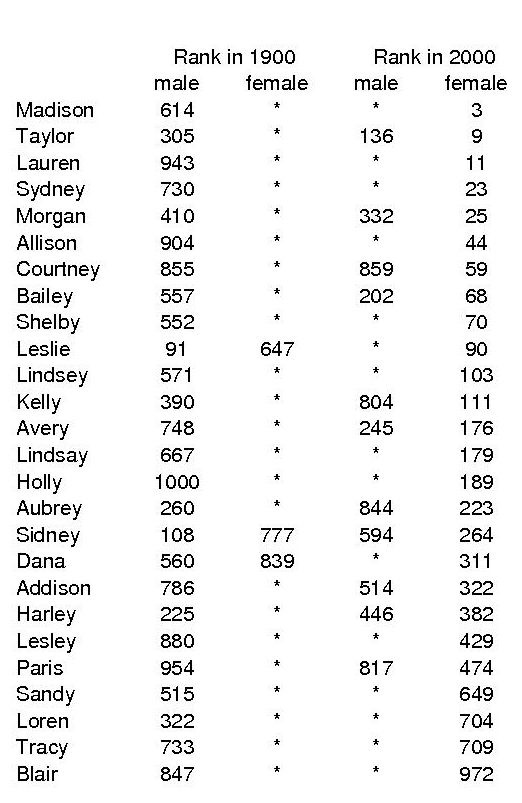
And this is why there is tremendous concern among MAGA about trans women, but not nearly as much about trans men. Representative Nancy Mace is not calling for men in Congress to take note which of their colleagues never seem to use the urinals.

No one is complaining about trans males competing in sports with bio males. It is the rejection of inherited privilege that is the offense—Nancy Mace and her ilk don’t give a shit about women’s sports, or they would not be relegating women to second-class status in all the other ways they do it.
The hours following Charlie Kirk’s assassination was a nonstop barrage of MAGA escalation. They wanted blood—there were calls for the Boogaloo (the White Nationalist name for the civil war they want), and they KNEW (in MAGA-think, there is no such thing as suspecting) the shooter was a liberal. The Wall Street Journal reported phrases “related to transgender and anti-fascist ideology” were found on shell casings. This was later shown to be false. It merely increased the vitriol.
I also thought the shooter was of an identity group that Kirk was targeting, for the source of the deep motivation most people need to kill another. Clearly, the shooter was well-trained at hitting targets at a good distance, and was familiar with the layout of the campus and surrounding area. While speculation turned to professional wet work (Mossad, CIA), I assumed a more pedestrian source. This is America, after all, we are heavily armed, we fund our military more than any other public sector, and (especially in the more rural areas) we know how to shoot.
In an address to the nation—where he also ordered national mourning for the leading proponent of racism, sexism, transphobia, homophobia, xenophobia, and Islamophobia—Trump blamed the shooting on the Left and confirmed MAGA’s prejudices. The danger is inclusion, is the message. Charlie Kirk was protecting America with his free speech. When people mocked Kirk or lauded his killing, MAGA sought to punish them for saying things that upset them. That is how they honored his commitment to that particular civil right.
And this is logically consistent. Charlie Kirk championed the first amendment, and those who smite his memory do not deserve to be heard, and should hurt for having hurt me.
The Reagan Drug War picked up the slogan “A Drug-Free America.” Abbie Hoffman made the keen observation that what is really meant by that phrase is that drug users are not American. If they are not American, then they do not deserve to be treated as Americans; and thus we can infringe upon their rights.
They could not do that without infringing on their own; but they did not see or care about that. As non-users of illegal drugs they had nothing to hide. The persecution did not apply to them, they were among the privileged.
The privileged live in a world where they may recognize in theory the costs of that privilege, but assume their privilege means only others will have to pay it.
The shooter, Tyler Robinson, turned himself in after confessing to his father, a local law enforcement officer. Had he not done so, I doubt the FBI was going to try all that hard. The agency is fully corrupted along with the rest of the Justice Department, and for as long as we did not know who the shooter was, he was going to be exactly what MAGA wanted him to be.
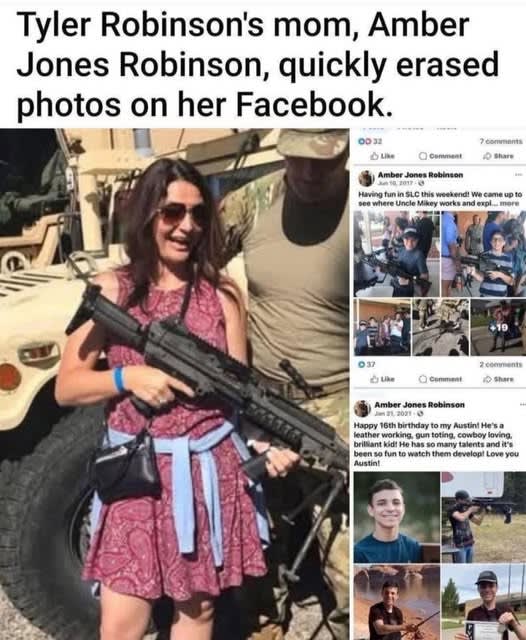
He was raised in western mountain gun culture (Lauren Boebert’s milieu), and appears to have been a Groyper—a follower of white nationalist Nick Fuentes, who so happened to have had a beef with…Charlie Kirk.
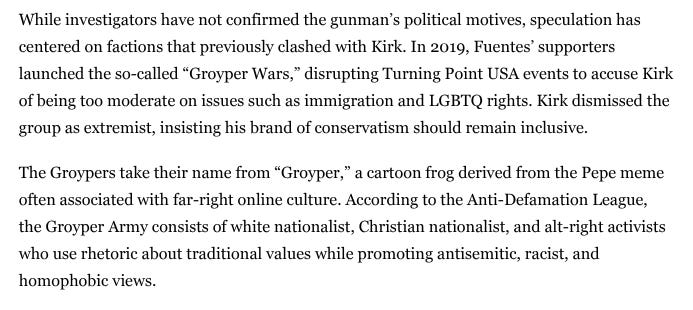
While investigators have not confirmed the gunman’s politics motives, speculation has centered on faction that previously clashed with Kirk. In 2019, Fuentes’ supporters launched the so-called “Groyper Wars,” disrupting Turning Point USA events to accuse Kirk of being too moderate on issues such as immigration and LGBTQ rights. Kirk dismissed the group as extremist, insisting his brand of conservatism should remain inclusive.
The Groypers take their name from “Groyper,” a cartoon frog derived from the Pepe meme often associated with far-right online culture. According to the Anti-Defamation League, the Groyper Army consists of white nationalist, Christian nationalist, and alt-right activists who use rhetoric about traditional values while promoting antisemitic, racist, and homophobic views.
Not only was the shooting MAGA-on-MAGA crime, this is a factional rift on the right of MAGA politics. While some have compared Kirk to John Lennon (!), the better analogy to the Left is Trotsky and Lenin, prior to Trotsky walking away from the Mensheviks to join the Bolsheviks. Only without Trotsky getting the chance to have his change of heart. Kirk was not radical enough for the Groypers, Fuentes’ followers saw him as selling out for mainstream acceptance…
Here is where it’s important to realize that Kirk was a more effective propagandist than Stephen Miller will ever be. Miller is a mouthful of sand, tacks, and glass shards, Kirk was pudding, gregarious, claiming to be upholding an ideal, rarely raising his voice, all the while advancing a white Christian nationalist agenda, and platforming it in venues full of young adults where it had failed to make incursions in the prior decades.
Fuentes is more verbally palatable than Miller, but will never match Kirk’s capabilities; and Fuentes is more divisive than even Kirk. There are concerns this may escalate, as evidenced by Fuentes’ after-the-fact disavowal of violence. There is good reason to believe it might, given MAGA’s eagerness to escalate everything they find upsetting.
To persecute marijuana users—to threaten grower Eddy Lepp with the death penalty for gardening—is to practice a politics of division. When we stop thinking of drug-users as American it becomes easier to see them as threats. When we see people as threats it becomes easier to treat them violently—eventually, it becomes the prescription, the prophylaxis.
A boy raised among guns, privileged in every form of his identity in the community in which he lived, was radicalized to murderous violence by an ideology of division, where many others are not quite people, and become disposable.
Most human beings need to suffer a high degree of motivation, to kill another. Some methods require this degree be maintained for a long time, while others are crimes of passion accompanied by a swift dispatch. An assassination is never a crime of passion though—especially when the shooter had plans for escape.
The kid was raised with a relative silver spoon in his mouth—white, male, American, Mormon in Utah, two-parent home, never missed a meal, always had health care, always had shelter provided to him. He was Charlie Kirk’s ideal type. And he was motivated to kill, because he had a slew of social privilege.
The politics of division are most appealing to those who hold privilege.