
Fellow Workers!
Trump's latest incursions on speech are Fascistic, but far from new

The Red Scare in the United States was the incursion on speech, made “necessary” through a social panic fostered by Senator Eugene McCarthy. He exposed a crisis of authenticity. How are we to know that someone is authentically “American”? Discussing Socialism or Communism, as often took place during the Depression, were posed as threats to America. The Godless Communists will do anything to conquer the world! The crisis called for a purge and attendant sacrifices. “The Hollywood Ten” were targeted and blacklisted—officially out of their professions, but working under aliases—for not “naming names.” Others would face public accusations and ostracism; for many a public loyalty oath became the means of managing the threat.
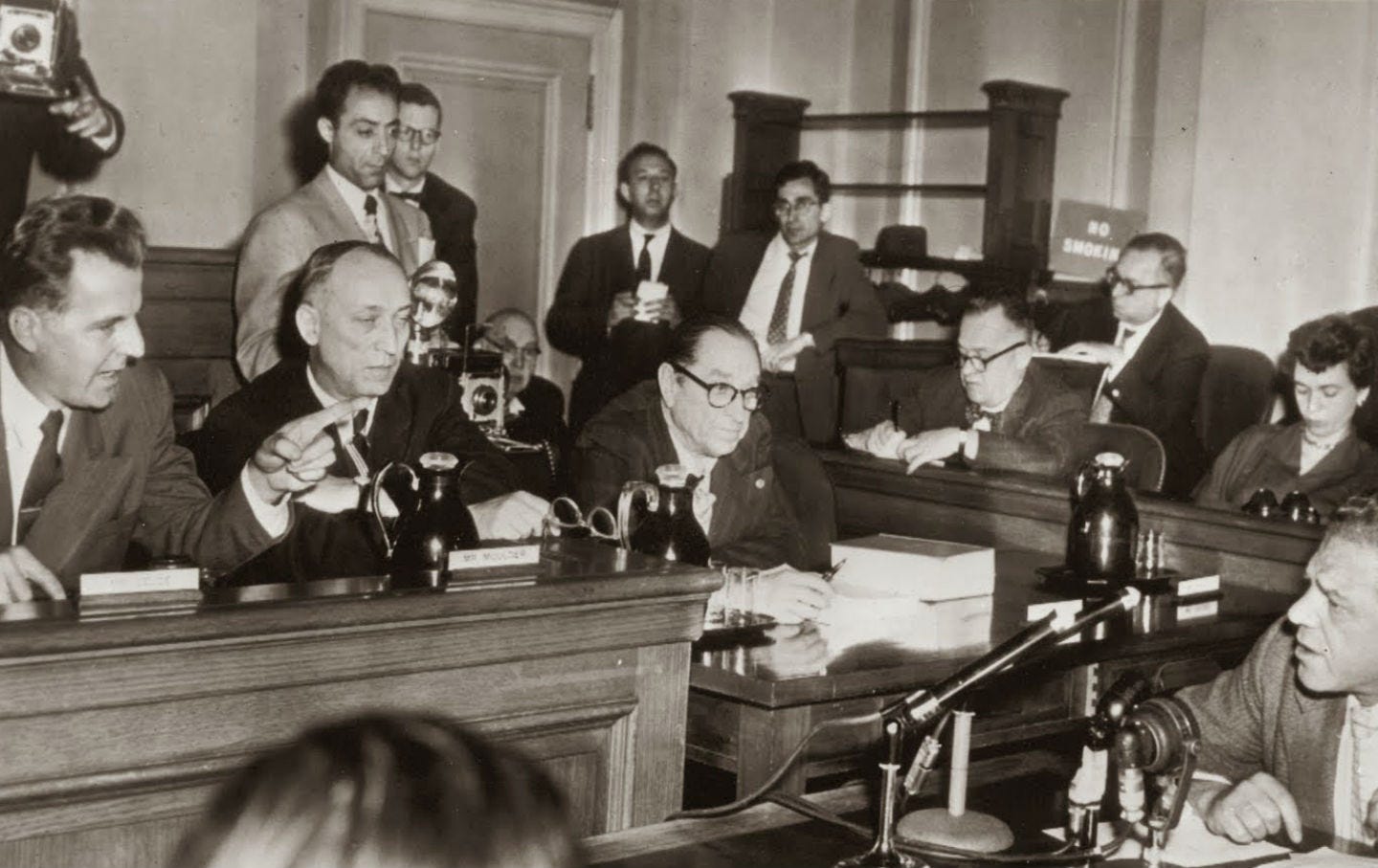
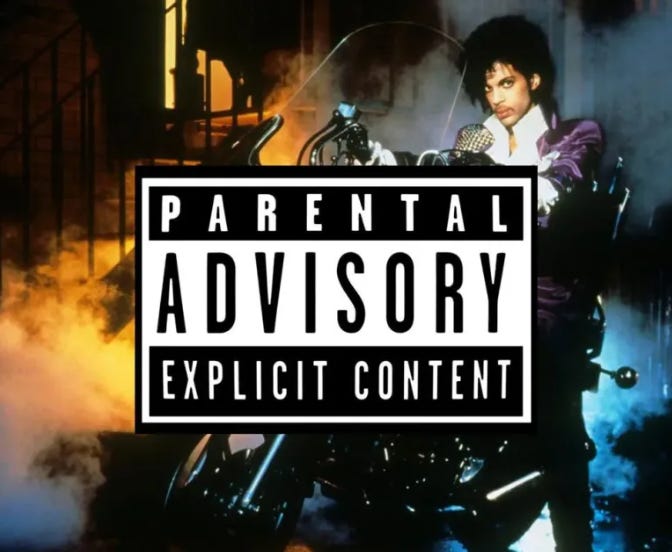
When the government makes incursions on popular entertainment, there are always particular forms that become targets. Whether it be the Red Scare of the 1940’s & 50’s, or the 1980’s with Tipper Gore’s moral crusade over music lyrics and the disappearance of positive or humorous outcomes from recreational marijuana use in Hollywood films, or the current cancellation/suspension of centrist talk show hosts for mocking Trump, the practice is the same. Moral entrepreneurs draw attention to social problems they claim are caused (or exacerbated) by expression and depiction.
The popular memory draws a sharp distinction between American culture in the 1950’s versus the 1960’s, with Kennedy’s assassination as the informal dividing point. But Brown v. Board of Education was in the middle of the 1950’s, and that was also the decade with the greatest amount of labor unrest in the 20th century. The material foundation for much of the cultural shift that became apparent in the mid-1960’s had been laid a decade earlier.
Wages matched rising productivity, mass consumerism promised sustained growth, and this helped lead to increased fertility in the United States, from 1946 - 1964. Mao was relying on Marxist theory when he encouraged the Chinese people (in this same era) to have as many babies as possible—labor is the source of value and humans are the source of labor. More people, more potential value, and the greater the influence on markets—it does not matter if the economy is supply-constrained or demand-constrained. The people are on both sides—supply and demand.
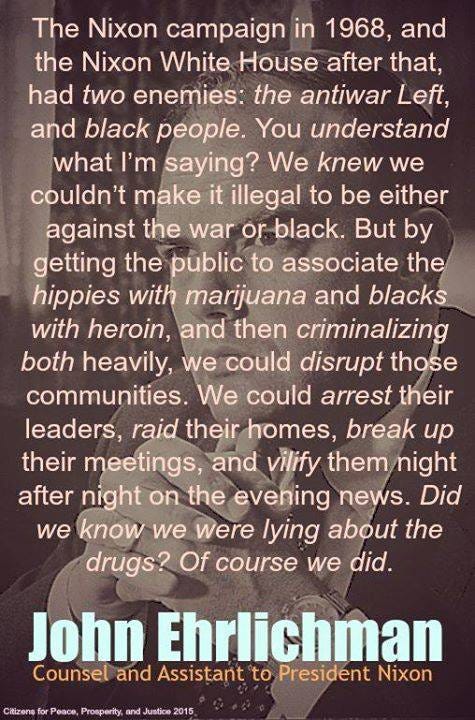
The Nixon campaign in 1968, and the Nixon White House after that, had two enemies: The antiwar Left and black people. You understand what I am saying? We knew we could not make it illegal to be against the war or black. But by getting the public to associate the hippies with marijuana and the blacks with heroin, and then criminalizing both heavily, we could disrupt those communities. We could arrest their leaders, raid their homes, break up their meetings, and vilify them night after night on the evening news. Did we know we were lying about the drugs? Of course we did.
—John Ehrlichman, Counsel and Assistant to President Nixon
Drug War I actually had a fair emphasis on public health and dedicated as much monetary resources to treatment as to law enforcement. Its initial budget was $17 million. Sanctifying medical use, making it the only legitimate intention, meant having to exclude the most popularly-used drugs—caffeine, nicotine, and alcohol—but that was easily done. It also coincided with the corporatization of medical practice through “HMO’s” that Nixon helped usher in.
Michel Foucault noted that Modernity proliferated scientific forms of social control and topmost among these would become the medical gaze. Through the medical gaze, any drug use outside of medicinal purposes is problematic—it can lead to diseases and death. Yet when they sell us pharmaceuticals on TV we are warned of the potential for disease and death from taking them. But those are side effects, see? Pharmaceutical corporations, whose advertising was once limited only to medical professionals, lobbied for deregulation and got it under the Clinton Administration. While pursuing the Drug War II as vigorously as his predecessor (the resistance to California’s state-legal medical marijuana was led by the DEA), Clinton freed profit-seeking drug speech.
Out-migration of manufacture from U.S. cities began to accelerate in the 1980’s. Labor, having organized around workshops, suffered declining influence as wages had uncoupled from economic growth. The more this army of labor would produce (as decreasingly-organized workers), the relatively poorer they became. A decline in their quality of life was to be expected.
Objectively, if higher wages were a marker of a “better” job, and those who could afford to buy larger houses, new cars, travel for vacation, and afford private educations for their children actually had a higher standard of living than those who could not do some or all of those things, then as wages fell relative to economic growth, people could afford less, and the general quality of life declined.
While this was going on, two things needed to be done to manage the population—first, Capital had to keep the consumerism going, the population had to keep buying consumer goods (which were being manufactured more than ever outside the U.S.) because the U.S. has a demand-constrained economy. This was accomplished by mass consumer credit: High-interest loans on a lot of relatively small lines of credit, such that workers were able to buy electronics, clothing, travel (and necessities). Getting them to individually absorb the bankruptcies, rather than the market suffer the lack of spending.
The middle class has historically secured its social class position through education and training for particular occupations, investment in personal housing, and inheritance. Since that was how the middle class was built, by fostering more of it elected officials expected to see the middle class grow (or so went the thinking). They made credit for school and housing widely available through government programs, not taking into account prices inflating to meet cash supply, nor the falling wages across debtors’ occupations.
This was the setting for Drug War II, the Reagan-Bush incarnation, where the military was enlisted into the effort, both domestically and internationally. Urinalysis took the place of loyalty oaths and employers gladly made people prove they were “drug-free” (or at least knew how to make it look that way) before granting them the privilege of being paid less and less, the more they produced.
Urinalysis is class-based. Aside from a tiny number of particular professional and managerial occupations, it has been reserved for the working class. This is most obvious in any industry with a class-stratified workplace, such as a university.
In the name of Drug War II, restrictions were placed on speech and assembly, search and seizure by police was expanded, judgement was taken from the Judiciary by the Legislative levying mandatory minimum prison sentences for drug offenses. It was Drug War II that saw the for-profit prison industry emerge and that drove the U.S. to become the world leader at locking people in cages. When we monetize the treatment of deviance, do not be surprised when Capital creates more deviance: It works the same way with crime, disease, and war.
When there is money to be made chasing the Enemy Within, we see a proliferation of them. They were Communists and Socialists immediately after WWII. They became drug users, terrorists, and sex offenders, each with their own sets of special laws that applied to them (and everyone else) that allowed for greater surveillance and stricter discipline and punishment. Moral entrepreneurs operating in a capitalist market will seek to profit from their creations.
The state took on a more punitive and disciplinary role through Drug War II, while hitting its own crack-hype pipe. Crack was played up more by the media than by the users themselves—well less than half of those who tried crack used it a second time.
Meanwhile, Madison Avenue advertisers tripped over themselves putting together a massive, multi-year propaganda campaign pro bono under the name The Partnership for a Drug-Free America. Not to be left out, TV networks and Hollywood studios (having learned their lesson in the 1940’s) put anti-drug messaging in their storylines and submitted the scripts to the FCC for consideration when it came to the unpaid public service announcements licensees are required to broadcast.
Put in a scene where someone has a bad trip on “U4EA” and the dealer gets busted in an episode of Beverly Hills 90210, and you can sell those 10 minutes of PSA’s.
Trump has acknowledged he wants FCC-licensed media to stop criticizing him because he is a Fascist. But that doesn’t set him apart from those government officials who have enlisted private corporations to silence messages they do not approve of in the past. We might want to recognize there is a longer history of Fascism running through state practices, as evidenced from when the state has fallen under control of moral entrepreneurs in the past. Trump is merely willing to use the Office to do so, rather than have some Senator or Senator’s wife lead the charge.
The one segment of media that Trump had the most direct sway over, PBS, he eliminated rather than flip it to ‘TrumpBS.’ The philosophy of eliminating all state support supersedes his immense self-idolatry. Privatization matters, and the FCC has no jurisdiction over private communications.
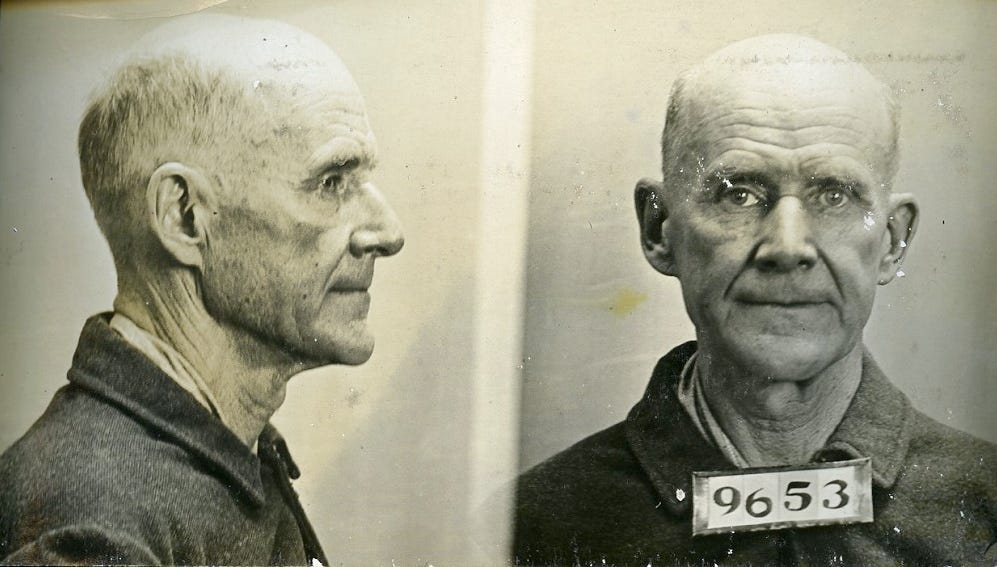
Eugene Debs once spent years in prison for uttering the words, “Fellow workers.”
Jimmy Kimmel, on the other hand, will just slide into podcasting, which is more popular than network TV anyway.