
Fixing Things
Calling the party "Democratic" is like calling a bald man "Curly."

The Conspiracy Theorist looks to the future, to understand the present.
The Materialist looks to the past, to understand the present.
One constantly manages failed prophecy; the other manages ignorance.
March 2, 2025
If you think of Joe Biden’s nomination not as a means of keeping Donald Trump out of the White House, but instead Bernie Sanders, IT MAKES A LOT MORE SENSE.
Here is how the DNC screwed us all, for the SECOND time.
In 2016, after more than 40 years of wage-stagnation in the United States, Americans got a real-life lesson on the difference between Liberalism and soft Leftism, through the conflict between corporate interests and their own.
The “Clinton magic” of the 1990’s was turning the Democratic Party into a less-sexist, less-racist (but not yet less-homophobic) version of the Republicans. Other than a one-term hiatus following Nixon’s disgrace, Americans had chosen a Republican for President, in five of the prior six elections.
Bill Clinton portrayed himself as a common man (he was the first President raised by a single mother) and offered lip-service at hard hat photo ops, but when asked about the American economy, he boasted about business profits and growth. Despite an obvious and growing value-distribution crisis, Clinton made no mention of the widening gap between productivity and wages, much less attempted to address it.
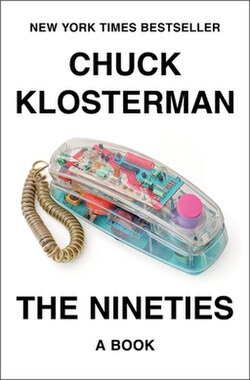
Social commentator Chuck Klosterman noted in his retrospective The Nineties: A Book:
For all of the summer and most of the fall, the 2000 race felt stupefyingly dull: It was two conventional candidates who were somehow both familiar and unknown. Neither exhibited any quality that could pass as dynamic or transformative. They were more similar than different, or at least that’s what became the analysis everybody wanted to express. A Pew Research poll found 44 percent of registered voters from both parties believed “things will be pretty much the same regardless of who wins… (Klosterman, 319).
Prior to election night, the race between Bush and Gore was a cosplay of how people thought about political culture in general: The candidates are different (but not really), the outcome matters (but not that much), and the winner will either be the affable guy we want to have a beer with or the uptight guy who seems to know what he’s talking about (and it will work either way, probably). At the time, polling suggested 40 percent of Democrats and Republicans has a “favorable and warm” opinion about members of the opposing party. It was easy to think about politics as something that could be argued over without much risk, because the final outcome would always be some version of a compromise. (Klosterman, 330).
Labor still had a champion in the 2000 race. It was Ralph Nader, running hard to try to capture 5% of the vote, so that the Green Party might find a place in the “bi-partisan” federal electoral process. Al Gore had made global warming a centerpiece of his campaign, and would not have de-regulated corporations or put federal lands up for resource-extraction as Bush did; but Gore was still a corporatist. Enough of the electorate saw a difference between Nader and Gore that the Democrats would come to lay blame for losing upon Nader for running to the left of Gore and winning “his” votes.
That result foreshadowed the 2008 Democratic primaries. Liberalist philosophy and values put Barack Obama to the left of Hillary Clinton, solely by virtue of his race. If we look at prognostications made in the 1980’s about who might be the first Black President, it was near-universally acknowledged that he would be politically conservative. The belief was that his politics must be so appealing to wealthy, white people that they might overcome racist inclinations; and that would mean the candidate would be pro-business and pro-military, and quite possibly Republican. Obama winning as a Democrat was an indicator of how U.S. politics shifted, from the 1980’s to 2008.
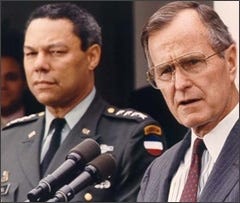
The Republicans had a pro-business, Gulf War I-winning, former Secretary of State, General Colin Powell, who could have run, but for having been a Black man in the Republican Party. Republicans tolerate women and racial minorities in their ranks, finding them useful tools and sacrificial lambs. They also tolerate overt racists, white Nationalists, and Nazi-sympathizers, but never seem to use them in the same way they use women and minorities.
In 2002, Powell was assigned to sell Gulf War II: Junior’s Revenge to the American people and the world, claiming Saddam Hussein had a nuclear weapons program in development. We later found there was no such thing. And by 2008, Americans had grown weary of the Iraq occupation—a Bush Administration/Project for the New American Century side-quest made possible by 9/11—which had nothing to do with Saddam Hussein.
So Obama faced GOP veteran Senator John McCain in the general election, and won on the messages of “Hope & Change.” The economy was in recession, the housing market collapsing, unemployment was spiking (the Great Recession saw men generally abandoning neckties, even when they returned to working—this shift is worthy of deeper examination), and in 2008 the Republican candidate stood no real chance of winning.
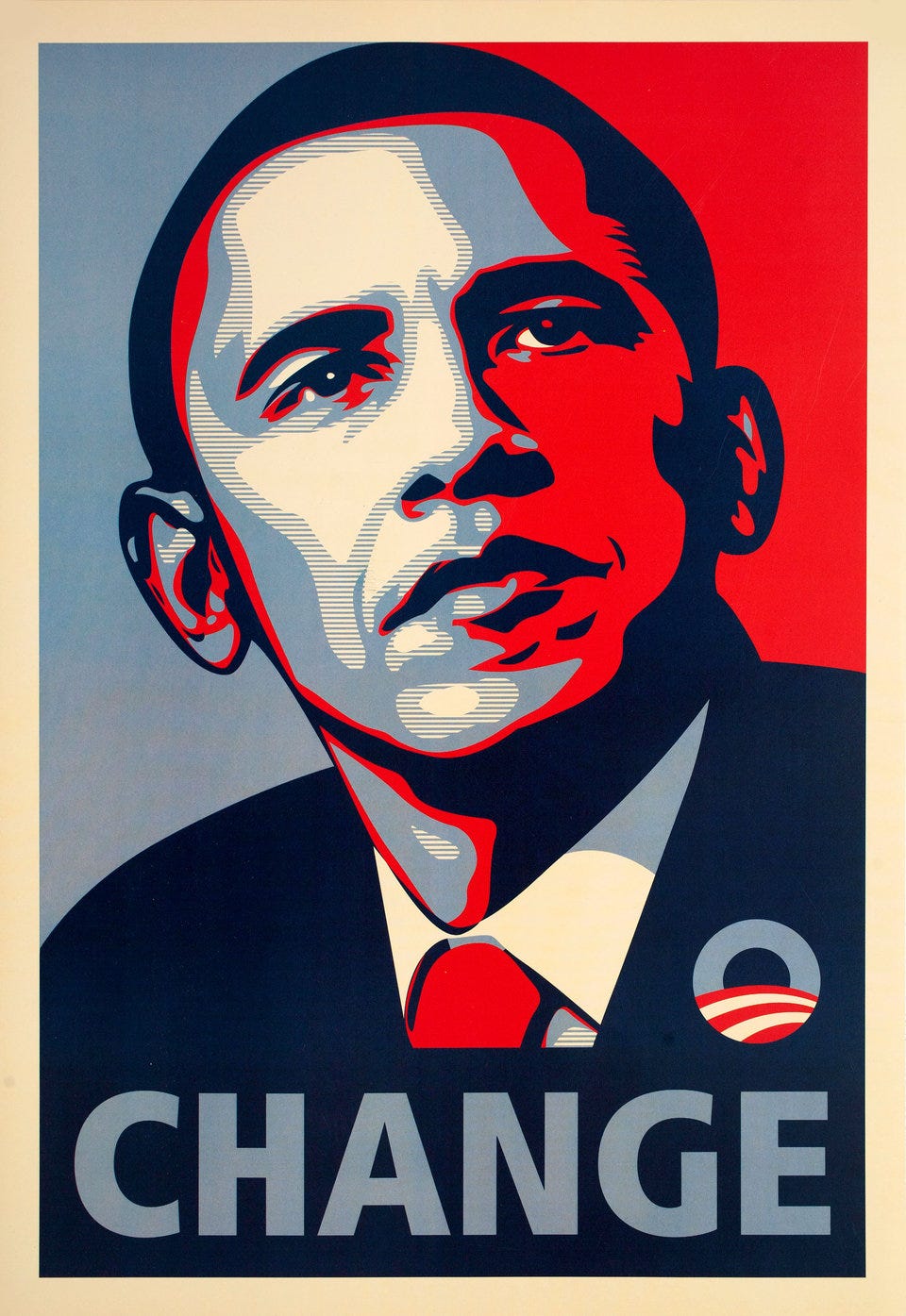
Americans wanted change, and by appearance alone, Obama promised it. It turned out that the first Black American President was indeed a conservative. Prior to Clinton’s election, Obama would have fit better ideologically in the Republican Party. His remedy for recession was pumping billions of dollars in national debt into failed financial institutions. They had taken the de-regulation they had lobbied so expensively for, and run everything into the ground; yet they would be given a second chance. The folks who took out those de-regulated mortgages and loans had their purchases repossessed, and got bupkis.
I voted for Obama the first time, which was also the last time I voted for a corporate party candidate. I realized early in his first term that while the packaging was different, he was Neoliberal to the bone. What I failed to anticipate was exactly how dedicated he would be to his sponsors, at the people’s expense.
The 2016 election was to be Hillary Clinton’s. She chose the horribly egotistical slogan “Her Turn” for the campaign, because that fit the pre-2020 model the Democrats liked to work with. One party gets a turn, and then the other party gets a turn; since we will be taking turns, then it behooves us both to work with the other party when it is their turn because someday it will again be our turn.
That must have been why the Supreme Court split on nominating-party lines, when they decided the 2000 Florida recount would be stopped, and the results showing Bush had won would be the ones that mattered. After two terms with a Democrat, it was the Republican’s turn! [n.b.: The 2000 Florida results were a statistical tie—tallies would vary within a range narrower than the margin of error, no matter how often they were taken. Who won Florida in 2020? Both of them. Quantum politics.]
In 2016, the Clinton Campaign found an unanticipated challenge from Bernie Sanders, who had eschewed corporate sponsorship and used the internet to organize and fundraise. The Sanders Campaign was effective enough that Clinton coordinated with the Democratic National Committee to withhold party resources from Sanders. A year after the primaries, DNC leadership testified under oath that the party was a private organization that could run primaries, or not run primaries, any way they chose. The court agreed and refused the Sanders Campaign’s claim.
2016 proved the first time that the Democrats were more committed to Neoliberalism than they to being popular enough to win elections—and putting economic philosophy ahead of popularity is a Republican approach. As the Democrats blamed Ralph Nader for Al Gore not appealing to anti-corporatists in 2000, they blamed Jill Stein in 2016, saying it was the Green Party candidate’s fault for Hillary Clinton’s lack of appeal. The party denies to this day that Bernie Sanders would have been able to beat Trump, even though polling showed Trump’s margin of victory in multiple states came from Sanders primary voters who had either stayed home in the general election, or had voted instead for Trump.
Americans wanted real change in 2016, which is why the corporate parties both faced major challenges from outsiders in the primaries. It befit the race between the two least popular candidates of the prior 120 years, that the one who received the fewest popular votes, won.
By 2020, Americans wanted a change, again. This time, to anyone but Trump. Before COVID-19 hit, Trump had already proven himself unqualified for the job, by all Presidential standards. Despite having had full control of Congress for the first two years, Republicans did nothing of substance, aside from passing a pro-corporate, pro-billionaire tax scheme.
Trump’s mismanagement of COVID did nothing to improve his chances for re-election in 2020. Polling showed Trump lost votes, from the primary to the general election, in Georgia. A small part of that would be COVID deaths, but a larger part of that drop off was disillusionment that had grown in the seven months between the two elections. Trump did himself no favors by telling people not to mail in their ballots, but to stand in line, unmasked, to vote in person.
Like many others, Trump demands risky, potentially-lethal demonstrations of loyalty from his followers. He has since proved that loyalty matters more than popularity, even in electoral politics.
Today marks six years, since Super Tuesday, 2020.
March 3, 2020
Politics: America’s Favorite Bloodsport.
And Today is Super Tuesday!
#VOTE
In the 48 hours leading up to that day, American voters were shocked to hear that first-time Presidential aspirants Pete Buttigieg (who claimed to have won the Iowa caucuses, over Sanders) and Minnesota Senator Amy Klobuchar decided on the same day to withdraw from the race. Political campaigns—especially for newcomers in primaries—are all about fundraising and brand-building. By Super Tuesday serious candidates have already dedicated most of their political capital to building support—they have taken in hundreds of thousands, if not millions, of dollars in donations, promising supporters they will deliver for them.
To drop out the weekend before the make-or-break Tuesday is to screw those donors. Thanks for giving me your money to piss away. Pete & Amy had spent loads of cash across fourteen states, and thanked the supporters who had cast early ballots for them by rendering their votes moot.
You might see how dropping out on the cusp of Super Tuesday could be very costly to a candidate’s future.
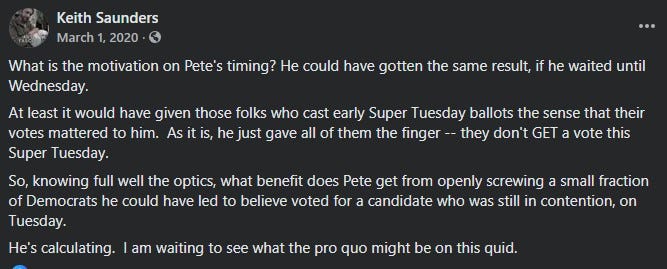
March 1, 2020
What is the motivation on Pete’s timing? He could have gotten the same result, if he waited until Wednesday.
At least it would have given those folks who cast early Super Tuesday ballots the sense that their votes mattered to him. As it is, he just gave all of them the finger -- they don’t GET a vote this Super Tuesday.
So, knowing full well the optics, what benefit does Pete get from openly screwing a small fraction of Democrats he could have led to believe voted for a candidate who was still in contention, on Tuesday.
He’s calculating. I am waiting to see what the pro quo might be on this quid.
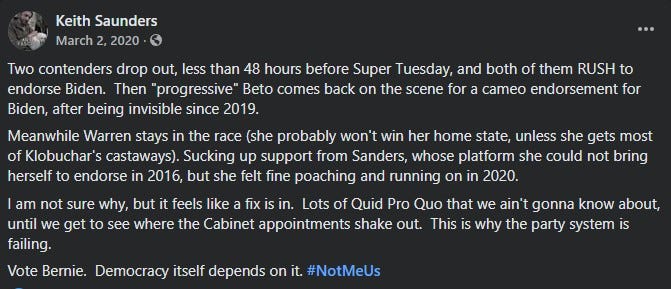
March 2, 2020
Two contenders drop out, less than 48 hours before Super Tuesday, and both of them RUSH to endorse Biden. Then “progressive” Beto comes back on the scene for a cameo endorsement for Biden, after being invisible since 2019.
Meanwhile Warren stays in the race (she probably won’t win her home state, unless she gets most of Klobuchar’s castaways). Sucking up support from Sanders, whose platform she could not bring herself to endorse in 2016, but she felt fine poaching and running on in 2020.
I am not sure why, but it feels like a fix is in. Lots of Quid Pro Quo that we ain’t gonna know about, until we get to see where the Cabinet appointments shake out. This is why the party system is failing.
Vote Bernie. Democracy itself depends on it. #NotMeUs
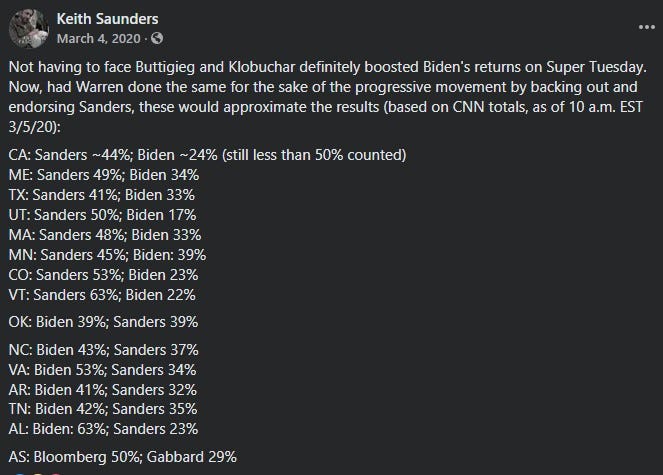
March 4, 2020
Not having to face Buttigieg and Klobuchar definitely boosted Biden’s returns on Super Tuesday. Now, had Warren done the same for the sake of the progressive movement by backing out and endorsing Sanders, these would approximate the results (based on CNN totals, as of 10 a.m. EST 3/5/20):
CA: Sanders ~44%; Biden ~24% (still less than 50% counted)
ME: Sanders 49%; Biden 34%
TX: Sanders 41%; Biden 33%
UT: Sanders 50%; Biden 17%
MA: Sanders 48%; Biden 33%
MN: Sanders 45%; Biden: 39%
CO: Sanders 53%; Biden 23%
VT: Sanders 63%; Biden 22%OK: Biden 39%; Sanders 39%
NC: Biden 43%; Sanders 37%
VA: Biden 53%; Sanders 34%
AR: Biden 41%; Sanders 32%
TN: Biden 42%; Sanders 35%
AL: Biden: 63%; Sanders 23%
AS: Bloomberg 50%; Gabbard 29%
For Joe Biden (who had still never won a presidential primary at the time) Pete & Amy tanking their campaigns alone would not have been enough. Of equal importance was Elizabeth Warren not leaving the race, and siphoning progressive-leaning voters from casting ballots for Bernie Sanders.
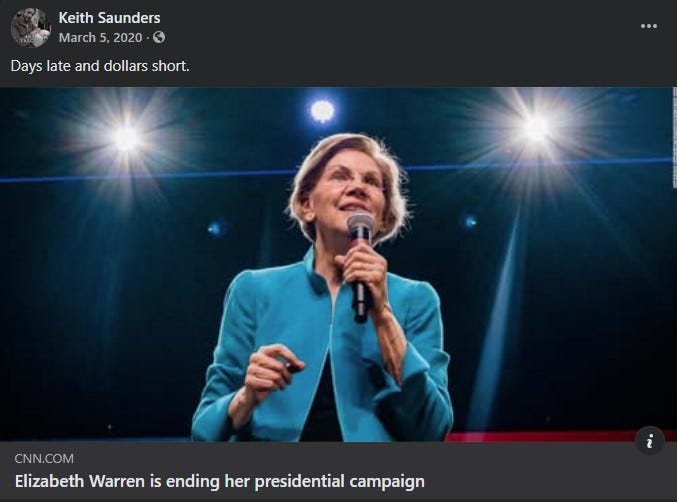
March 5, 2020
Days late and dollars short.
CNN.COM: Elizabeth Warren is ending her presidential campaign
It was a more complex task than Hillary Clinton conspiring with her old pals who ran the DNC. Whomever made the entreaties to Pete & Amy had to have serious clout in the party, and wanted Biden to be the candidate. It also would have been strategically important to have Warren remain in the race through Super Tuesday, if the goal was to stave off Bernie Sanders.
Keeping Sanders out of the White House turned out to be more important to Democrats than prosecuting Trump for his crimes. How do I know?
Joe Biden had one job. When he failed to accomplish any of it by December, 2023, he should have been heavily primaried on that matter, alone. But no one—besides party outsider Maryanne Williamson—dared offend DNC leadership by opposing their will.