Flying High Again
Cannabis use promotes desired passenger behaviors better than alcohol

I have always found marijuana to be a welcome accompaniment to flying. Properly timed, the onset of an edible can make accelerating to hundreds of miles an hour exciting in its own right, and can help the time spent sitting in cramped quarters peel away.
While there are cultural and personal elements that affect the behavioral outcomes of drug use, generally, American cannabis use is associated with relaxation and passivity. American alcohol use is more closely associated with violence and aggression (despite it being a depressant). Flight attendants hate dealing with literal piss-drunk passengers. It seems to me that offering cannabinoid cocktails (with extra CBN for redeyes) and infused in-flight snacks would make for a more easily-managed flight.
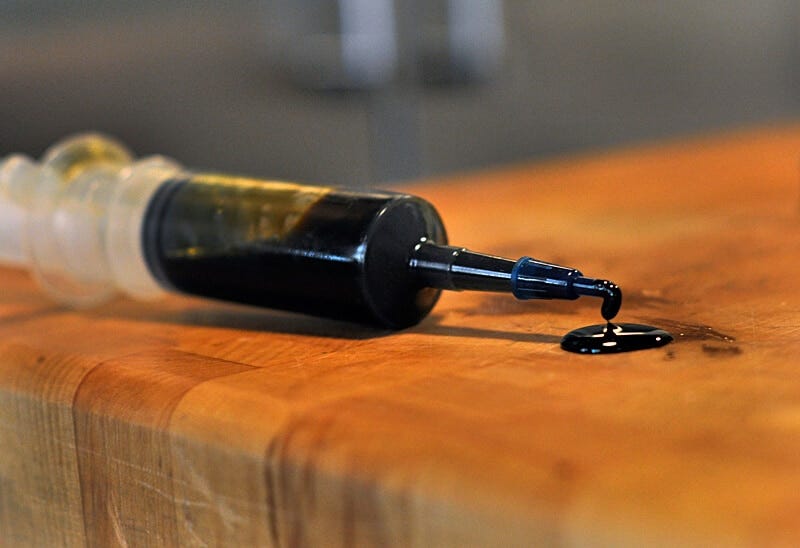
I once ate about half a gram of Rick Simpson Oil between two small crackers as I got in the security line at SEA-TAC for a redeye to Boston. I recall feeling the pressure of my body against the seat as we were lifting off, and nothing else until I was jostled awake by landing at Logan. I was genuinely rested and feeling ready for a full day, once I go home and unpacked. It was then I realized I had left my laptop in the seat back. I called the nice folks at JetBlue baggage in Boston. The conversation went something like this:
Me: Hi, I was in seat XX on flight whatever, and I think I left my laptop in the seat back.
JetBlue Person: Can you describe the laptop? We have a few.
Me: It’s the one with all the weed stickers on it.
JetBlue Person: Oh, yeah, we got that one.
I could practically hear them smile over the phone. It has long been an open secret that people fly with cannabis, both into vacation destinations, and from where supply is plentiful. The only cannabis in my possession on that particular flight was internal though.
One of the old, valuable skills and necessary practices in marijuana culture under prohibition was finding weed in a “foreign” location. Regular consumers will establish local supply lines. Before I began researching marijuana policy reformers, I had repeatedly built supply networks, whether it be while an undergrad in upstate New York, while living in New York City, or later in suburban Boston. By the time I began my research among marijuana policy reformers—which led to developing a transcontinental network—I was already in a position that I never had to wait more than a few hours to get it, whenever I wanted it.
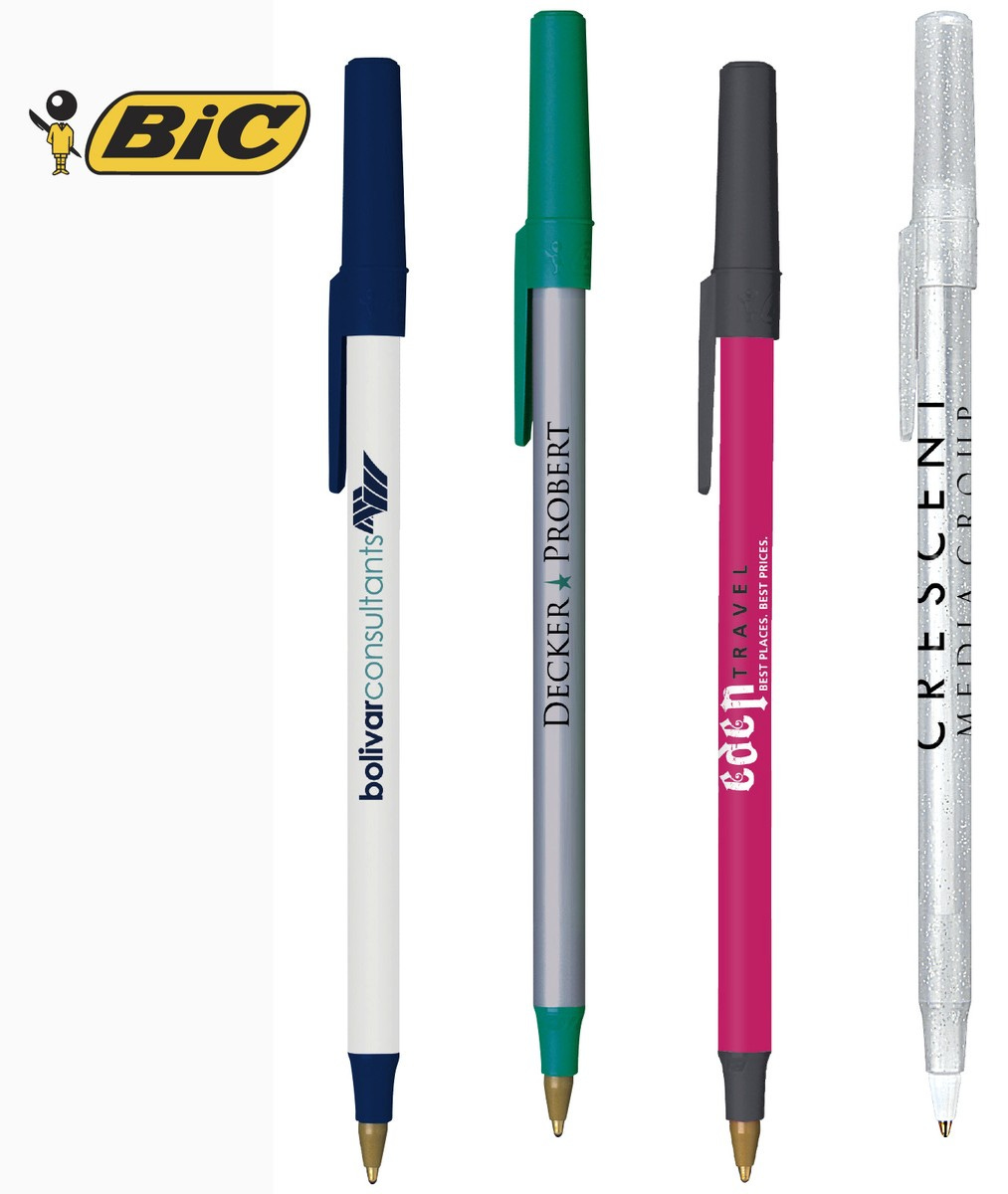
But traveling to new places meant either having to score locally, or to bring one’s own. Regular visits to my ex’s family in suburban Chicago called for bringing a few grams of flower, stashed as pin joints inside Bic pens that had their ink tubes removed. Saran Wrap plugged the ballpoint and the pen carcass was reassembled. Before we had full body scanners, there was nothing to set off a magnetometer, so you could avoid the X-ray, and carry it all on your person.
The September 11 attacks changed the nature of airport surveillance, which has largely been Kabuki theater, meant more to accustom Americans to invasions of privacy as a condition of public life than to prevent a repeat of that day. Searches and surveillance became more intense, but people still flew with weed. The “Trans-High Market Quotations” in High Times indicated no significant change in marijuana prices, following the attacks.
The War on Terror came to supplant much of the Drug War, in everyday life. Drug screenings were still commonplace, but metal detectors and armed security were not strategically located for the sake of finding weed. In fact, the concern over things that might explode took a little heat off the flyer looking to bring a head stash on vacation. Dogs are trained to detect drugs or explosives, not both. With marijuana decriminalization in Massachusetts in 2008, police dogs became unreliable, since there was no criminal offense for possession of less than one ounce of cannabis.
Still, there is no winning or losing; there is only social movement, and the leniency that accompanied the Obama administration’s hands-off approach to state legalization would not last. I foresaw the second Trump administration using Drug War tools to jack up surveillance and discipline, and they have been doing so.

There is a downward flow of administrative pressures upon those at lower levels, to more extremely exert their authority. Here we have a case of a passenger vaping or smoking (the pilot calls it both) marijuana in an airplane bathroom.
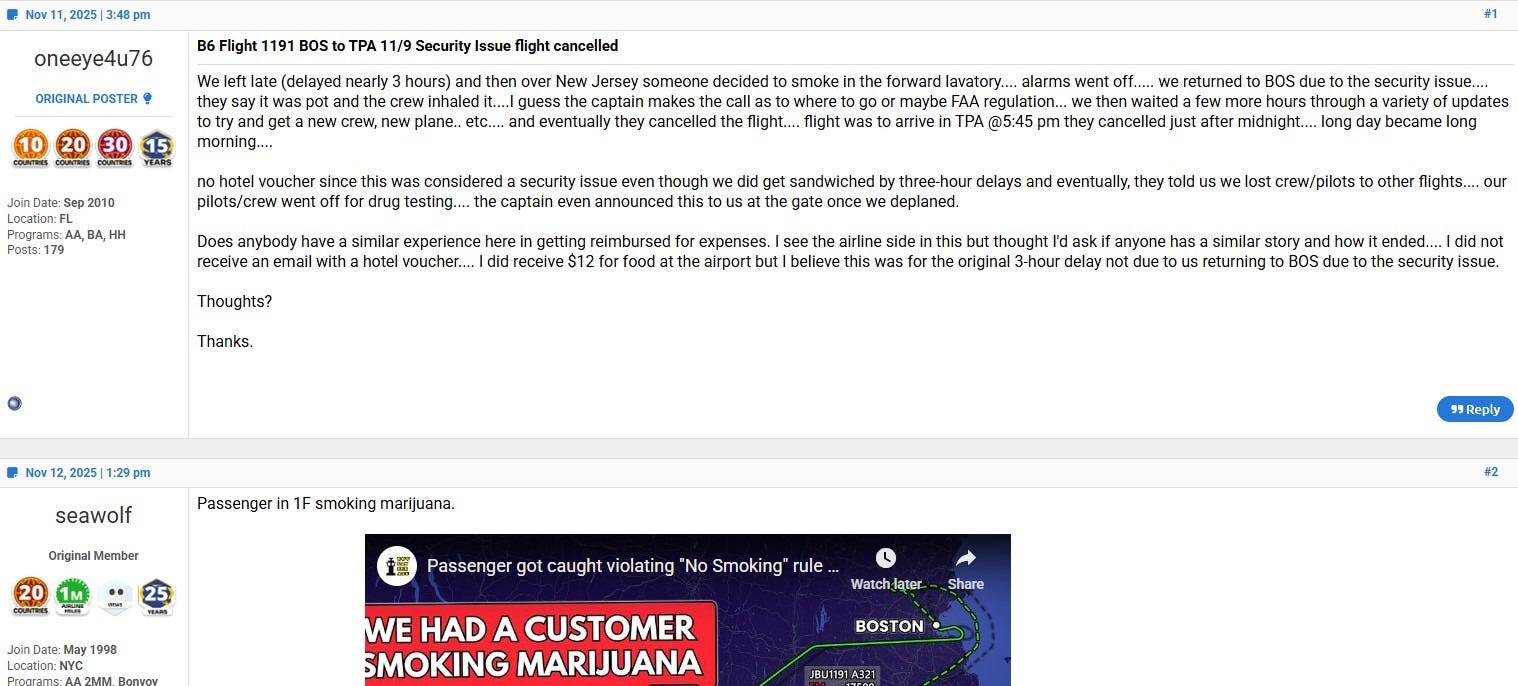
B6 Flight 1191 BOS to TPA 11/9 Security Issue flight cancelled
We left late (delayed nearly 3 hours) and then over New Jersey someone decided to smoke in the forward lavatory.... alarms went off..... we returned to BOS due to the security issue.... they say it was pot and the crew inhaled it....I guess the captain makes the call as to where to go or maybe FAA regulation... we then waited a few more hours through a variety of updates to try and get a new crew, new plane.. etc.... and eventually they cancelled the flight.... flight was to arrive in TPA @5:45 pm they cancelled just after midnight.... long day became long morning....
no hotel voucher since this was considered a security issue even though we did get sandwiched by three-hour delays and eventually, they told us we lost crew/pilots to other flights.... our pilots/crew went off for drug testing.... the captain even announced this to us at the gate once we deplaned.
Does anybody have a similar experience here in getting reimbursed for expenses. I see the airline side in this but thought I’d ask if anyone has a similar story and how it ended.... I did not receive an email with a hotel voucher.... I did receive $12 for food at the airport but I believe this was for the original 3-hour delay not due to us returning to BOS due to the security issue.
Thoughts?
Thanks.
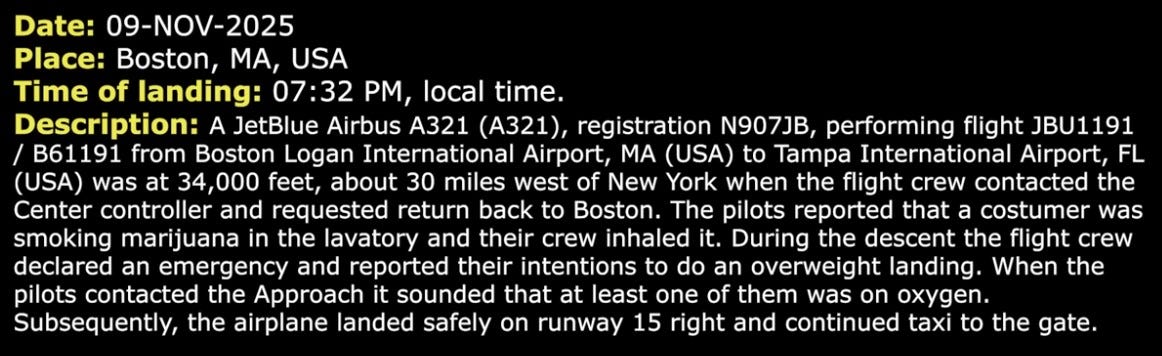
Date: 09-NOV-2025
Place: Boston, MA, USA
Time of landing: 07:32 PM, local time.
Description: A JetBlue Airbus A321 (A321), registration N907JB, performing flight JBU1191 / B61191 from Boston Logan International Airport, MA (USA) to Tampa International Airport, FL (USA) was at 34,000 feet, about 30 miles west of New York when the flight crew contacted the Center controller and requested return back to Boston. The pilots reported that a customer was smoking marijuana in the lavatory and their crew inhaled it. During the descent the flight crew declared and emergency and reported their intentions to do an overweight landing. When the pilots contacted the Approach it sounded that at least one of them was on oxygen. Subsequently, the airplane landed safely on runway 15 right and continued taxi to the gate.
Excerpted Transcript:
[0:22] Pilot: New York. Jet Blue 1191.
Air Traffic Control: Yeah, go ahead.
Pilot: Due to a customer disturbance we will be returning to Boston. Requesting diversion to Boston.
ATC: JetBlue 1991, you’re diverting to Boston?
Pilot: Affirmative. Requesting direct Bos, er, uh, back to Boston.
ATC: JetBlue 1191, uh, uh, do you have an emergency?
Pilot: Negative at this time. We did have a customer disturbance.
ATC: A customer disturbance. Roger. [0:47]
[1:51] ATC: JetBlue 1191, I just have some questions. Is the cockpit secure right now?
Pilot: Hey, our cockpit’s secure. We just had a customer vape in the lav, yeah, smoking marijuana in the lav; we’d just like to return to Boston. [2:02]
[6:39] Pilot: And was there anything else?
ATC: And the seat number of the person in question.
Pilot: One foxtrot. [6:44].
The abundance of marijuana in California under the state’s medical program led growers and processors to start extracting cannabinoids from their trim. Rick Simpson Oil is one form, there are many others. Solvent extraction uses alcohol, naphtha, butane (or some other hydrocarbon), or CO2 to pull cannabinoids from plant material and concentrate them. These concentrates lend themselves to multiple routes of administration. They may be dissolved in ethyl alcohol or oils and ingested, or they may be vaporized and inhaled.
Marijuana culture embraced vaporization before it became popular for nicotine administration. Hydrocarbon extraction also knocks off the terpenes, the source of marijuana’s recognized scent. No one had any clue what the early adopters were doing.