
Funny Money
What happened to the Tubman $20 bill?

The ideal capitalist currency has no use-value—
That is, it cannot be anything other than the universal equivalent that allows all commodities to be matched. Commodity barter systems are rife with static wholes that cannot be subdivided—one cannot halve a living sheep to meet the value of an axe, for example. Further, the potential trade partners must have corresponding surpluses and needs. Corn may be plentiful for all who grew it while there was a tomato blight that summer—the entire valley is willing to trade their corn for tomatoes, but no trades can be made.
Currency resolves the problem of unmatched commodity values. The $1 bill is worth $1 of anything: food, gasoline, education, candy, space travel; it matters not the quality of the commodity. The trick of currency is not its divisibility, however, but it’s cultural location. Currency only has value when the trading partners both agree on what value it has. This value is not a material condition of the currency, but of the culture.
Use-value interferes with the expediency of currency. Should the currency be more valuable in its material use rather than in exchange, currency supply will become depleted. People will be reluctant to exchange for it if they do not have a use for it other than exchanging it for something else. Elements of commodity barter are re-introduced, and with them all of the inefficiencies.
Further, should the value of the currency fluctuate, it becomes unreliable as a means of exchange. The more volatile, the less of a purpose it can serve. While some may think that the currency will increase in value and gladly accept it, others will be cautious of losses incurred after the transaction. Those who believe the currency will increase in value, however, will also be reluctant to exchange again it for commodities. The currency becomes a commodity unto itself, and again we meet the inefficiencies of bartering commodities for commodities.
Blockchain technology serves as a stand-in for currency—the brand of the securities exchange may vary, but it is the technology, and not any one brand that offers the fundamental process. The ongoing problem of blockchain currencies is their volatility—value is in constant flux, and one-day swings of 10% or more in valuation occur frequently. These exchanges are easily dominated by small numbers of big-money investors, who routinely use “pump and dump” techniques to boost short-term returns and then “rug-pull” on all those left holding the now-worthless $HAWK coin, for example.

In keeping with the Venture Capitalist approach to breaking up and selling off the United States, the Trump administration just announced the U.S. will be buying crypto. We have already seen market manipulations springing from this decision. For all the upset MAGA expresses over elected officials who have been using insider knowledge to line their pockets, there has not been a peep of protest over this:


Is there anyone among the dozen billionaires in the Trump Cabinet that might have had knowledge there would be major market adjustments in their favor—in both directions? Taking 50x leverage means a gain of 2% would have wiped out the entire investment in Ethereum, and a loss of 2% would have wiped out the entire investment in Bitcoin. One does not take such investment risks unless one can afford to lose millions of dollars, or one knows they are not taking a risk at all.
Remember this?
And then this?
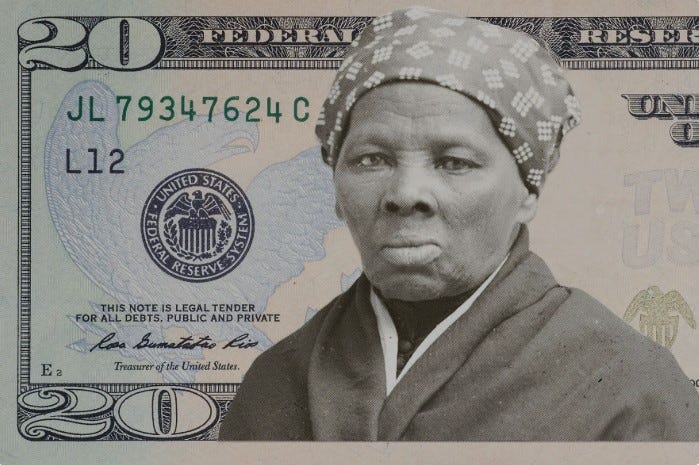
So where are these?
“'Cause I'm Black and I'm proud, I'm ready, I'm hyped, plus I’m amped.
Most of my heroes don't appear on no stamps.
Sample a look back; you look and find nothing
But rednecks for 400 years, if you check.” — Public Enemy, Fight the Power, 1989.
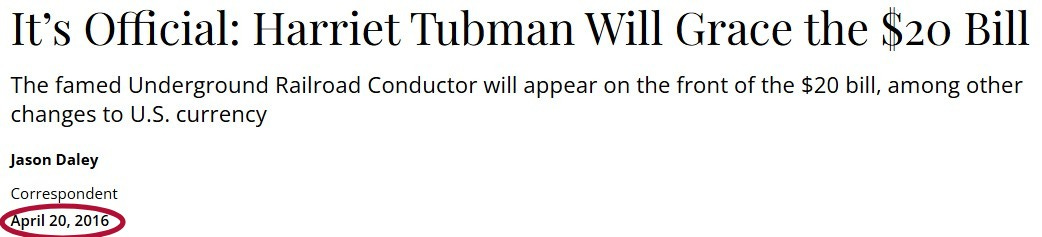
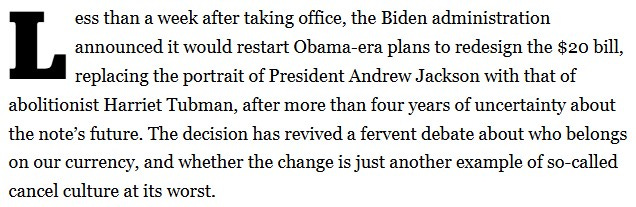
Obama had been late to the game in proposing the re-design of the bill, back in 2016, his last year in office. We were informed that printing new currency is a process that takes years to implement, and it would occur during the next administration, to be released before 2020. Of course, the first Trump administration tried to kill the plans for the Tubman $20, but Joe Biden promised to resurrect the effort, in literally the first week in office.
The bill’s design was finalized when Obama was still president. Whatever tasks that could have been completed by 2020 could surely have been completed by 2024. So what happened?
Your guess as to the machinations that resulted in absolutely nothing happening with the Tubman $20 is as good as mine. Maybe Joe forgot, like how he forgot to push for prosecutions of the coup leadership. It’s America’s loss that Biden lacked the urgency.
In the hopes that not all is lost forever, I make the following suggestion: Rather than displace Andrew Jackson’s face from the $20 bill, it is better to put Tubman on the newly-minted $25 bill.
This would have eliminated accusations of “canceling” Jackson, while offering two benefits: First, as the economy grows, more products will be priced in excess of $20 and it takes just four $25 bills to meet five $20 bills. When making higher-priced purchases the $25 bill will offer more utility and greater efficiency, through needing fewer bills to make payments. Second, as the $25 bill goes into circulation, the $20 becomes obsolete, most useful for purchase totals between $10.01 and $20 only. The $25 bill becomes the go-to for anything priced $20.01 - $75.00; and when the $20 bill fades from circulation, the $25 will be used for purchases of $10.01 - $75.00.
U.S. coinage exists in 1 cent, 5 cent, 10 cent, 25 cent, 50 cent, and 100 cent denominations. Creating a $25 bill will bring the denominations into alignment, coins and paper.
Of course, under the current administration there is no way we will see a woman, much less a Black woman, on any object representing value in the United States. Racism and misogyny are central to their operation, and they are really big on visual cues.
#BankruptElon
Great post as usual