
God's Own Medicine
One case for recognizing religious use of cannabis

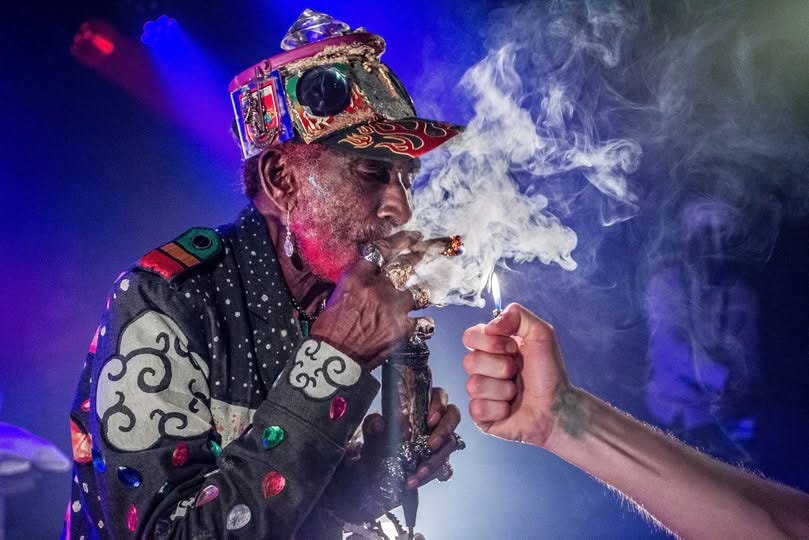
Thinking about Lee Perry (1936 - 2021) this morning.
Interviewer: So tell me about Dub. Where did Dub come from?
Lee Perry: After I see so much people making copies of my original music, singing ugly words on my original music. I say, “Okay, I’m gon’ break a while,” and said, “God, what should I do?” God said, “Give the Reggae to Bob Marley. And let’s make a new thing in the studio called ‘Dub’.” So I really do as God says. So I give Bob Marley Reggae as a present—”Funky Reggae Party.” And then I was free from the Reggae. I go and do my Dub and we create a new scene, and the children they love it ‘til they can’t love it no more.
Interviewer: Where, where did it come from?
Lee Perry: From God.
Interviewer: Where did that sound come from?
Lee Perry: From God.
Interviewer: But was it you? Did you invent Dub?
Lee Perry: That’s what I am. You said it, I am an inventor. I didn’t even know that, but it’s the truth you speak. And that truth coming from the roots.
What is the difference between medicinal use and religious use of marijuana?
If the Controlled Substances Act had made religious use the main criterion for judging viability of drug use we would have seen stores selling sacrament, and millions of folks converting in the first decades of legal ganja. We would have special accommodations made for the sacramental use of the plant. Believers would be permitted to grow, but heretics might be criminals for doing the same act. There would be religious use-only advocacy, formed by those who fear that a general legalization would only come back to harm adherent access.
Phenomenologically there is no difference between taking a drug to change one's spiritual state and sacrificing an animal for that same purpose. The same applies to medicating. Indeed, the Greek pharmakon (a drug) shares a root with pharmakos (a goat). Both involve sacrificing another, to change one's own state of being.
The difference between religious and medicinal marijuana use is the intentions and expectations of the user. That's it.
With the Supreme Court we have, I would think a religious challenge to federal marijuana prohibition would do quite well, and given precedents related to the religious use of otherwise-prohibited substances (i.e., peyote), I could see the Court stipulating a "sincere religious belief" be the condition under which one may be protected from criminal prohibitions.
On the other hand, it is far more in line with Foucauldian understanding that the power/knowledge matrix would shift from a state-centered to a medical framing. Confess your disease and you may be granted absolution and protection.
All this to say, "legalization" that does not meet the same degrees of freedom as medicinal programs in the states that have both, is Jim Crow Cannabis. If patients can grow but non-patients are criminals for the same act, it's Jim Crow Cannabis. If patients may purchase 2 ounces of flower at once but non-patients are limited to just 1 ounce, it's Jim Crow Cannabis. If patients may medicate by smoking in public but that is an offense by anyone else, it’s Jim Crow Cannabis.
The fear that a sudden equalization of medicinal and non-medicinal use would wreak havoc is just as misapplied as the fear legalization would do the same. We have had legalization for over twelve years in two states and more than six years in close to ten of them—a large enough dataset to draw conclusions about deleterious effects. What are they? Where are they? If there is the *least* amount of new or chronic negative impact, why are the prohibitionists silent about it? So far we have kids and dogs eating too many edibles and surviving, of course, because the refined sugar in weed candy is the poison, not the THC. People in legalized states are using more of it and are no longer hiding it. We are not seeing the negative outcomes we were promised by legalization opponents.
No carnage. I voted YES because I was promised carnage, and I got none of it!