Hail! Hail! Michigan...
Visiting the Promised Land

What is the lowest sustainable price per milligram for THC? I ask only because I am spending a few days in southwestern Michigan. I am right across the border from fully-prohibited Indiana, and driving here I could not help but notice the last 20 miles of Interstate 94 peppered with pot shop billboards, each promising a better deal than the last. There is one, largely-symbolic board near the start of it all, courtesy of the State of Indiana reminding the locals about to cross over for their re-up that “MARIJUANA is ILLEGAL in INDIANA.”
Some elected officials would take a look at all the Indiana license plates on cars parked outside border-town dispensaries and want to station state cops to keep a record of comings and goings. Others would rather legalize and keep those cannabis taxes at home. Indiana lawmakers decided instead to ban the advertising. The current billboards are grandfathered in, but absent a successful legal challenge by the ACLU or Indiana NORML, as the contracts expire the ads will disappear.
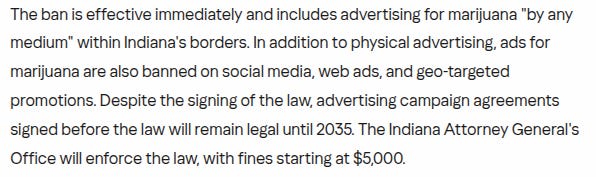
The ban is effective immediately and includes advertising for marijuana "by any medium" within Indiana's borders. In addition to physical advertising, ads for marijuana are also banned on social media, web ads, and geo-targeted promotions. Despite the signing of the law, advertising campaign agreements signed before the law will remain legal until 2035. The Indiana Attorney General's Office will enforce the law, with fines starting at $5,000. — yahoo.com

Just how low are pot prices in New Buffalo, Michigan (year-round population 2,476), the current home of nineteen (19!) cannabis retailers?
Edibles
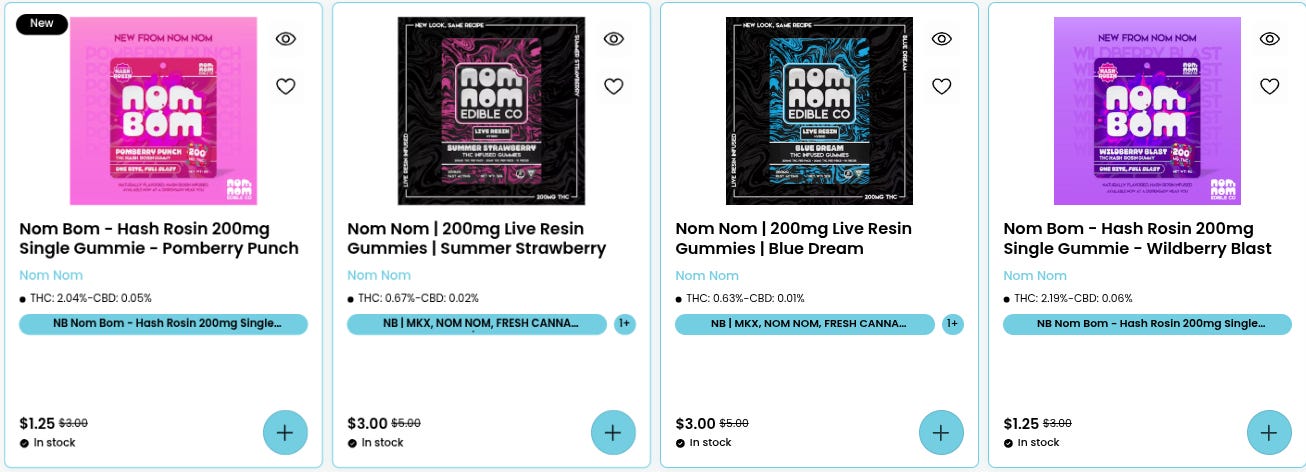
Michigan considers 10 mg THC to be a single dose (many other states have set the dosage at 5 mg) and 200 mg packages are widely available. While the prices listed above reflect sales, the regular price for Hash Rosin gummies is $3 and for Live Resin gummies is $5. THC in edible form can be found everywhere in Buffalo City, Michigan, for under 3 cents a milligram.
In Massachusetts it is rare to find edibles priced at less than 5 cents a milligram THC; prices are routinely 8 cents a milligram or higher.
Flower
Many New Buffalo dispensaries offer 1-cent half-ounces to the first 100 customers in a day, or as a premium for having made a minimum purchase of $50 or more. Similarly, Massachusetts dispensaries will offer a discounted pre-roll as a purchase incentive—with at least $25 purchased, customers at CannaVana in Rockland, Mass. may opt for a $3 pre-roll (about 50% off regular price). It’s not a fair comparison.
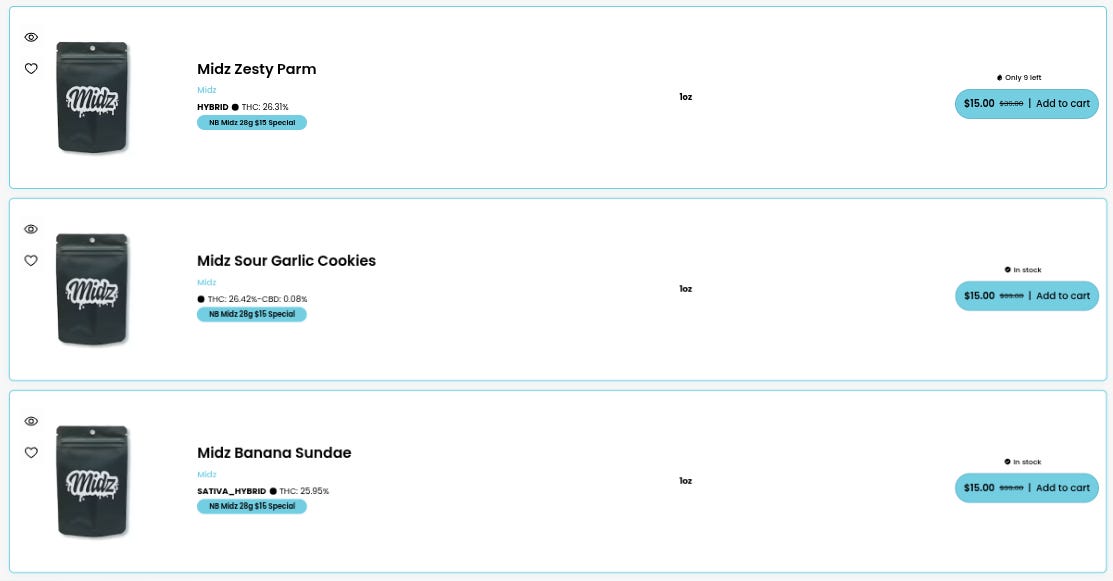
Raw flower products reflect the greatest range in pricing, among Michigan cannabis products, with the aforementioned “free” half-ounce incentives, and regularly-priced ounces ranging from $15 (see below) to over $200.
Cultivation, Synthesis, and Prohibition
I have questioned (and still do) whether the cultivation of THC would be preferred over synthesis for pharmaceutical production. Synthesis offers reliability and predictability of cost and output that cultivation cannot possibly match; the process is both faster (by months) and simpler. Cultivated THC must be separated from the plant and the other cannabinoids the plant may produce, while synthetically-derived THC requires no further distillation. Further, the lesser cannabinoids, such as THCV or CBC are essentially trace bi-products of cultivating plants for THC, and would cost less to produce in volume by themselves.
Due to prohibition, the traditional production methods became the preferred source for medicinal marijuana and the quasi-legal patient cooperatives that sprang up at the end of the 20th century in the U.S. The state forced patients into communities of care outside mainstream, licensed pathways and as such swept them up into the marijuana policy reform movement.

In the hearings on the 1937 Marihuana Tax Act, the American Medical Association’s representative, William C. Woodard, specified that the Act would kill the further exploration and development of cannabis as a medicine. Cannabis had been listed in the U.S. Pharmacopeia since the 1840’s and had been sold as medicine for close to a century, by the time Woodard delivered his testimony. Without the Tax Act, it is likely cannabinoid drugs would have been further developed, synthesized, and been under the control of licensed physicians at the time AIDS was discovered.
Physicians would have held a monopoly on cannabinoid medicine, and the Buyer’s Clubs and patient co-ops built communities and bodies of knowledge that could do nothing other than stand as resistance to twin cultural/criminal prohibitions of the time: Marijuana and Homosexuality.
The social movements spurred by the marginalization of both marijuana users and homosexuals in the U.S. went through parallel phases. From strict criminalization and severe closeting into the development of public advocacy groups and budding normalization, starting in the 1960’s. In the 1990’s as some states recognized “domestic partnerships,” some legalized “medical marijuana;” both actions stood as contravening “national” social mores, if not laws. Both movements saw massive benefits and advancements through the semi-anonymity offered by the early Internet (back when we capitalized the word).
While the “gay rights” movement won landmark cases in state and federal courts, the lone Supreme Court case on medicinal marijuana resulted in a reaffirmation of federal authority though the Commerce Clause. In Gonzales v. Raich the USSC ruled that even when the pot is grown and consumed inside one state, without ever being transferred to another person, that is an act of interstate commerce and the federal government has authority over it.
Unlike the cultural custom-turned-licensed marriage being opened to all who may qualify, the custom-turned-licensed medicinal practice of applying cannabinoids would be forbidden. Patients would have to grow their own medicine, or someone would have to grow it for them.
Concentrates
The cannabis plant is the principal source of THC and while it may produce THC less efficiently than through synthesis, a properly-grown plant will produce thousands of effective doses. The THC and other cannabinoids are most concentrated in the flowering buds of the female plant, though it can be found on fan and “sugar” leaves. The topmost buds are most potent and are sold as-is, but the smaller “popcorn” buds and leaves are processed into concentrates.
Cannabis produces far more leaf than flower, by weight, but through the wonders of science we have learned how to separate the trichomes where the THC is located from the plant material. This is how cannabis concentrates came about. People have been concentrating cannabinoids through hash-making for millennia, whether in Morocco or India. By the 19th century we understood that cannabis could be rendered into alcohol tincture (we would not discover delta-9-THC until the late 1960’s in Israel, since such research was banned in the U.S.), and at-home hash oil making devices were being advertised in High Times in the 1970’s. Hash oil is made by boiling the alcohol off a cannabis tincture—due to heating, hash oil has been decarboxylated and will produce a high when eaten.
The record is not clear who was the first organic chemist to realize that hydrocarbons will bond to cannabinoids and strip them from plant material, or that once that happens the hydrocarbon solvent will boil off (not entirely) at near-ambient temperature, leaving a cannabinoid concentrate. Similarly, simple heat and pressure will create solventless rosin from dry-sift keif:
With the volume of plants being grown, there is almost more bi-product than flower. Cannabis concentrates are used to make a variety of products, including edibles, vape carts, salves and topicals, suppositories, and infused pre-rolls, or they are left in their original form, then volitalized and inhaled by users.
Here is a small selection of concentrates available in New Buffalo. Note, Michigan’s daily purchase limit for cannabis concentrate is 15 grams.
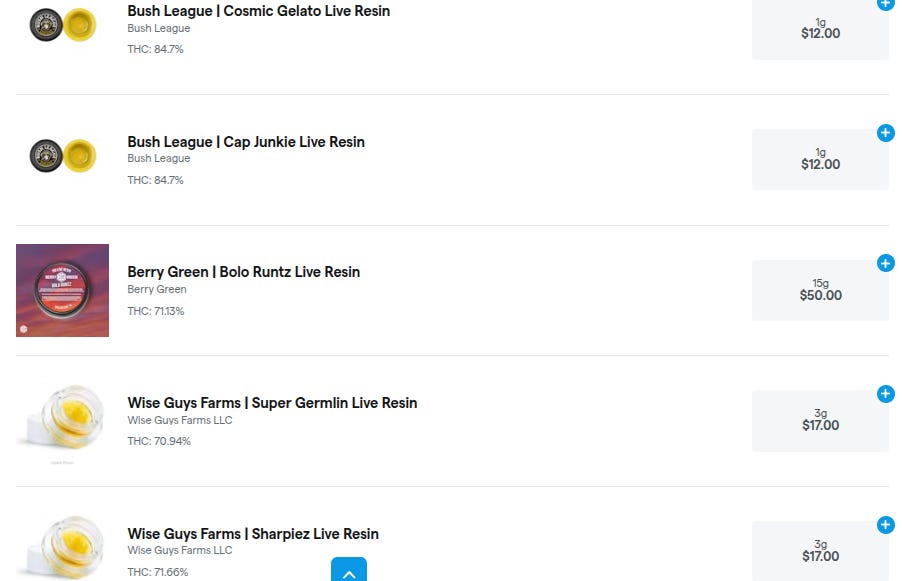
The base price for a single gram of concentrate is $10. In the photo above we can see there are 3-gram packages available for $17, and in the middle the Bolo Runtz Live Resin at 71.13% THC is available at $50 for 15 grams.
The mystical THC maths used by state licensing commissions estimate that each gram of concentrate is equal to just over 5 grams of flower (in reality, it depends on the potency of each). $50 divided by 15 grams is $3.33 a gram for concentrate that is five times its weight in flower. $3.33 a gram in concentrate translates to flower that prices at under 66 cents a gram, retail.
Apparently Michigan cultivators are able to get by on returns of pennies-per-gram.
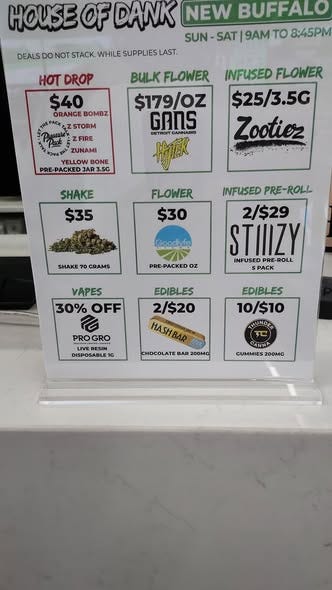
$30 ounces of buds, shake at 50 cents a gram when buying two ounces, and 2000 mg edible THC for $20—those are some of the offers at the House of Dank—far from the only specials to be found among the town’s 19 cannabis retailers.
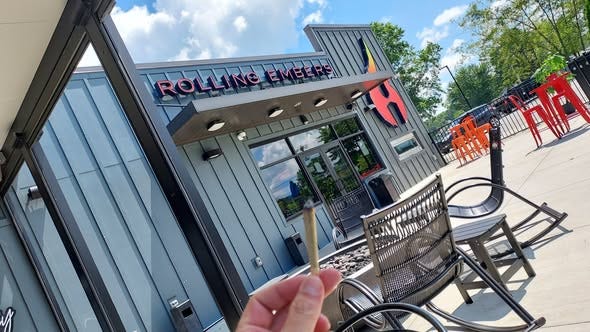
But the highlight of my visit to New Buffalo was discovering the consumption lounge located at Rolling Embers. Like Massachusetts, and too many of the other states that have legalized cannabis, Michigan has yet to figure out how people might get together in a commercial location to consume cannabis. It might seem simple, but decades of Reefer Madness have muddled what legal public consumption might look like, and regulators are not pioneers, by nature.
Native tribes show less confusion, and Rolling Embers is operated by the Pokagon Band of the Potawatomi Tribe. They do not offer the variety of choices found among the three others plainly visible across the streets, or three more in a shopping plaza a few hundred yards away…
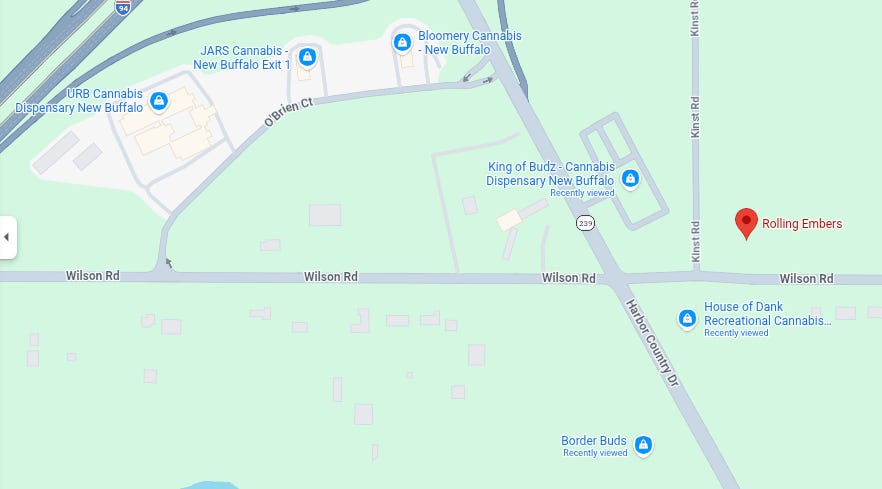
but they have $6 joints for purchase and enjoyment on their outdoor deck. The locals consider the joints overpriced.