
Illicit Education
The unknown-known

Donald Rumsfeld: There are known knowns: There are things we know we know. There are also known unknowns. That is to say, we know there are things we do not know. But there are also unknown unknowns, the ones we don’t know we don’t know.
Missing from Rumsfeld’s cross-tabulation of knowledge and knowing is the field of the Unknown-Known. This is the desmaines of conspiracy theory—

—as well as verifiable, illicit knowledge.

Trafficking in illicit information about marijuana was once NORML’s raison d’etre. While we had criminal prohibitions of any amount of marijuana everywhere, NORML was the clearinghouse for non-prohibitionist information. In cultural partnership with High Times, NORML publicized messages that supported changing the law, while offering historical, medical, economic, and civil libertarian arguments that countered criminalization. From its origin NORML shared otherwise-unpublicized, scientific research findings that countered prohibitionists’ positions on medical use, health risks, criminality, and the cost-effectiveness of prohibition.
The Drug Enforcement Administration was created as part of Drug War I (Nixon). The DEA Administrator has always been charged with suppressing positive information about marijuana. To this day, the DEA is vociferously skeptical of medicinal benefits—witness Joe Biden’s attempt at rescheduling marijuana, thwarted by the DEA. During Drug War II (Reagan-Bush) and beyond the National Institute on Drug Abuse refused to fund public health research that might portray marijuana in a positive light.
NIDA, a member institute of NIH, has as its mission to study factors related to substance abuse and dependence and conducts research on the negative health effects and behavioral consequences associated with the abuse of cannabis and other drugs (NIDA, 2016b). Because cannabis was historically perceived to have only negative effects, the majority of cannabis research has been conducted under the auspices of NIDA.
In fiscal year 2015, studies supported by NIDA accounted for 59.3 percent ($66,078,314) of all NIH spending on cannabinoid research; however, only 16.5 percent ($10,923,472) of NIDA's spending on cannabinoid research supported studies investigating therapeutic properties of cannabinoids.
https://www.ncbi.nlm.nih.gov/books/NBK425757/
“Because cannabis was historically perceived to have only negative effects” recognizes the unscientific foundation of this collection of “scientific findings.” Science is a mode of inquiry—applied with bias, it will produce findings that support desired ends. Prohibitionists then claim the absence of positive findings is proof there are none to be found. They are well-practiced at this. Just listen to them say, “There’s not enough research.”
The most important illicit knowledge related to marijuana, for most people, is how to use it and where to find it. How to cultivate the plant for THC typically comes later in the moral careers of marijuana users. Cannabis is cultivated for three different purposes. We were not supposed to know what those are, as it threatens the argument that any possible value offered by the plant was more than offset by its multiple dangers. Of these, we were well-informed (though always under-informed, according to prohibitionists).
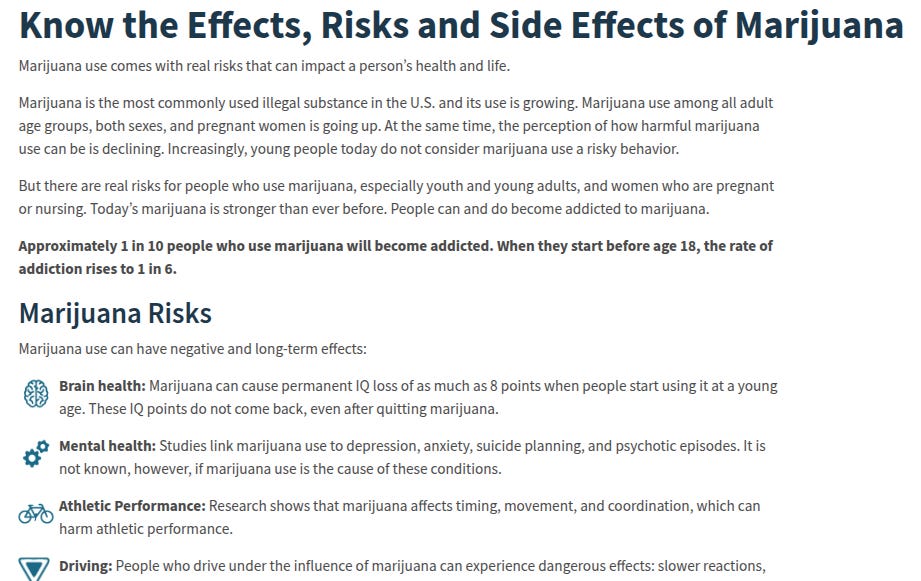
Know the Effects, Risks and Side Effects of Marijuana. From the SAMHSA.
The SAMHSA page does not, of course, list any “Marijuana Benefits.” But, as Richard Klein points out, all drug use (even smoking a tobacco cigarette) has to have some social purpose and benefit. Framing drug consumption as dangerous and criminalization as necessary requires filtering and suppressing information to the contrary. This bleeds out into other authoritarian exercises, regarding all sorts of information.
Teaching knowledge coded as illicit is the most basic resistance to this authoritarianism.
You take a seed. You plant it. You grow it. You dry it. You roll it. You smoke it, and it goes down smooth. —Herbal Nation.