I'm Not Joking
Dissecting the Narrative Joke

Humor is a social construction.
So, what makes a joke funny?


Joke-telling in conversation involves creating a particular “joke-telling” social space—failure to demarcate the space as a joking one may lead to confusion and other undesired responses. In normal conversation the query, “Is this a joke?” highlights the existence of this social space, by declaring its absence. What are the contextual conditions such that when information is provided to an unknowing person that they would recognize such information would serve as a punch-line?
Ethnographer Harvey Sacks has a short, detailed scholarly article where he captures joke-telling by a group of teenage boys. Sacks’ data shows the establishing of the “joke-telling” social space by the question, “Do you want to hear a joke?” There is the proffering of a gift, and the affirmative response by any one of the others establishes the next utterances be considered “unserious.” Sacks also notes that once joke-telling time is established, it opens up occasion to make jokes off the narrative, while it is being delivered. The narrative joke Sacks recorded involved a farmer’s wife, three daughters, and the daughters’ shared wedding night in the farmhouse, told by younger teen boys.

Jokes, such as the one captured by Sacks, also serve as knowledge tests—to “get” the joke requires understanding the context—and the lack thereof exposes the listener. The inability to get a joke when first hearing it can be a learning experience—jokes are effective pedagogical tools—or it can be an in-group demarcation. The “outsider-ness” of the listener who cannot find the humor leaving them susceptible to the joke being “on them.” As such, joking can also serve an informal disciplinary or ranking purpose.
Joking is serious social business.
The implied ranking of the joke-teller and listener, vis-à-vis the subjects of the joking also serve as a form of social control. For example, when a new immigrant population moves into an area there usually is a response by those who consider themselves “native” to the area. The new immigrants’ ethnicity, religion, appearance, and diets are considered invasive and the longer-term residents will create and spread rumors about these. The anxiety and fear of new neighbors, amplified by their apparent differentness, leads to characterizations. Most people understand these characterizations to be fundamentally untrue—it is not the facticity of the characterization that matters, it is the emotional response.
So when Quincy, Massachusetts saw a large in-migration of Chinese citizens beginning in the early 2000’s local residents started joking about Missing Cat posters that had been commonly put up on telephone poles and at the local grocery store for decades.
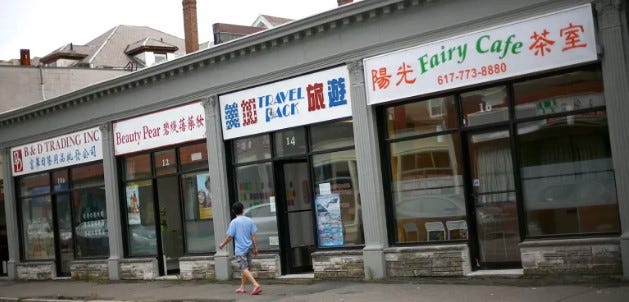
According to the white locals, those cats were definitely being served at the growing number of Chinese restaurants replacing the Irish- and German-American bars and restaurants that once dominated the business district. When people I knew personally made such comments, it was not because they believed the food they ordered had cat meat. It was merely their expressing anxiety about their new neighbors and changing neighborhood.
Jokes both cause and relieve anxiety, and are therefore commonly found among anxious people as expressions of their uncertainty. The in-group/out-group delineation also serves groups that are sensing encroachments (data show that when just 10% of a previously all-white American neighborhood is replaced by an outsider group, the locals perceive it as more than 30% new neighbors, and when the number climbs to an actual 20%, the white locals perceive it as 50%).
The Narrative Joke
It was the grand opening of the new tallest building in North America, and the builders were holding a VIP party on the rooftop to celebrate. People were dressed in formal clothes, eating fancy food, and drinking expensive champagne.

There was a gentleman standing right at the edge of the roof, and another walked over from the bar and began to make conversation, “Lovely evening, isn’t it?”
“It certainly is,” came the response, “I am prouder of this building than any other I have designed.”
“Oh, you’re an architect?”
“Yes, and I designed this to be my safest building. You’ll notice there is no guard railing right here at the edge of the tallest building in North America, and that is because as the prevailing winds come off the shore and travel vertically up the side of the building, meaning no one can fall to their death from here.”
“Oh, I don’t believe that.”
“No, really. Let me show you.” With that, the gentleman put down his drink, went to the very edge, and stepped off. He did not scream or flail as he fell further and further. When it seemed he was sure to hit the ground, his descent slowed, and he started rising up the side of the building, to come to a soft landing, right back where he stepped off.
“Oh, wow! I gotta try that!”
He went to the edge and stepped off. He, too, remained calm as he fell further and further. Only he never slowed—he just splattered all over the sidewalk.
The gentleman walked back to the bar and asked for another martini.
“Superman,” said the bartender, “You can be a real asshole when you are drinking.”
The story is the manifest narrative, what we all hear—tallest building in North America, cocktail reception, an architect, a thrill-seeker, and a tragic death.
When the latent narrative — the actual story — is exposed, we call it the “punch-line.”
The way to ruin every narrative joke is to expose the latent narrative too early. “It was the grand opening of the new tallest building, and Superman was in attendance, dressed in a tuxedo…” makes the story cruel. Which is, of course, the joke. Superman has a drinking problem.