Imagine
The future is certain, give us time to work it out.

Popular music has shown us that both contrarian and deeply philosophical lyrics could be made palatable to the average American, if the message comes with a catchy melody and is regularly played on the radio or MTV.
Take this paean to post-nationalist Communism, popularized by the late John Lennon:
Imagine there’s no countries
It isn’t hard to do
Nothing to kill or die for
And no religion, too
Imagine all the people
Living life in peace.
You may say I’m a dreamer
But I’m not the only one
I hope someday you’ll join us
And the world will be as one.
Imagine no possessions
I wonder if you can
No need for greed or hunger
A brotherhood of man.
Imagine all the people
Sharing all the world.
In terms of messaging, “Imagine” is a companion piece to The Manifesto of the Communist Party. “Imaginers of all nations, unite!”
Indeed, Marx and Engels deduced that the rise of the Proletariat would involve a series of fundamental social changes. As you read through them, imagine the opposite and think of when you may have heard Republicans arguing in that direction:
1. Abolition of property in land and application of all rents of land to public purposes. 2. A heavy progressive or graduated income tax.
3. Abolition of all rights of inheritance.
4. Confiscation of the property of all emigrants and rebels.
5. Centralisation of credit in the hands of the state, by means of a national bank with State capital and an exclusive monopoly.
6. Centralisation of the means of communication and transport in the hands of the State.
7. Extension of factories and instruments of production owned by the State; the bringing into cultivation of waste-lands, and the improvement of the soil generally in accordance with a common plan.
8. Equal liability of all to work. Establishment of industrial armies, especially for agriculture.
9. Combination of agriculture with manufacturing industries; gradual abolition of all the distinction between town and country by a more equable distribution of the populace over the country.
10. Free education for all children in public schools. Abolition of children’s factory labour in its present form. Combination of education with industrial production, &c, &c.
—Marx, K. & F. Engels. 1848. The Communist Manifesto. Pp. 48-49.
Marx and Engels, applying a scientific methodology and empiricism, created a political economy. Following what they had already observed in capitalist economies (both macro- and micro-), they drew conclusions about what would be expected to happen as Capital progressed. Central to their conclusions was a positivism that ignored the possibility for a regression to Feudal relations of production.
The Manifesto was published in early 1848. It was meant to be a polemic, to stir the emotions of literate laborers. And well it should have, as a dispassionate, empirical analysis of capitalism showed it to be a social stratification machine that would never, despite promises, offer the large majority a better quality of life than wage-slavery.
Note that when Marx and Engels were writing about wage-slavery that chattel slavery was in full swing in the American South. They were not simply moving the concept of slavery into a capitalist form of production and equating workers to slaves. The people who lack capital are physically coerced to enter the marketplace to sell their labor-power for a wage. The wage—which commodifies labor-power—is the means by which the Bourgeois ensures the relations of production and mobilizes all value to move from the point of production into Capital, where they may monopolize it.
Certain relationships, such as between the Bourgeois and Proletariat, as well as between buyers and sellers of other commodities, must therefore be in conflict. All exchange is contested, where each participant is attempting to gain the greatest advantage. Over whom? Over their business partner, or their customer, or their employee. An economic form that pits all against all would undoubtedly be a most active one, but we cannot operate a society in such a way for very long. That is why we create all sorts of moral guardrails by which we generally agree to comport.
While it is unacceptable for an employee to pull $100 out of the till on their way home from work, employees are routinely shorted on promised work hours or paychecks, without much recourse. The general public condemns the petty thief, but ignores the institutional one. They have been told it is morally wrong to steal.
The operation of the wage system, however, means the worker is paid for their first hour of work many days later. By design, the worker must produce much more value than their wage, so their labor pays for their productivity in the first few hours of a week’s work and then works essentially unpaid for the remainder of the value they produce that week.
If the worker doesn’t like it, they can get another job. But they cannot. All jobs operate in the same manner. All the worker can do is try to mitigate their rate of exploitation (i.e., find a better-paying job), they cannot opt out of exploitation.

Only under capitalism do we have wage-slavery. It is not present in prior historical eras or societies; it is not natural.
While there are material elements to production and there are natural limits to both the quantity of those materials as well as economic limits on the costs of extraction and transportation, the distribution of value is purely social. There is nothing natural about it.
Capitalism has a problem that manifests in the distribution of value. Add voting to the mix, and we have to construct castles in the clouds to explain why it is in the interests of the large majority to see the economy fail them. Forty-five years of Neoliberal policies forced more and more value from the shop or office floor, upward. The more the bottom 80% produced, the harder they worked, the relatively poorer they became. The Trump Administration is addressing the problem of a falling quality of life by firing people who measured such things, and not publicizing data that shines a poor light upon the Administration.
Neoliberalism was justified at first by promising that wealth would “trickle down.” The least familiarity with how capitalism operates showed this to be a bald-faced lie, but most Americans bought it because teaching how capitalism empirically, materially, and dispassionately operates was made illegal in the 1910’s, again in the 1940’s & 50’s, and again in the 1980’s. With Kamala Harris and Donald Trump recently demonizing each other with the same word, we will see further marginalization of “communism.” Regardless of the political party, both agree the real enemy is not (capitalism-in-decay) Fascism, but Communism.
The critique of Capital is not communist, but it sounds like it, to capitalists. They, too, are uneducated about how their favorite economic form actually operates. They think it offers rewards for hard work, not understanding the reason workers are always told to work harder is because hard work keeps them where they are.
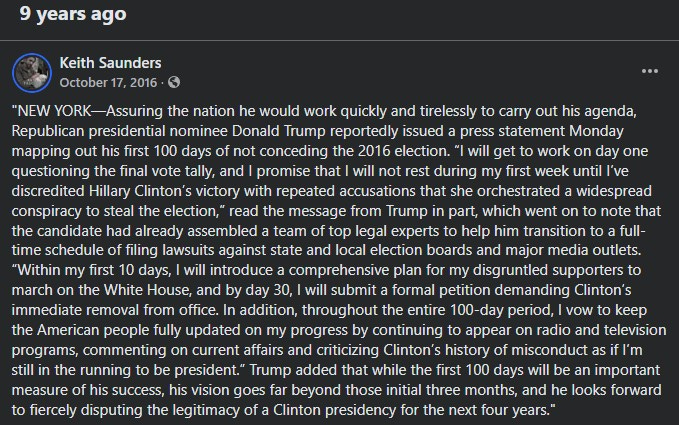
As for fortune-telling, I misread the polling and thought Trump was bound to lose in 2016. It turns out that I was just four years ahead. From Facebook:
NEW YORK—Assuring the nation he would work quickly and tirelessly to carry out his agenda, Republican presidential nominee Donald Trump reportedly issued a press statement Monday mapping out his first 100 days of not conceding the 2016 election. “I will get to work on day one questioning the final vote tally, and I promise that I will not rest during my first week until I’ve discredited Hillary Clinton’s victory with repeated accusations that she orchestrated a widespread conspiracy to steal the election,” read the message from Trump in part, which went on to note that the candidate had already assembled a team of top legal experts to help him transition to a full-time schedule of filing lawsuits against state and local election boards and major media outlets. “Within my first 10 days, I will introduce a comprehensive plan for my disgruntled supporters to march on the White House, and by day 30, I will submit a formal petition demanding Clinton’s immediate removal from office. In addition, throughout the entire 100-day period, I vow to keep the American people fully updated on my progress by continuing to appear on radio and television programs, commenting on current affairs and criticizing Clinton’s history of misconduct as if I’m still in the running to be president.” Trump added that while the first 100 days will be an important measure of his success, his vision goes far beyond those initial three months, and he looks forward to fiercely disputing the legitimacy of a Clinton presidency for the next four years.