
Institutionalized Sexism
Homophilia and Board Composition

Overview
This data comes from a study I did of a nonprofit organization’s board of directors. Data was gathered from public documents and via interviews with longstanding board members. The scope of the study was to determine the factors that attracted people to serve on the board, how long and in what capacities they served, why they departed from the board, and whether the subject was male or female.
The discussion has been excerpted and anonymized from my original study. The data illustrates how a self-selected body might introduce homophilial biases—preferring new members who resemble existing members—which lead to institutionalized sexism in board composition.
Discussion
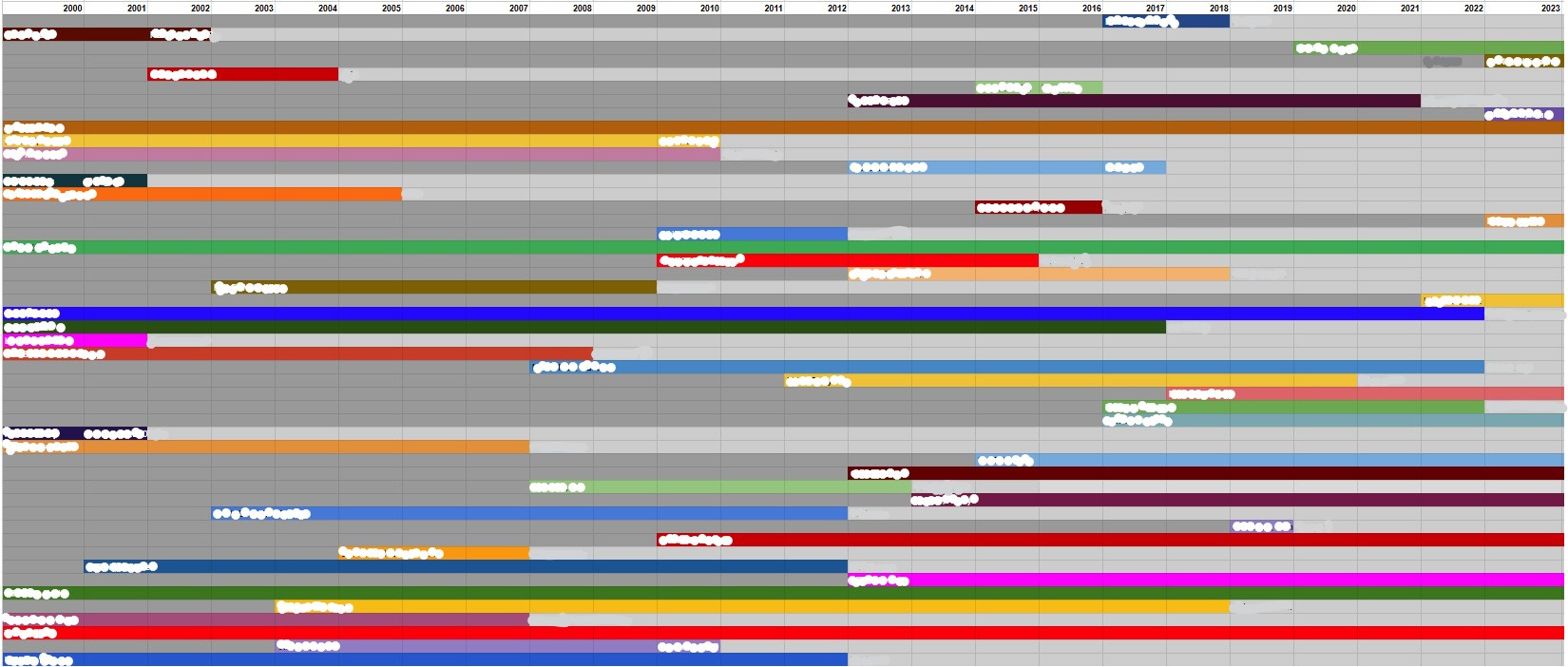
Since 2000, The Board of Directors has had 49 individual members, on a board that has had a mean of 16.875 members (range: 14 - 20, mode=17 (7)) in its 24 incarnations.
The Board has had a total of 34 men (69.4%) and 15 women (30.6%) serving on it during this time. Board composition by sex has varied slightly over the years, ranging from 73.3% - 88.2% for men and 11.8% - 26.7% for women. The board was least imbalanced in 2018, with 19 members (14M/5W), and most imbalanced in 2013 & 2014, with 17 members (15M/2W). The largest number of men on the board at once was 17 (85%) in 2015, the smallest was 12 (75%) in 2002. The “average” board has 14 men and 3 women.
Board member tenure differs by sex as well, with women in the study serving an average of 5.2 years and men serving an average of 9.5 years. Terms are three years, so on average less than two terms for women and over three terms for men.
The board has five male outliers, four of whom were on the board every year of the study, and one for 23 of the 24 years. Removing the five outliers changes the mean service time to 6.85 years for men, or over two terms. Removing the outliers from previous board composition ratios would not have brought the board into balance however, with the closest being a 7/4 split in 2002. The 2023 board would be a 9/3 split, absent the outliers.
This board of directors has a persistent overrepresentation of men, and if it has made any attempts to correct this imbalance over the past 23 years, it has been by bringing on 4 new women for every 6 new men. This shortcoming is exacerbated by women being twice as likely to depart the board as men, resulting in a retention of 2 new women for every 5 new men.
Women have not held positions of board Chair, Treasurer, or Secretary since before 2010, if ever. When one woman member who had served for seven years expressed her desire to be board Chair, the board changed the bylaws to create a “vice-Chair” position for her and assigned a 3-consecutive-year term limit on the Chair. She left the board before the third year and a man has since occupied the vice-Chair position.
Until 2022, nominations for board seats were produced through informal discussions among senior board members, and between 2011 - 2022 there was never a competitive election for a board seat. In 2022 the board formed a committee that presented ten nominees for three seats, at the 2023 annual meeting. As of November, 2023, there was no plan to fill any seats on the board at the 2024 annual meeting.
A board that has always been 3:1 or 4:1 in favor of men has been keeping itself that way, despite expressed desires to change that ratio. No male member of the board sees himself as overtly sexist or intentionally discriminating against women. By the same token, the board is incapable of retaining most women members for more than two terms–just four of the eleven women in the study served more than two terms on the board.
Conclusion
The imbalance of men and women on the board since 2000 has been exacerbated by a cohort of five men who served a combined 143 years (In this same time all eleven women on the board have served for a combined 78 years). However if these five men were not present the “average” board would become 9 men and 3 women. Removing these five from the composition of any year’s board would still leave women with less than 40% of the vote in the year closest to parity (2002).
Past efforts to more closely balance board membership have failed due to the imbalance in new memberships (4 women for every 6 men) and women’s attrition at twice the rate of men. Without addressing the faster rate of attrition, admitting new members in equal proportion will not balance board membership.
The means to achieve parity is not to remove men from the board, but to add women in such numbers that they are considered viable candidates for leadership positions by their fellow women board members. As women’s claims of leadership are validated by their fellow board members, membership on the board will be more appealing to women and their tenures should increase to meet men’s–especially as the outlying cohort departs the board (Recall there remains a 1.6 year/1 term difference between men’s and women’s tenures, minus the outliers).
There is a need to formalize board member nominations, to prevent unconscious biases and to incorporate a vetting process that may involve all members of the board. As it did in 2022, this will open nominations to more candidates than seats and make elections more selective and competitive, generally improving the quality of the board. The board should maintain a pool of nominees and formally discontinue the practice of nominating and voting a person onto the board at the same meeting.
The risk in consciously seeking a parity of men and women on the board is the board may inadvertently skew to women-majority, and should this become institutionalized over a period of decades, steps may need to be taken to make membership on the board more appealing to men.