
Justice Systems
The case for human fallibility

We need a new constitution. Keep that which worked from the old one, but if there is to be a democratically-determined social order in the future, we must do better than the one we had.
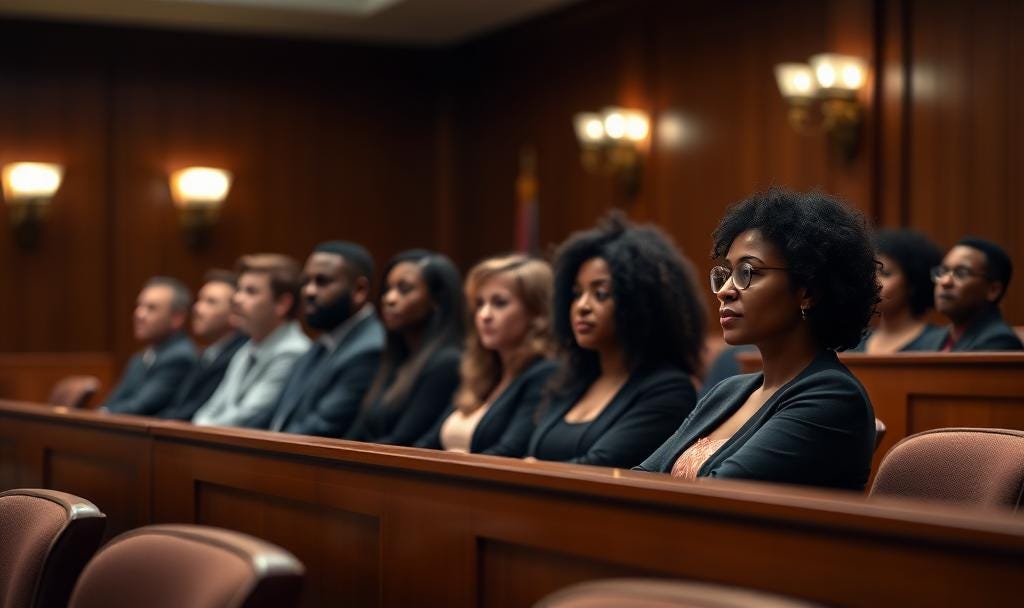
We need to preserve uniform due process (there will be talk soon about separate forms, for different classes of people), as well as uniform citizenship (there will be proposals for first-, second-, and third-class—they won’t use THOSE names—citizens). We need to preserve jury trials with human beings.
The inclination is going to be to surrender to “objective, rational” justice through applied technology. Artificial intelligence is already being used by casinos to catch people card-counting while playing Blackjack, it was put into physical and commercial use by Amazon in “cash-free” stores where shoplifting was made impossible, and telemetry records from colliding cars are retrieved from their operating systems and used by insurance companies to determine fault in auto crashes.
Advocates for computerized justice will present the same rationale that was used to make mandatory minimum prison sentences for drug crimes acceptable—every offender gets the same punishment, there is no subjectivity that may intervene, no bleeding heart judge to offer less-than-punitive sentencing.
That brings up another, related question: What is the purpose of justice? Punishment or rehabilitation? Vengeance or resocialization? If we are to apply restorative justice, how do we accommodate for inequalities that preceded the offense? Dollar-for-dollar renders those with the most money undeterred from committing violations, while those with the least become incapable of remuneration. The injustice of the situation a priori cannot be justice, by being restored.
The UK is testing computer modeling that is purported to identify people likely to commit homicide. Philip K. Dick called this approach “pre-crime,” in his dystopian science fiction story Minority Report.
Statistically, the person most likely to intentionally kill you, is YOU. Perhaps they should just set the screener to detect suicidal ideation. It will save more lives and won’t unleash the horror of being told, “You are a danger to those around you and we will be keeping an eye on you for OUR safety.”
The UK’s model relies on prior convictions, so it is only being used on those who have already been caught and convicted. Do you perhaps see how a bias may develop in their data? Could there be intervening variables that separate those who have been caught and convicted from those who were only caught, but not convicted? How about those who have never been caught?
It reminds me of an old study of prisoner IQ, that showed prisoners have lower average IQ than the population as a whole. The study was internally valid, but the conclusion that criminals have lower average IQ was never tested. The fallacy in the conclusion was in two directions: Not all criminals were prisoners, and not all prisoners were criminals.
For several years I used to run a jury exercise as part of an Intro to Sociology course offered by the “Alternative Freshman Year” program at Northeastern University. Enrollments were capped at fifteen per class, so a jury format worked well. We watched Paradise Lost: The Child Murders in Robin Hood Hills, a true crime documentary I discovered when the producers were highlighted in my undergraduate alumni magazine.

The film presented the story of three boys under the age of 10 whose bodies were found in a waterlogged ditch in the woods between the trailer park where they lived and an Interstate highway truck wash. They had been tied and mutilated by the killer(s). The police targeted three older teens who also lived in the trailer park. The movie presents the prosecution and defense teams examining the evidence, the townsfolk—including the parents of the deceased and the accused—and their understanding of events, and portions of the trial.
I would stop the film at the time the jury goes into deliberation and then would instruct the class to choose a foreperson and come to a unanimous decision as to whether the three accused were guilty or not guilty of the crimes. My role then was only to clarify evidence, after they unanimously agreed on what question to ask.
The first deliberations were usually animated, as the timing left us with close to half an hour. Not once in close to a dozen runs of the exercise did a jury reach a unanimous verdict in the first half hour. A couple juries reached a verdict in the second day, but most still had three or four people who did not agree with the majority. Day three of deliberations brought pressure. This exercise was conducted in the middle of the term, so there were exams upcoming, other paper assignments, and other readings to do. It took over two class meetings to watch the film, and now they were in the fourth full class meeting—more than a week.
“What about the other work we have?” someone would ask. “Real-life juries have work and outside obligations, too,” I would reply.
I learned that when a small group is required to come to a unanimous decision as American juries are, one of the chief considerations has to do with absolutely everything other than what they are coming to decide. The inclination, then, is to default. The default condition when the burden of proof is on the state is not guilty. This important safeguard needs to be preserved.
More information on the murders and the accused can be found here.
#BankruptElon