
Long Knives
Did Pete Hegseth's plan for a coup get thwarted?

What do people mean when they say they do not want “political violence”?
Given more frequent use of the phrase following recent shootings of elected officials and a podcaster whose main focus was pumping a politics of division, we might think “political violence” is violence enacted against an individual who is strongly affiliated with electoral politics in some way. In other words, an assassination.
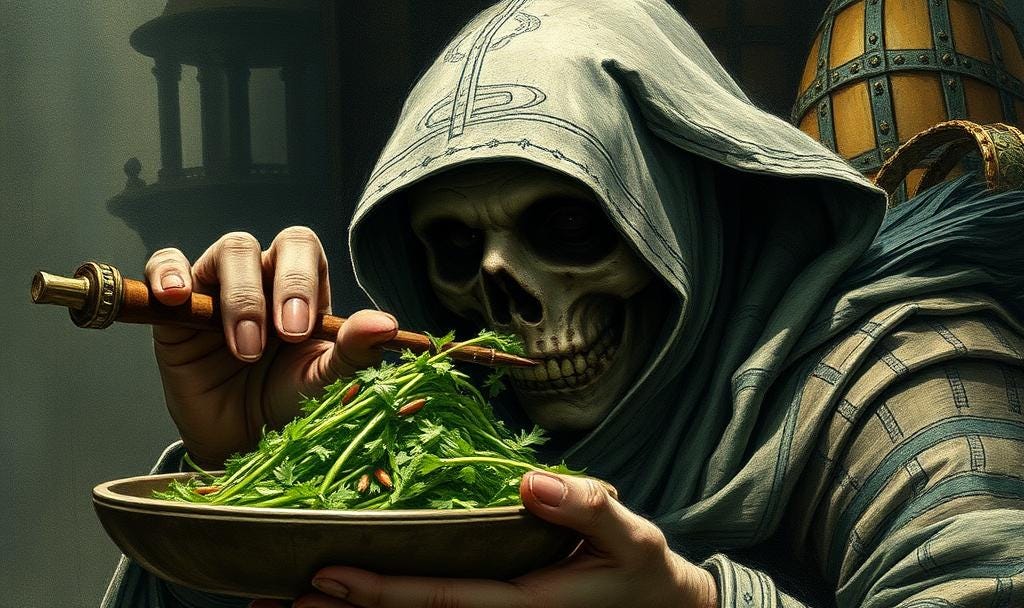
The word “assassin” comes from hashishan, or “hashish eater.” With the right mindset and setting, any drug can be used as a performance-enhancing substance.
Assassination is a noteworthy form of political violence in its suddenness and permanence, and the status of the victims. But if we are to consider political violence to extend beyond homicide, to include violence done to a people (a polis) for the sake of exercising social power over them, we would have to include larger, institutional, and more chronic phenomena like famine, genocide, and mass imprisonment.
When, at a very special meeting of top-ranking military members, a President promises they will be “training” ground troops in U.S. cities with U.S. citizens as the occupied population, that is political violence, too.
There is an essential difference between an opinion and a call to action. By definition an opinion stands alone and cannot be incorrect. Disagreement with an opinion does not invalidate the opinion or the person holding it. The New York Yankees may be your favorite baseball team. Whether others hate the Yankees or have never had a thought about them, your opinion has no effect on the Yankees or anyone else.
A call to action on the other hand, is often contextualized by using opinions—they are given as reasons for taking the action. When an opinion is used as a reason for action, it is no longer just an opinion. While opinions themselves cannot be wrong, they can be based on falsehoods or wrong beliefs. When an opinion is wrong, the actions called for in the name of the opinion will also be wrong.
Take Drunk-on-War Pete Hegseth, who iterated his opinions about women in combat service. We have to assume as a platoon commander deployed in combat, Hegseth was aware of the standards that the soldiers under him were to have met. He would also have been aware that there is no difference in standards among service members. Every general in that room knew it, too.
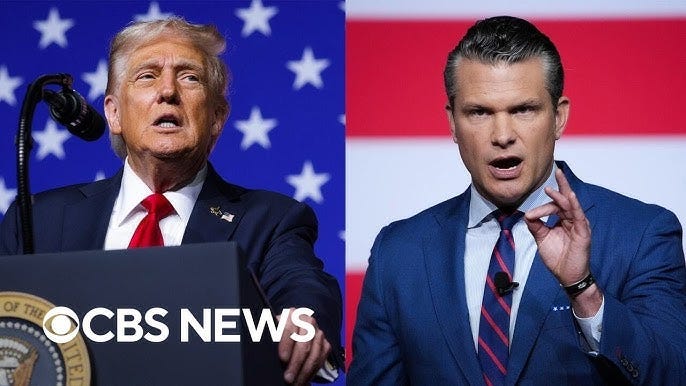
If Hegseth lasts through October, it will only be due to the Peter principle—there is no higher level of incompetence for him to achieve. It’s probably better to have a SecDef who either ranked as a general or admiral, or to have had no military experience at all. None of the people in that room inherited their rank, and all of them well-outranked Hegseth when he was a soldier; they sat and listened to Whiskey Pete’s fantasy of how the military operates. They knew he was full of shit when he complained the military had lowered standards, among other things.
A teacher that loses students’ respect is done; it becomes impossible to lead such a class. Not that Hegseth was ever much of a leader, anyway. While he complained about unqualified soldiers, everyone knew he was the least-qualified “soldier” in that room, other than the President. And not for nothing—complaining that “fat generals” are “not a good look” is probably better mentioned when we do not have the most obese president since Taft, sitting in the White House.
On September 25 the Washington Post reported that Hegseth was calling the generals back to Quantico, VA.
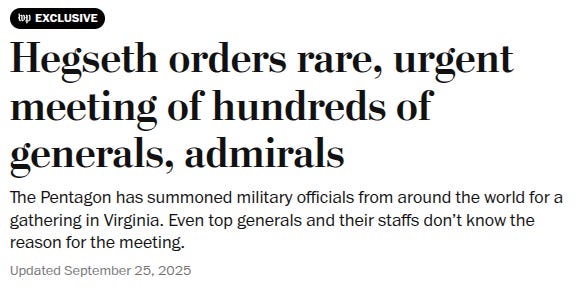
Hegseth orders rare, urgent meeting of hundreds of generals, admirals.
The Pentagon has summoned military officials from around the world for a gathering in Virginia. Even top generals and their staffs don’t know the reason for the meeting.
September 25, 2025
Trump seemingly had no idea that Hegseth called them to assemble, and Pete’s plan was changed to revealed to be an in-person pep talk. Something that would normally have taken place via a Zoom call or memorandum. Trump saw the threat for what it was. Would the generals continue to follow him, follow Hegseth, or would they take control of the nation themselves? He had to be there. He had to show he was still in charge. On Sunday, September 28, Trump said he would be at the meeting.

Trump says he’ll attend Pete Hegseth’s gathering of generals to tell them ‘how well we’re doing militarily’
In an interview with NBC News, Trump discussed the meeting and what he’ll tell military leaders: “You know the expression ‘esprit de corps’? That’s all it’s about.”
So it became a Trump rally, of course, though with less overt bloodthirstiness among the crowd. He prattled about personal grievances and how unfair everything is to him, and made the grand announcement he plans to ignore posse comitatus. Thanks to the Coup Court, there’s nothing we can do within the parameters of the legal system when the President shits all over this law, and with it our freedom. We have a lawless Executive, who must be corrected.
Coups follow coups because the first one showed a government was incapable of maintaining itself, and the new regime does not have the chance to stabilize. Pay attention to what happened in Egypt and South Korea. The U.S. military remains fundamentally of the People—we have not fully replaced human soldiers with automatons and AI—and draws its soldiers and officers from them.
While the American Empire’s military exists to enact global political violence, and it is the most effective death and destruction machine humans have ever created, the people involved seek legitimacy for their actions. Self-defense, revenge, preemptive intervention, “stability,” these are the legitimizing contexts for military action. Imaginary wars in American cities whose offense was never having given Trump an election victory? Not so much.