
Losing Faith
Opening the Epstein Files will make the remaining believers believe more strongly.

I am not a religious person. I was raised without religious practices—my father was a lapsed Catholic and my mother’s father was a practicing Jew who married a shiksa and died three months prior to my mother’s birth. Perhaps because of this, I am fascinated by ideological constructions. Philosophically, I am a materialist, so my concerns are principally with the Earthly elements of faith. Things like how religions form, what their sign systems say about the social order, and why people move in and out of religious groups.
For the entirety of my senior year at Colgate University, I studied religious conversion while observing the Jewish calendar. To a lesser extent I looked at the loss of faith, or conversion to faithlessness, as the case may happen. A lot of attention has been paid to “deprogramming” members of cults, but subscription to religious ontology in a secular America has become an increasingly tenuous relationship between believer and belief.
People move “both ways,” from secular agnosticism into a faith-based belief system, as well as out of belief systems. The conversion to faithlessness has been more common in the late 20th and early 21st century, but that does not itself indicate a triumph or superiority of secularism, nor is it the product of an explicitly secular nation-state.
Congress shall make no law respecting an establishment of religion, or prohibiting the free exercise thereof; or abridging the freedom of speech, or of the press; or the right of the people peaceably to assemble, and to petition the Government for a redress of grievances.
The Roberts Court has taken the mandate to neither respect nor prohibit religious belief and exercise to mean the state shall not infringe upon religious exercises that may not comport with other civil rights, such as marriage or public access. “Sincerely-held religious belief” is now a legal standard, though there is no objective measure of sincerity, and the loss of faith has often been described as instantaneous. One’s belief being sincere is a far step from one’s belief being secure; with “sincerity” specifically employed in place of security!
Believers refer to it as a “test of faith.” When faith is insecure, be more sincere.

On a related note, offering “thoughts and prayers” in a time of crisis is telling people whose faith may be shaken to keep the faith. The “help” that is offered is in the interest of maintaining the collective strength of faith, not to resolve the crisis or prevent it from recurring. Plus, thoughts and prayers are limitless and cost nothing, so go ahead and take as many as you want.
It should come as no surprise that the population of an explicitly secular nation-state would germinate a thousand new religious sects, or that their political movements would reinterpret ancient scriptures and figures, to serve modern ends.
John Humphrey Noyes started three separate religious movements in his lifetime. Each one of them centered around the practice of “complex marriage,” or what came to be termed “polyamory” in the late 20th century. The Oneida Community practiced free love a century before the concept hit the TV airwaves. Noyes’s was not a possessive polygyny, but plenty of other sect leaders have made universal claims upon female members, regardless of their ages.
Marx and Engels noted in 1848—concurrent with Noyes—that “the Bourgeois share a system of wives and concubines in common.” The historical materialist in me points to the mimicry of Bourgeois behaviors among the fledgling professional and managerial middle class. Religious manifestations of social class relations are found across historical eras—animism to polytheism to monotheism to secularism—each reflecting a new division of labor and relations of production. Where do we go, beyond secularism? The seeming absence of any next stage of mysticism contributed to Marxist Positivism regarding social class revolution.
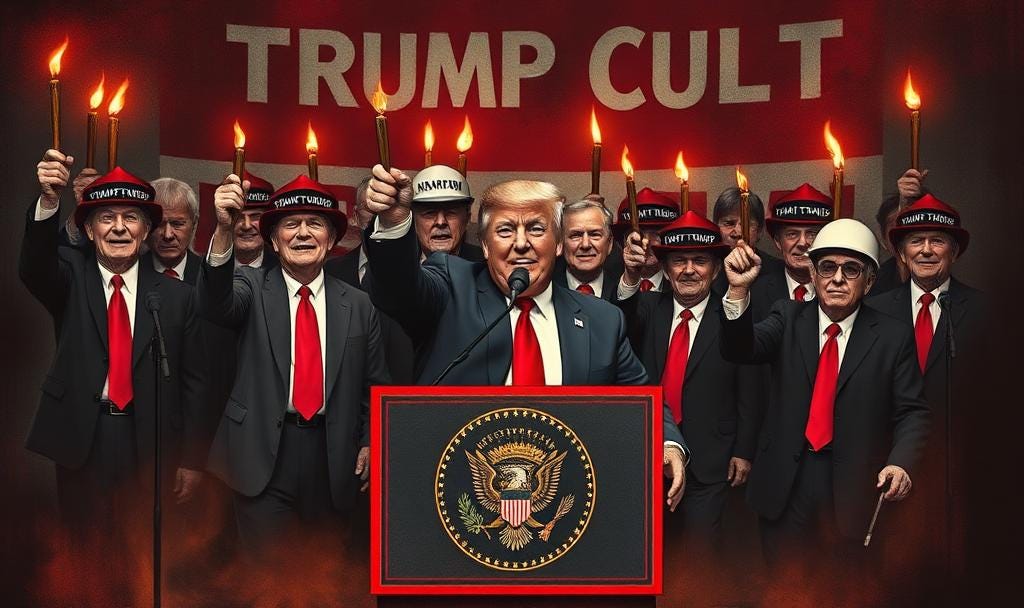
The Trump cult is not unlike many other cults that follow a male leader who insists on deflowering the group’s virgin brides on their wedding nights. The concern about pedophilia is offset by cultic acceptance that the leader sets his own norms.
Child sexual abuse commonly happens under religious auspices. The cultic qualities of MAGA will insulate Trump from a full reckoning, because they have always done so. Back in 2015, the perception was that Trump was as vulnerable as any other candidate to the Gary Hart effect. Sexual scandal had derailed Hart’s campaign and career, it blunted Bill Clinton’s effectiveness through his second term, and a child out of wedlock (while his wife suffered the cancer that killed her) ended the promising political career of John Edwards. Despite (or perhaps because of) Trump being Republican, the belief at the time was he was going to be hurt by the Entertainment Tonight audiotape.
When Prophecy Fails is a sociological study of UFO cults in the mid-20th century. When prophecy fails, members’ faith is tested and these tests are turned back into demonstrating commitment to the faith, by the leadership. Proselytizing exercises work the same way—followers are sent into a harsh and unwelcoming outside world to spread faith and are confronted with rejection. They return to the cult from a full day of their outsider-ness being reinforced, to where their insider-ness is reaffirmed. This is also why everyday, innocent expressions of welcome or friendliness to proselytes are returned with eager invitations to join the cult—this person is not rejecting us.
Many cults and other small groups such as gangs require body modification as a mark of membership. Whether it be tattoos, branding, amputation of a fingertip or earlobe—the member shows commitment through changing their physical appearance. The Trump Cult esteems women having facial reconstruction as a mark of deep membership (“Mar-a-Lago face”).

As with all cults, the prophecies set the group’s goals and aspirations. They never grant too much attention to the material world, Even when they involve building a compound or operating a business to sustain operations, these actions are done for future reward. The reward never comes in the material plane, aside from those who control the material wealth, whose power itself is evidence of their having been the Chosen Ones.
It comes as no surprise that a cult leader would rely on a politics of Us and Them.