
Management Styles
Volunteers and stigmas

While some folks claim to have a “management style,” in my experience, effective management has to be adjusted for circumstances. Not merely the situation at the time, but one must consider how the structure of the group, the goals of the group and its members (not always the same, group-to-member or member-to-member), the societal milieu (cultures, politics, identities, statuses) of concern, and the amounts and forms of available resources (both volume and pathways) call for different approaches.
One-tool managers have their place; but when it’s the wrong fit, things can go south quickly. I have seen a talented, high-end restaurant kitchen expediter fall apart when charged with running a baseball team of 16- to 18-year-olds. It was a matter of different people, different motivations, different settings, and different resources—about the only thing that was the same is the fact that losing your crew’s respect means failure will follow.
I spent over two years observing the Massachusetts Cannabis Reform Coalition as a non-member, joining only after having completed my doctorate for my study of them and other marijuana policy reform groups. I was elected to the coalition’s board in March, 2003—it was as much my willingness to serve as anything else that won me the seat, as I recall. Although MassCann was an established and relatively popular NORML affiliate at the time—known for hosting the Boston Freedom Rally—there were but a dozen or so core members who attended most all monthly meetings and otherwise put time into making the organization real by doing things in its name.
Hurricane Irene washed out the 2004 Freedom Rally and brought substantial debt to the nonprofit. Multiple board members had to visit ATM’s near Boston Common to put together a four-figure cash loan to the nonprofit, just to cover unavoidable day-of-event payments. Four months later the coalition’s President Bill Downing, citing family and business obligations, asked me to run for the seat with his endorsement. I told him I would if the current membership would pledge two hours a month to MassCann. I wanted one full day of effort per year, for reform, for legalization, for the sake of getting high with each other…whatever personal motivation someone might have.
I was not demanding anything of substance at the moment, and we were six months beyond having fallen over $20,000 in debt, so anyone who was still sticking around and paying up for another year of membership was already showing commitment.
But the very first step of effective leadership of volunteers is to set an easily-achieved goal. Getting people to acknowledge a commitment to MassCann and its mission built group solidarity—having them do so in the face of greater-than-normal adversity strengthened this social cohesion. Fraternities and the United States Marine Corps haze their newest members by putting them through physical and mental trials in cohorts; though the two are very different types of organizations, calling for different membership and leadership traits.
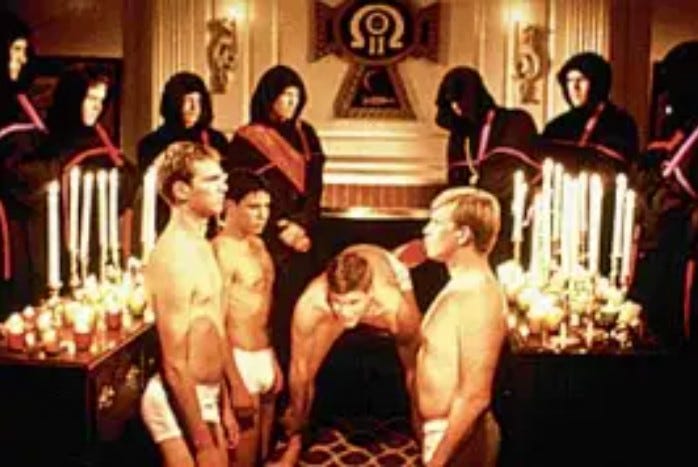
Stripping recruits naked in front of each other is common among resocialization institutions, be they boot camps, prisons, or frat houses. With MassCann, members exposed ourselves to each other as criminals—that would normally be enough to forge a group cohesion, but we were volunteering to be in the financial hole, as well.
Over the five years of taking primary responsibility for MassCann, I utilized an entrepreneurial management style among the board and other core volunteers—”cat herding” is another way of putting it. There was no playbook per se, there were strategies, but I imposed no limitations on executing them. The main strategy was to mobilize financial, cultural, and volunteer resources to educate the public about the benefits of the cannabis plant (MassCann’s mission). How we would raise money, what messages we would promote, and the activities we would engage in were wide open.
I personally solicited donations from my regular weed suppliers, and got them from every one. It makes no business sense to donate to an effort that would cut one’s profits considerably, should it succeed. Indeed, legalizations have driven in-state prices for cannabis flower down considerably, even with taxes added. But at the time the desire to see the stigma lifted superseded longer-term financial interests, so giving me back half or more of what I paid in cash on my promise to put it in MassCann’s account made sense to them.
My presidency coincided with the social media explosion tied to the rise of Facebook and Twitter. When total strangers would put MassCann’s logo up on their accounts with their own messaging, we could do little to prevent that. This was a bothersome development to board members who were concerned with MassCann’s logo being appropriated.
I took the position that as long as their statements do not offend MassCann’s sensibilities that we should encourage people to create their own memes, ephemera, or other postings. Spontaneous compositions of folk art are cultural resources—when a people have no financial or political power, they still have culture and identity. Social life, and social struggle, is very much a traffic in signs and symbols.
We would come to open up Freedom Rally artwork to a competition, soliciting contributions from across the nation. We decided to announce the award of a Freedom Rally performer slot to the band that raised the largest amount for the coalition. It was overtly pay-to-play, but we had debt to cover, and the bands (that may or may not have had MassCann members in them) staged MassCann fundraiser events through the year, independently. It cost the board no time, money, or particular effort.
Peoples’ movements mobilize cultural capital before all other forms, as it is free to use and requires only one person to manifest. Free availability is also why those with financial and deep political capital see culture as having no value in particular—it challenges their power from every direction.
Six months into my second term, and another hurricane, Ophelia, hit the Freedom Rally in 2006. Board members and volunteers added to our fundraising repertoire—golf tournaments, tea parties, a day at the ballpark, awards shows, book signings, a bake-off. If someone had an idea and found other members who supported it and were willing to put in the work, I gave it the green light. The sole limit: Don’t break any laws, other than marijuana laws. Break those as much as you want; but don’t be stupid about it.
By mid-2008, MassCann had paid off its Freedom Rally debts and was operating in the black, when the decriminalization initiative was up for a vote. The Freedom Rally theme that year was “No Cuffs for Cannabis,” and it was an outstanding day. The MPP-sponsored decriminalization campaign had offered MassCann $1,000 (giant laughing emoji) if it canceled the 2008 Rally. They had the money, but they feared the consumers and their culture. When a social movement becomes professionalized, there will be those ‘advocates’ who legitimize the stigmas, while they assure the ‘normals’ that the stigmatized should be treated just like people, too.