
Media Inequality
You don't help build a movement by stealing people's shit

I can guarantee you, by subject matter alone, the text you read in “Practicing Sociology Without a License” is not produced by Improvisational Algorithm, or what is commonly known as “AI.”
Further, I consciously attribute theories, concepts, themes, and ideas I have learned from others, to their sources. It is a fundamental discipline I have carried over from my training in the scientific method: Identify the foundation of one’s own work. Science is a public knowledge, or it is not science.
To be first in scientific fields confers a valued status, often through the naming of the theory (Freud), the scale (Fahrenheit), the effect (Bernoulli), or the disease (Parkinson) after the “discoverer.” While I see this as an over-valuation of originators, by the same token, whatever the subject may be, there is an empirical history to it that includes its origin.
Presenting a scientific (empirical, objective, testable) finding that another has largely produced as one’s own undermines both the empirical history of the discipline and science as public knowledge. It presents a falsehood—that it stands alone—as truth.
Once upon a time, plagiarism was, in the academy at least, grounds for expulsion. Rank in the institution mattered, of course, with students taught to rigorously eliminate the casual tendency to plagiarize (source? the instructor—me—would comment on the paper, while deducting a full letter grade). Graduate research assistants and junior faculty would jeopardize their careers for presenting another’s research findings or theory as their own.
Senior faculty, on the other hand—especially that select few dozen of them who have booking agents who handle their many public appearances—routinely take work produced largely by others (often graduate research assistants’ and junior faculty’s) and put their name first on the list of authors.
There’s a pecking order, you see.
This was a guiding reason I chose to focus on critical theories of economy and culture, along with ethnographic research—developing and utilizing these skills made it much more difficult to exploit my original academic labors. Teaching undergraduates, on the other hand, grew into one of the academy’s most exploitive practices.
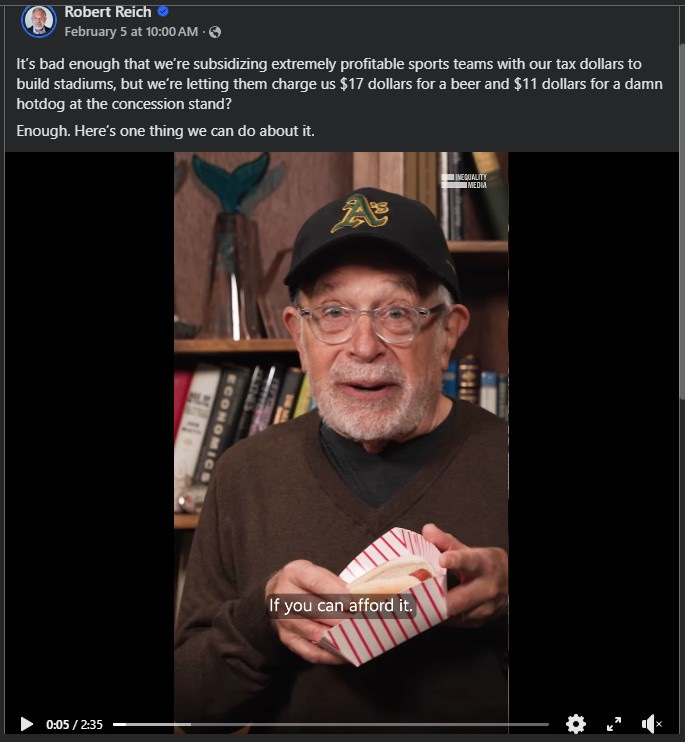
When I started writing “Practicing Sociology” I would compose and publish first drafts. I have evolved into sketching pieces and sometimes finishing them a day in advance of publication. But there are still times when an event or other matter compels me to address it, first thing in the morning. The first few paragraphs of this one are from yesterday afternoon, when a sometimes-reader of “Practicing Sociology” shared a video from Robert Reich on his FB account.
It took me about five seconds to recognize Bob (we have friends in common, though I have never met him) was regurgitating, almost topic-for-topic, what I had watched a week prior as a subscriber to the More Perfect Union YouTube channel. [More Perfect Union since republished their video—note the new title, compared to the second photo below it].
I am not linking to the Reich piece—because algorithms—but you can find it without much effort.
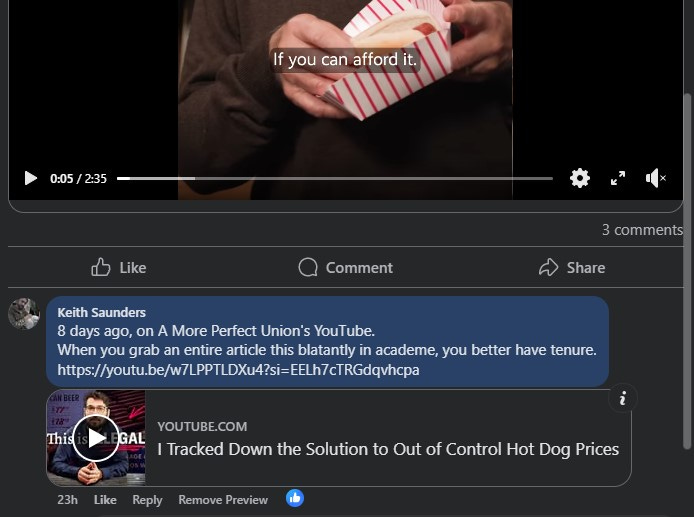
Keith Saunders
8 days ago, on A [sic] More Perfect Union’s YouTube.
When you grab an entire article this blatantly in academe, you better have tenure.
Watch More Perfect Union’s video about what fans can do to get sports stadium pricing under control, if you are interested in such a thing. As for the plagiarists, there’s not much that can be done. Bob taught his “last class” (replaced by an adjunct, no doubt) in 2025, but I bet he’s emeritus somewhere.
Perhaps the only faculty with greater insulation from accountability than tenured faculty are emeritus faculty.
And who am I kidding? He didn’t actually do the work on this. Just like Doris Kearns Goodwin, he lets his underlings do all the work, and then he gets to be the “face” and garner the public recognition and the rewards that come with it. Kearns Goodwin lost face (but not her position) when it was discovered “her” new book had taken full paragraphs from another historian’s, and presented it as her own.
I chalked that up to a graduate research assistant recognizing they were being exploited, knowing Kearns Goodwin was lazy and sloppy, and happy to claim others’ work as her own. Further, that Kearns Goodwin either would not have bothered to read the original and recognized the passages—or, worse, have read the original and not have proofread what was going to be published as hers.
Either Bob Reich was not aware that his “new” video was a paraphrasing of More Perfect Union’s and was set up by the folks at Inequality Media, or worse, he watched it and turned to his worker elves and said, “Let’s do that.”
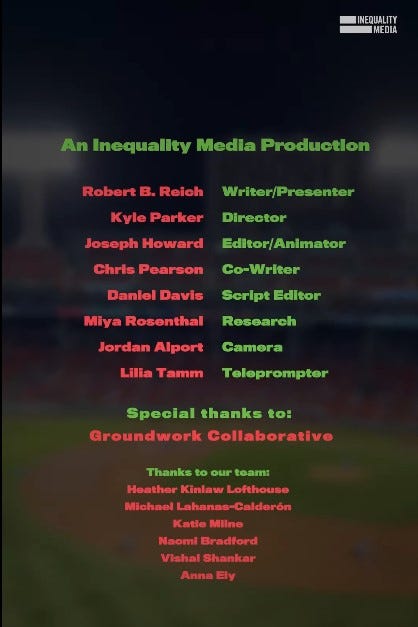
There’s a lot of talk about building community in resistance to fascism, but ripping off your neighbors and not crediting them for the work they did is not the kind of community that works for me.