
Metamorphoses
From slavers to wage-slavers

At what point in the reproduction, re-branding, or repair does the original cease to exist?
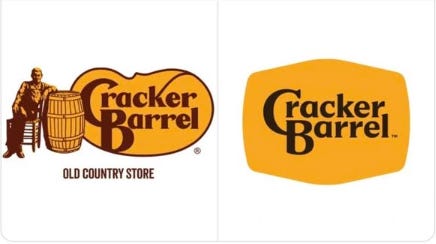
Despite removing the “cracker,” the barrel, and the “whip” in the ‘k’, Cracker Barrel’s reputation for serving white Southern food (as opposed to Soul Food) with a side of corporate racism remains as strong as ever.
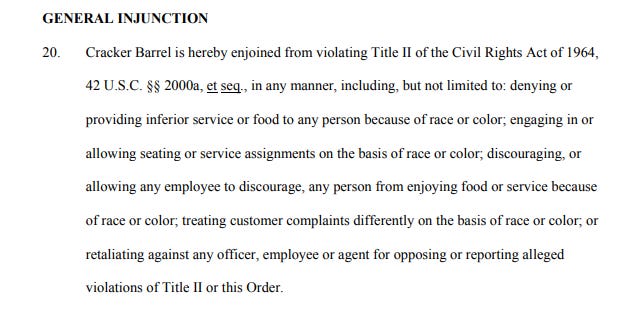
GENERAL INJUNCTION
20. Cracker Barrel is hereby enjoined from violating Title II of the Civil Rights Act of 1964, 42 U.S.C. 2000a, et seq, in any manner, including, but not limited to: denying or providing inferior service or food to any person because of race or color; engaging in or allowing seating or service assignments on the basis of race or color; discouraging, or allowing any employee to discourage, any person from enjoying food or service because of race or color; treating customer complaints differently on the basis of race or color; or retaliating against any officer, employee or agent for opposing or reporting alleged violation of Title II or this Order.
Funny thing was, this lawsuit was not settled in 2024, but in 2004. There was no provision for Cracker Barrel to change their logo—perhaps because it did not recount particularly racist themes—at the time. By that time, both Aunt Jemima’s and Uncle Ben’s mascots had both been recast with late 20th century social class indicators. There was no impetus to remove the Jim Crow-era tropes entirely.


The Cracker Barrel logo has nothing to do with the quality of the food served, which will remain prepared in proletarianized, preportioned servings, ready for sous vide baths and microwaving. There is no evidence of public concern over the logo that preceded its redesign. The restaurant’s name is more prominent than before and unlike McDonald’s, the company never created an anthropomorphic mascot. No one complained when McDonald’s dropped the clown from its advertising in the 20th century, yet here we are with folks upset about the removal of a nameless figure. Dare we say it is because of the reputation the restaurant earned, over 20 years ago?
The Democratic Party is the longest-running political brand in the United States.
They started as devout slavers who separated from the nation due to a conflict over the mode and relations of production. They learned from it that industrial capital and the “free” labor it was built on was destined to outpace plantation agriculture.
To the new-formed Republican Party, slavery was an economic drag that laid huge costs upon the slaveholder that capitalists could refuse to bear. But lest I give the wrong impression, the early Republicans were not devout corporate capitalists. First, corporate capitalism would not come to dominate the economy until decades after the Civil War, and second, Abe Lincoln was a fanboy of his contemporary, Karl Marx.
Marx had published over five hundred pieces in The New York Daily Tribune, from 1852 to the start of the civil war—opposed to chattel slavery and raising class consciousness among the urban proles. Having been a reader, Lincoln understood the social classes formed by capitalism were interconnected, though he lacked the foresight to see how Capital would universalize wage-slavery.
“Labor is prior to and independent of capital. Capital is only the fruit of labor, and could never have existed if labor had not first existed. Labor is the superior of capital, and deserves much the higher consideration. Capital has its rights, which are as worthy of protection as any other rights. Nor is it denied that there is, and probably always will be, a relation between labor and capital producing mutual benefits. The error is in assuming that the whole labor of community exists within that relation. A few men own capital, and that few avoid labor themselves, and with their capital hire or buy another few to labor for them. A large majority belong to neither class--neither work for others nor have others working for them.” — Lincoln’s First Address to Congress. December 3, 1861.
The petit bourgeoisie was a transitional class into Modernity. It has become a feeder system in global capitalism, where a million entrepreneurs build small-scale, high-quality products in hopes of selling their business to one of eight conglomerates that control most all our food and hygiene products. It will then “optimize” the production process, sacrificing original quality for greater profits.
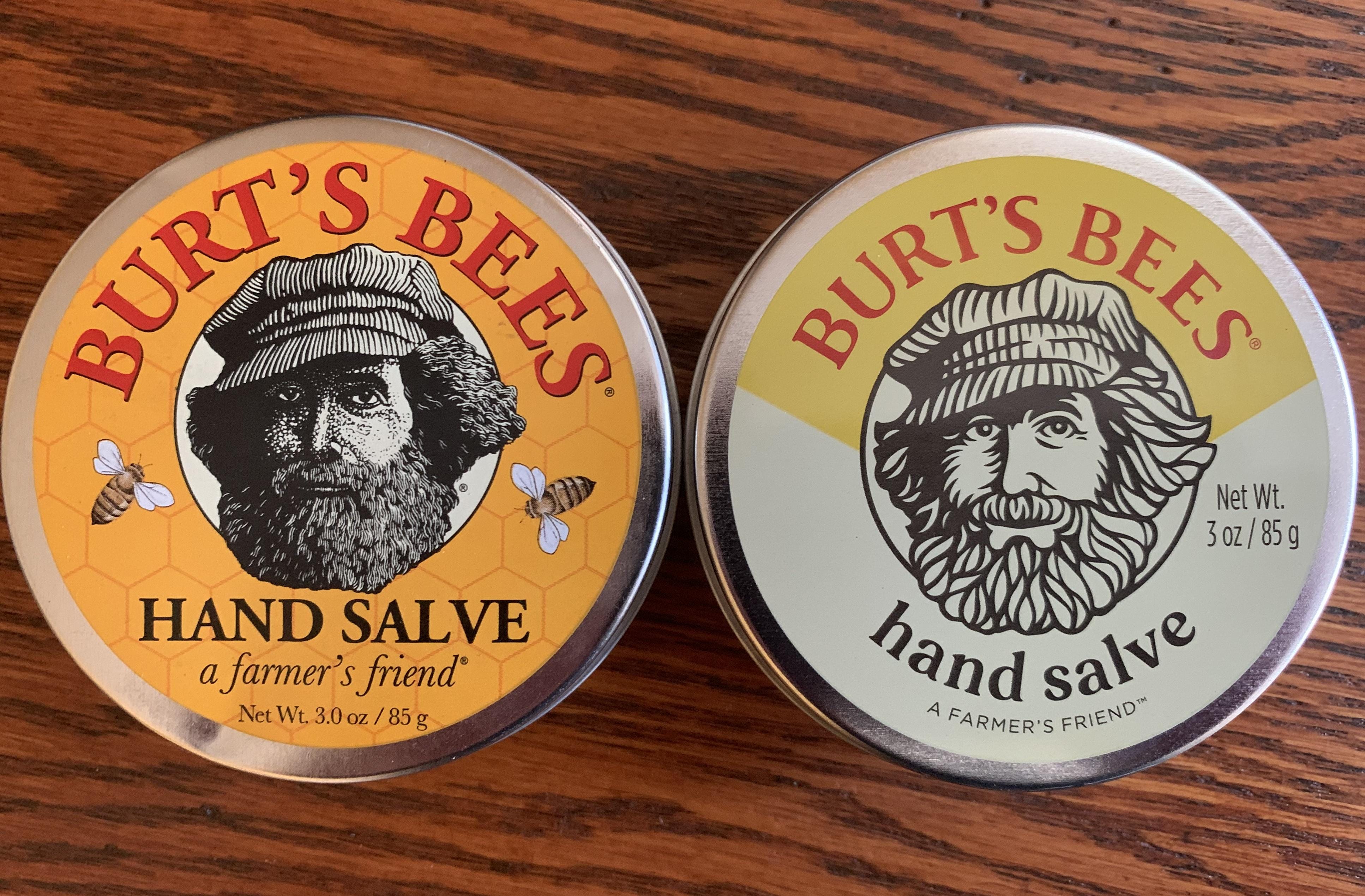
Burt’s Bees, launched in the late 1980’s as a 2-person candle-making side gig, morphed into a personal care products company, and was bought by the Clorox Corporation in 2007 for $925 million. For every one of these stories there are hundreds of thousands of others, where the venture never grew, or it grew but never large enough to be attractive to buy. Personal upward social class mobility (from petit bourgeois to bourgeois) through entrepreneurial efforts is rare. Though it is more common than upward social class mobility from the proletariat to the bourgeoisie. No one can ever work their way into the bourgeoisie; the bourgeois hold their class position through the absence of having to labor.
In some ways, that was the American Dream: To labor, to amass enough surplus to buy capital, and then amass enough capital that one would no longer have to labor. The American Dream was to escape exploitation, but the only way to do that is to exploit others.
Do you see how this design could not possibly work for the majority? Herein lies the contradiction. The promise of democracy is that the majority will be able to choose what is best for them. The promise of the American economy is that a minority will be able to claim what is best for them.
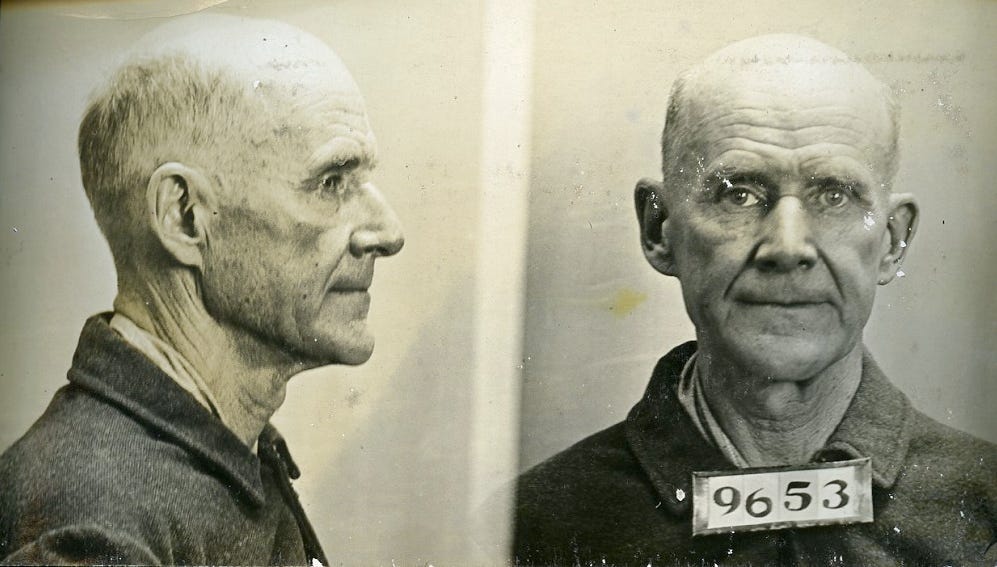
The Republicans took the side of business owners, and Democrats outside of the South became friendlier to laborers and immigrants. Though the Democrats were glad to cede to Republican demands for draconian immigration measures, such as the ones offered by the Biden Democrats in 2024, that Republicans rejected at Trump’s behest. Democrats in the early twentieth century supported disciplining labor and like today, when Socialists such as Eugene V. Debs spoke publicly in workers’ favor, party leaders showed opposition.
The collapse of capitalism in the United States was brought about by the chronic suppression of labor and acute overvaluation of capital. The sudden, massive readjustment in value led to a plummeting stock market, bank runs, cash shortages, collapsing real estate, foreclosures, bankruptcies, and mass unemployment.
Capitalism is not designed to fulfill social needs—whether a need may exist is immaterial to Capital. This is one of the contradictions of the economic form, as economy revolves around the fulfillment of social needs. Despite a plethora of work that needed to be done in 1932, there was no way for profit to be generated, so capitalism was useless as a means.
The “pro-labor” party, the Democrats, saved Capital through utilizing the nation-state as the employer and purchaser of last resort, leveraging its borrowing power to seed (literally) agricultural and industrial operations, and creating programs and policies that would offer base-level social supports for workers from a minimum wage to Social Security.
Extending and expanding these policies were central to the Johnson administration’s War on Poverty. In the late 1960’s, the Republicans (who had been disfavored for decades, despite Eisenhower’s two terms) began to advance a counter-narrative to social support programming, claiming that the state could only interfere with the “proper” operation of the market. They put forth the notion that the health of the society should be measured principally, or solely, through the “health” of the economy. They won converts from among Christian conservatives by framing education, health care, and civil equality as moral issues (that often broke down on racial lines) that the state should stay out of.
From 1968 - 1992, Jimmy Carter was the only Democrat elected President, and that was in response to the Nixon-Ford debacle, more than personal appeal. Being a Southern Baptist from Georgia helped Carter but not enough to win re-election. In the late 1980’s Bill Clinton arose as a New Democrat, also from the South but not as overtly Christian. Clinton was willing to “steal” Republican positions on welfare and other social programs, as well as deregulating corporations and expanding free trade. Bill Clinton was the first Republican-Democrat, and his success ushered in a wave of Neoliberal politicians, regardless of party affiliation.
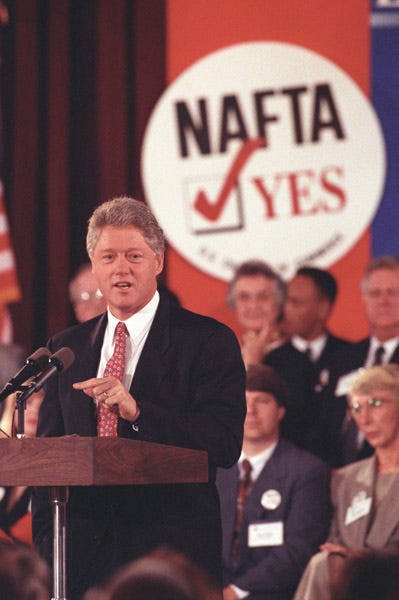
While Reagan had directly attacked labor, Clinton assured everyone that industrial production in America was to be forsaken and the new, technologically-aided, service-based economy was going to produce abundance for all. Nothing needed to be done to rectify the supply-side economics philosophy once labeled “Voodoo Economics” by G.H.W. Bush (who came to embrace it).
As the Democrats became economic Republicans in the Nineties, the party of big business needed draw even deeper into the well of True Believers—people with strong guiding principles—to win votes. Second amendment gundamentalists, survivalists, deep Christians, and white supremacists were still out there; it was a matter of motivating them to turn out. The same personality traits that led them to rigid beliefs also made them more likely to be single-issue voters who could be motivated by fear.
The recent attack on “woke” is a cornucopia of fear-mongering addressing many social issues that Liberals have been advancing in lieu of a public discussion of social class. When the Democrats went overtly pro-Capital in the early 1990’s, they stopped talking about social class, until President Joe Biden did a photo op at a union strike more than thirty years later. They still have not managed to make much of an incursion upon the working class support for MAGA. If anything, it is the cuts made by Musk and Trump that have turned working people away from the Republican party.
The Liberal ideal is a marketplace without discrimination by any form of identity, other than social class. Everyone has an equal chance at being exploited, is their promise to workers. Having lived it for a couple of generations, the People are questioning how they are to benefit from this. Everyone will also have the chance to accumulate enough surplus so as not to have to labor, goes the argument in favor. The People are skeptical about this as well.
Republicans, for what it is worth, were once opposed to government interventions in markets, and have seen impending deregulation and the end to a variety of federal government supports. However, MAGA wants a big, authoritarian, disciplinary state. This requires a reinterpretation of the constitution in many ways—restoring original intent with regard to personhood under the constitution, while fundamentally amplifying and altering the capacities of the Executive over the other branches of federal government, and the states.

The Democrats went from slavers to statist Liberals, while the Republicans went from advocating for the petit borgeois to positing corporate capitalism supra the state. The Democrats countered with Neoliberalism and the Republicans shifted to Fascism. Democrats will still cooperate with Republicans, though, when it comes to attacking (most) Socialists. That remains the only consistent element of either of these brands, since the beginning of the 20th century. Everything else about them has changed. The names are purely for marketing purposes—to portray a consistency that does not exist in reality.
Our elections are brand competitions by a cartel, the quality of the products released under those brands will vary by scale and who claims ownership.