
Mindf*cking
Substack's messing with writers' dopamine

“Gamification” is an awful term for the biochemical manipulations built into all sorts of revenue-generating electronic media.
Gaming is a particular social relationship that, like jokes, take place in the quotidian world, but also within a “timeout.” A cultural framework where what is done or said becomes rewarding in its own context. The game-world has rules we agree to live by, in the game and for the sake of the game, while we play. The joke-world also exists as a play space, this one where the rules and social order of everyday life are questioned or reinforced.
In both instances, play and joking, there is a biochemical reaction where the participants spur the release of dopamine. Mmm. Sweet dopamine.
One taxonomy of Intentional Drug Use lists the forms as: Religious, Medicinal, Recreational, Habituation, Addiction, and Performance Enhancement. The differences between Habitual and Addictive drug use lie not in the dopamine cycles that come from repeated administrations, but from the biochemical processes by which the body develops a tolerance and becomes susceptible to physical withdrawal syndrome, under abstinence. Sociologist Alfred Lindesmith postulated that addiction occurs when the user administers the substance for the sake of avoiding withdrawal.
Much of what Americans started terming “addiction” in the late 20th century was actually habituation—behaviors repeated not for the sake of avoiding physical withdrawal, but for the dopamine boost associated with the behaviors. This is how people become “addicted” to shopping, gambling, sex, acquisition (hoarding), and a host of behaviors that have nothing to do with administering extrinsic chemical substances. Those behaviors produce dopamine rushes. Folks in recovery from alcohol and other substances refer to “addictive personalities,” that prioritize seeking dopamine (or adrenaline) rushes.
The dopamine rush is built into gig apps. You know the old saying, “Do what you love and you will never work a day in your life”? Find a means to monetize your dopamine rush and the better you make yourself feel, the more you are willing to do. It will less often feel exploitive and alienating.
Having a bout of insomnia early this morning, I frittered and wasted the hours in an offhand way. I reposted to Substack something I had put up on Facebook, a marker of my mindset one year ago today. A couple hours later, I went back to Substack to see if anyone had read my 2:30 a.m. post. I found there had been 20 views of my post in the prior two hours. I have quite a few readers on the West Coast, and some others in Europe, so I assumed that was who had opened the post. Substack reports which subscribers have opened a post, received via email, and one in particular went to my partner in Iowa. She suffers the occasional fit of insomnia as well, so I asked her:
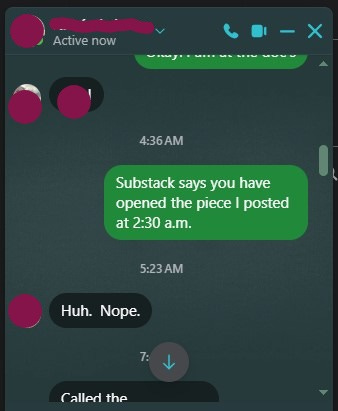
KS: 4:36 a.m. Substack says you opened the piece I posted at 2:30 a.m.
RL: 5:23 a.m. Huh. Nope.
I am to assume other, regular (free) subscribers listed as having opened the piece—whom I know to live on the East Coast—also had not opened it. I was given false feedback on the performance of my article. Would anyone care to guess why Substack would fictionalize response rates?
I know what it is like to post an article, and have few people read what I have spent hours or longer working on. It feels a lot like shouting into the void, and the lack of an echo can be disquieting. Fictional feedback still felt good at the moment. Twenty readers at 3 a.m.? My shit’s really taking off!
Alas, I was being manipulated. I have to wonder if my “regular readership” among those twenty people has ever been legitimate. Any subscriber can be listed as having viewed an email; I have no means of verifying, other than personally contacting them.
So if you have actually opened this piece, and you have read this far, please give a Like, a Restack, or a word in the Comments—something to verify reports of your activity. Thanks!
Excellent article.