
Modern Positivism
An affliction suffered by both the Bourgeoisie and Karl Marx, alike

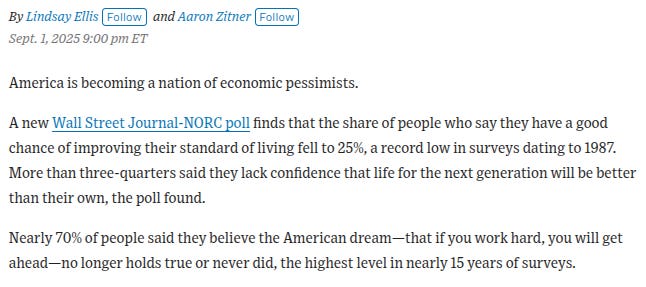
America is becoming a nation of economic pessimists [sic].
A new Wall Street Journal-NORC poll finds that the share of people who say they have a good chance of improving their standard of living fell to 25%, a record low in surveys dating to 1987. More than three-quarters said they lack confidence that life for the next generation will be better than their own, the poll found.
Nearly 70% of people said they believe the American dream—that if you work hard, you will get ahead—no longer holds true or never did, the highest level in nearly 15 years of surveys. Source: The Wall Street Journal.
While all economics is material, the necessary inclusion of the human element makes for a fair amount of fortune-telling. In the Libertarian ideal, all purchasers are fully-informed when they seek to make an acquisition. They know the range of products, the qualities of the individual models, and most importantly, the price. Pricing allows consumers to compare relative value, and to seek the greatest return for the least expense.
Even when this may be the case (and it almost never is) and the prospective buyer knows for certain where a specific product (i.e., a car) may be had for the lowest price, they may not be capable of paying for it. They may need to first buy the money they need to pay for the car. Should they be unable to pay back that money, the car will be repossessed.
So they not only need to know which particular car is least costly, they also have to know which loan in the amount they require will be, as well. The cost of a loan include all interest and fees—the actual amount of money bought will be the price of the car, regardless of the originator of the loan. Fixed-rate loans can be more costly than variable-rate loans, should the Prime Rate fall over the course of repayment; they can also be less-costly, should the Prime Rate rise.
A fully-informed consumer knows which direction the Prime Rate will move, over the course of the loan, and buys accordingly.
There is an element of uncertainty present in all economic transactions that make the fully-informed purchaser an ideal type, if not a mythical creature.
On the other side, loans are not issued based on knowledge they will be paid back (otherwise, no loan will ever fall into default), but on the promise they will. People enter these promises in good faith, for the most part. They intend to pay for the money they have bought on that promise, but they become unable to.
Life-events may interfere with one’s ability to sell labor-power. Injury, disease, or afflictions suffered by the loan-taker, or those the loan-taker is responsible for, can interrupt or divert income. The promise of future production tied to purchasing money is put on a schedule—like a prisoner—with monthly performance measures. Over the past decade, close to 50% of American workers aged 18-64 have suffered a non-COVID-19 “work interruption” of greater than one month, 49% of women, and 44% of men. The most common cause of work interruption in America is “layoff,” with 40% of workers having suffered them.
When laborers purchase money for the sake of buying a car, they are making a promise on behalf of Capital, too. Namely, that the market will bear their promise of future production. For if there is no one able to pay for labor-power, then the laborer has nothing to sell.

How well a particular Social Security account-holder has purchased and repaid money—or has repaid provided services such as shelter, telecommunications, and electricity—is tracked and a variable “credit score” is attached to it.

This is actually a measure of prospective profitability, more so than credit-worthiness, for the failure to carry any debt locks the individual out of the highest-ranking tier. Since they are not buying any money at all at the moment, the scorers cannot vouch for their potential to buy it in the future.
Capitalism relies heavily on time distortion, bringing the future into the present at accelerating rates, for the sake of producing “growth.” The need to generate capital from all resources applies to time, as well. By making more promises of future production in the present, the market appears to be growing as the purchased money goes back into circulation. The surplus-value held in potential in the commodity is exchanged for the money, and profit is realized (literally, made real).
But the money that was used to realize the profit is itself not real. It was rendered into a commodity itself, and while there are markets that function on the exchange of good-for-good, Capital needs to be fed value. Purchased money that cannot be repaid, with interest, is lost Capital. The exchange that was made is discovered to be valueless, the profit revealed to be unrealized, and on a larger scale the market enters a “correction.”
The soothsayers were wrong.
And who pays the price? Ultimately, it would be Capital—which contracts—and as Capital contracts, demand drops. Capitalism is a demand-constrained economy. Constrained demand hits labor-power first, as companies lay off workers and unemployment rises. Then the inability to sell labor-power results in falling demand for commodities, which causes Capital to further contract.
As Capital occasionally sees accelerated growth, it also can fall into accelerated recession. We have built emergency brakes into stock markets for a reason. We created the FDIC for a reason. We have made the nation-state the purchaser of last resort (hell, not even last resort anymore) for a reason. We learned that without external support, when Capital enters a downward spiral, it risks dying.
Charles Bukowski once observed:

       always

the important
thing
is
the obvious
thing
that
nobody
is
saying.
The Project 2025 folks are self-conscious revolutionaries. They are also Bourgeois. Revolutionary uprisings are rare among the ruling class, because they necessarily upend the social structures and institutions that were built to ensure that class’ rule. Taking down the Modern nation-state (whether Soviet or American, all nation-states exist for their People, and as such must support them) means dismantling the institution we have seen prop up Capital over and over again.
Eliminating fiat currencies in favor of Blockchain (the crypto market has none of the safeguards we built into stock markets) poses challenges to the future issuance of credit. How, in a monetary system where every “dollar” is materially accounted-for at all times, are we to introduce fictitious capital?
When eliminating labor-power from production, how are the demands of a living labor force going to drive the economy? The post-WWII consumerist economy relied on lots of people with a little cash to buy increasingly-disposable items. Amazon’s entire business model requires a globe full of purchasers, who need pieces of plastic shipped to them.
Trump’s cockamamie tariff scheme is choking economic growth, spurring layoffs and unemployment, and boosting inflation all at the same time. If the goal is to trigger an economic crisis, this is exactly the path to take. Meanwhile, he is nationalizing segments of industry—which is another very non-capitalist way of doing things. Then we have threats to sic state militias against each other. When trade wars against the rest of the world are not causing enough domestic disruption, turn armed citizens against each other.
The Southern states’ economy, even right after the Civil War of the 1860’s, was not capitalist. It was not driven by demand, labor-power was not commodified, and there was regular exchange of good-for-good without money in-between. This culture has been lionized by MAGA—by the base for all the racist “heritage,” and by the leadership for its own purposes.
Fascism is capitalism in decay. Today’s Fascists (Thiel, Yarvin, etc.) know there is no capitalism on the other side. They are counting on the capitalists to keep imagining theirs is the final economic form, and that all they need to do to save it again is to project promises of future production, further into the future. But there will not be a nation-state to bear the weight of reconstruction this time around.
Marx said the Proletariat was the Revolutionary Class because they were the final oppressed class. As they established the Dictatorship of the Proletariat, we would see how a classless society could form. Modernism is plagued by Positivism, which assumes ongoing improvement of the human condition. It is the greatest bias in Marxist theory, the belief that prior patterns of social class consolidation would continue. The Uber-Bourgeoisie are not motivated to liberate themselves and with them the rest of humanity; instead, they are scheming the new, global feudalism.