
Money Shots
We are all on drugs

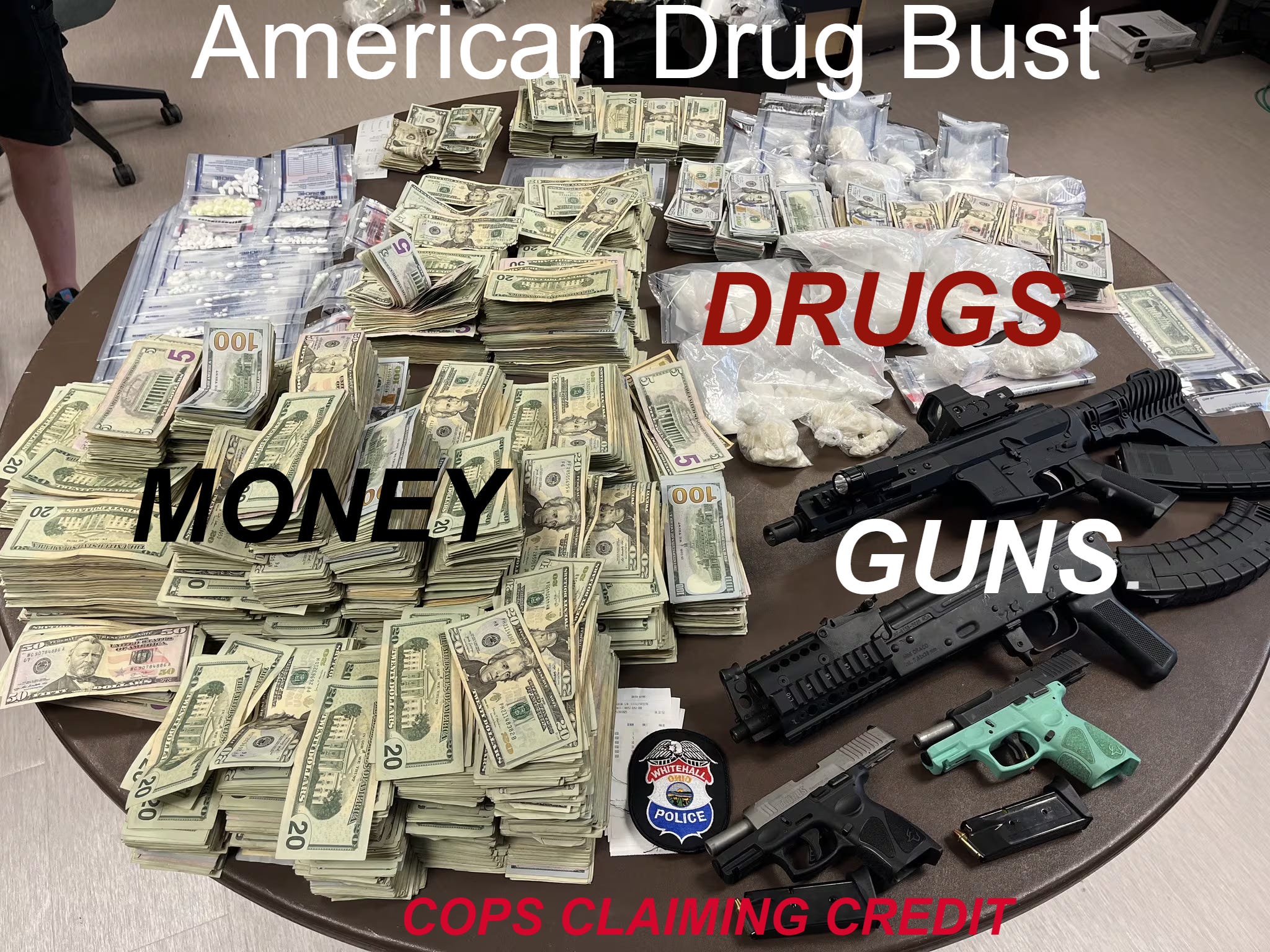
I know Trump, Hegseth, and the rest are lying through their teeth, when they claim the U.S. Navy is blowing up drug smuggling boats off the coast of South America. Cops always make a show of their bounty—when it’s a human, it’s a perp walk and when it’s a drug bust, it’s drugs, money, and guns.
Military maritime drug law enforcement has traditionally been under the jurisdiction of the U.S. Coast Guard (as the name implies, they operate along the coastline of the U.S., not Venezuela). The Coast Guard’s original purpose was customs enforcement, to prevent tariff-evasion; there were no federal drug laws to enforce until the 20th century. The Reagan Drug war elevated the Coast Guard’s role in intercepting prohibited drugs.

Get the people, the drugs, and the money, all in one place. That’s the holy trinity, I learned from a former student of mine who had gone on to work for the DEA. Our drug policy practically guarantees guns will be present, and when they are, penalties increase automatically, regardless of whether they are brandished.
Drug prohibitions give drugs magical powers. Drugs are bestowed the ability to render people into criminals, just for being in proximity to them. The Trump administration is relying upon over forty years of American drug war propaganda that has framed “drugs” as “criminal.” The worst status the state can confer on a citizen is that of criminal, for it justifies all following treatments: from property seizures, to prison, to execution. Outside the boundaries of the U.S. judicial system, the drug-crime connection is being used to justify summary execution.
Note the recent public objection to the story that Pete Hegseth personally ordered two survivors of an initial attack on a civilian craft to be killed does not question the legality of the attack that rendered them shipwrecked in the first place. It was not legal, either, but for the magic of the “drugs.” Invoke the spell by saying the word, and the state can do anything.
Using the military to address a public health matter is stupid, but predictable. About a year ago, I foresaw Trump’s second term relying on Drug War infrastructure to advance his authoritarianism.

Building a hemispheric dominance around American drug law goes back to Reagan. It was eventually scaled back by Obama, did not feature in Trump’s first term (he’s an experiential learner and did not realize its utility), and Biden also laid off narco-diplomacy.

Today, American public health has been turned over to people who deny germ theory and think vaccines are killing us. They are dispensing with social supports that favor drug treatment over incarceration (Crazy Kennedy, Jr. has proposed—I shit you not—Maoist “wellness farms” for drug abusers), defunding community health care that includes outpatient substance abuse counseling, and have cut USAID to drug-producing nations meant to divert labor from the unlicensed pharmaceutical corporations. Collectively, this is demented and dangerous policy that will harm public health.
American drug policy has been wracked by greater social forces: the rise of scientific medicine, its professionalization and control over the treatment of disease and medicalized deviances, the commercialization of pharmacy, moral entrepreneurs, racial, social class, and gender relations, state surveillance and discipline, and the politics of the eras in which policies have been enacted.
Our current omnibus federal drug law is the Uniform Controlled Substances Act, from 1970. It defaults “drug abuse” into crime, ensconcing a drug-crime connection into the policy itself.
This policy has created tautologies such as drugs with “high abuse potential” being prohibited and placed in Schedule I. Any use of any Schedule I substance is considered “drug abuse,” thus marijuana’s growing popularity proved its abuse potential was high. Despite recent talk of rescheduling marijuana, not once in 55 years has any drug been removed from Schedule I. By the logic of the original act, no drug would ever need to be.
Marijuana is illegal because it is “abused,” and it is abused because any illegal drug use is drug abuse. Do not look to U.S. drug policy for sensible public health; it does not exist for that purpose, despite words to such effect.
It would behoove us to decriminalize drugs; criminalization did not offer the protections its advocates claimed. Instead, prohibition has left hundreds of thousands of people dead from tainted opioids. Just about every lethal opiate overdose was made more likely to have happened because of our harm-maximization default drug policy, starting with clandestine supply chains. If we want to reduce the chance of lethal overdose we need to purify the supply and normalize supervised administration sites, like we have done with alcohol.
No one goes blind from drinking wood alcohol in a speakeasy anymore.
Prohibition relies on censorship and is ahistorical. The consumption of the drug prior to its prohibition is portrayed as a hazard and pushed aside for the present-day anti-drug messaging. Prohibition promises to be the last drug policy. Really. There is nowhere else to go. Once drug possession is criminalized, decriminalization becomes a threat to the social order itself.
This fall, some jamokes dropped hundreds of thousands of dollars on suspect signature-gathering to put a question on 2026 Massachusetts ballots that would reverse cannabis legalization. They are seeking a return to a time without a retail cannabis industry, and without home grow.
Now, I have my own complaints about home grow’s egregious, classist biases and the absence of outside-the-apartment cultivation (think Brew-on-Premises for GYO) under the current law. The way they created the industry locked out the folks who made legalization possible, the Social Equity program lacks equity for labor, the tax rate started too high (you reduce use rates by raising taxes, but there’s a threshold), and the Cannabis Control Commission has become a poster child for dysfunction—already into the eighth year of retail and no one has been able to figure out how social consumption might work. Pro Tip: You get a location and you let people smoke weed there.
Going back to Jim Crow cannabis, where only those with verified, horrendous medical conditions are permitted access (and they better not be using it for fun—thought crime!) is not a workable idea. Shit. Take a look at New Hampshire: They have residents bringing in weed from across their border, and none of the tax revenue! And that’s what Massachusetts would lose with a medical-only system.
All that lucrative drug money…left to random tax assignments, based on policing. That’s what it was, you know. The fines were the taxes collected for engaging in marijuana markets. Collection was random and haphazard. Cops got to keep a portion, providing incentive to prioritize drug seizures over crimes that do not generate direct revenue, such as the violent ones.
The Massachusetts Recriminalization sponsors would rather everyone in the Commonwealth bear the entire costs of marijuana use, rather than allow the marijuana users themselves to cover at least a portion of it, proportional to their consumption.

In 2021-22, myself and a small band of townies tried unsuccessfully to get Scituate, Mass. to lift its ban on licensed cannabis businesses. Our campaign centered on potential direct revenue to the town through the 3% local tax and additional revenues through Host Community Agreements.
Why would Scituate residents have wanted 3 cents of every cannabis dollar spent in town, to go to the town? They thought it was far better their neighbors cross a border and leave that money in another town. At least that is what the Town Meeting vote showed. They were under prohibitionist hegemony—the illusion that the policy prevents drug use, and marijuana use in particular. Evidence shows prohibition helped make marijuana use more popular than it would have otherwise become, had there not been prohibition. The policy gave rise to an identity group that spread marijuana-knowledge and led to the legalization movement itself.
Why is some entity willing to drop enough money to buy a house outright, just to see if a question can make the ballot? Should the petitions qualify, a serious campaign runs millions of dollars more. And it will get absolutely crushed, come 2026 Election Day. They will be looking upward, to see 45%; perhaps a long way upward.
Take every promise the prohibitionists made about what will happen if marijuana prohibition was ended. All of them ended up not happening, and in many cases exactly the opposite happened. Youth cannabis use rates have dropped, opiate use in general has dropped and lethal overdose with it, in the areas around cannabis retail stores real estate values have risen and local crime has declined. The presumed surge of DUID-marijuana has not left a trail of car wrecks, carnage, and bongs tumbling from the driver’s seat when the Jaws of Life pry the crushed door open.
Anti-legalizers could not have been more wrong. Prohibition was not justified by actual outcomes but by the imaginary outcomes it was believed to be preventing. Now we have the evidence to show just how full of shit the prohibitionists were.
We are seeing a backlash, no doubt, against the cannabis reforms of 2012 - 2022. The reformers’ multi-state strategy created at the turn of the century (reform state by state until there is sufficient representation in Congress) has stalled, and even before it did, the outcome was not what they had hoped to see. We are still a long political way off from federal policy that would allow for interstate commerce in cannabis flowers. We will be getting a pharmaceutical model for THC and the other cannabinoids instead. They will call it “reform,” but it will only be to the degree that a prohibitionist hegemony may be maintained.