
Negotiating Pleasures
The placebo effect is a cultural phenomenon

What do you think about the drugs you take and why you take them?
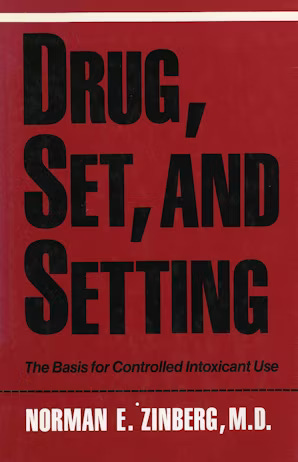
In the early 1960’s, sociologist Norman Zinberg (1964) developed a theory of controlled intoxicant use that contains a model for understanding a given drug’s varying effects, across cultures. It has long been observed that people respond differently when engaged in drug use, both across cultures, and within the same setting. Using Zinberg’s model we can effectively isolate the physiological effects of marijuana use from the psychology of the user and the cultural and social situations of use. [n.b.: Zinberg would later be asked for advice by Keith Stroup when he was founding the National Organization for the Reform of Marijuana Laws (NORML); Zinberg later became a charter member of the NORML board of directors].
Within the “Set” of Zinberg’s model we attend to the intentions and expectations of the user; these are culturally as well as experientially contingent. In the case of marijuana, intentions are exercised within metaphors of health, leisure, the sacred, normalcy, and performance. All of these are social constructions through which the use of—or abstention from—marijuana is morally screened. The existential intent to use marijuana in a way separated from the social construction has been rendered impossible by the binocular gaze of scientific medicine and the state, which have long since dispensed with the notion of an action that could be isolated from their constructions of disease and criminality. The intentions of marijuana users since the bourgeois revolution have necessarily become political, first in a gradual submission to practitioners of scientific medicine that would prescribe cannabis, then as criminals. The pleasures of non-medicinal marijuana use were ripe for discover by the bourgeois in their drive to globalize trade and by living out the existence of those who had chosen to be condemned to be defined by what they consumed.
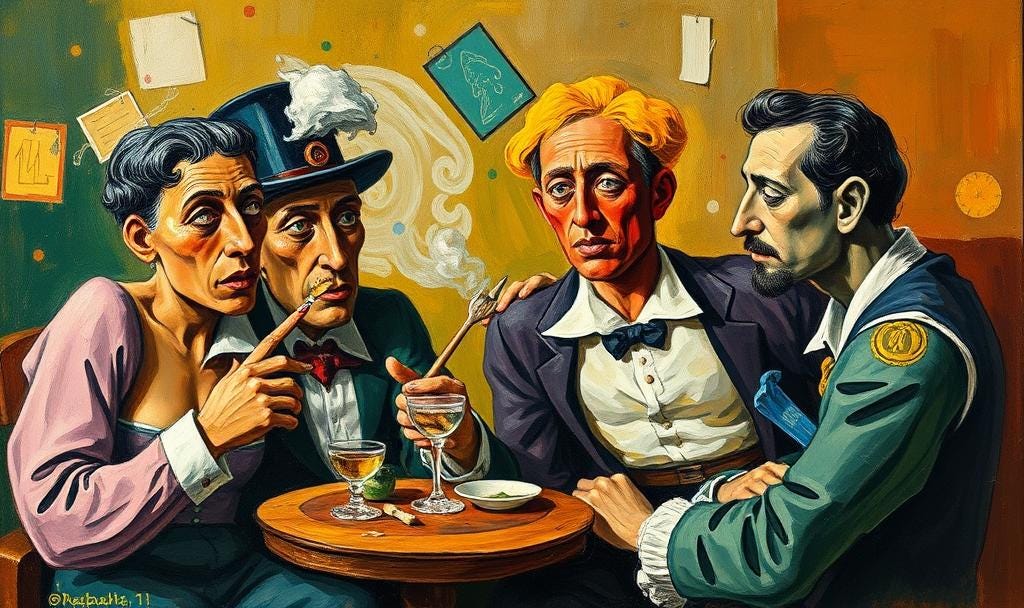
The bourgeois appetite for the (secular) pleasures of cannabis was drawn from the sacred practices of Hindus in the British colonies. As Theophile Gautier (1846) was writing of Paris’ Le Club de Hachichins, helping to popularize the practice among the European bourgeoisie, and W.B. O’Shaughnessey (1839) was collecting scientific observations of the effects of cannabis upon patients in Calcutta, the bourgeois format for the construction of cannabis was laid out. The primary taxonomy of action did not include the possibility of criminality; this would be added almost seventy years later.
The pleasures of marijuana are ethereal; Becker (1954) and others have found early-time marijuana users typically need to learn to identify the effects of the substance, after they have learned to effectively consume it. Lenson (1995) remarks that the marijuana high may be the one most susceptible to user construction; in an era of popular marijuana use in the U.S. the users still must ask, “How do I feel, now that I feel high?
Upon discovering the effect and the means to produce it, the marijuana user is freed to engage in the metaphors of intention as if they were real, and through experience learn to satisfy the expectations of effects.
The social risks’ relation to the users’ “Set” are not endemic to marijuana. Historically, cannabis use has been accurately associated with violent activity in one case; that of the Hashashan—the “Assassins” who would eat hashish. In the U.S. the connection between cannabis use and violence is largely fictitious. While there are many accounts of cannabis users (or small groups of cannabis users) engaging in violent behaviors while under the effects of the substance, the cultural expectations of cannabis users prove to be quite different. It would require a massive moral change for American marijuana users to begin using marijuana as a precursor to violence, in the way some use alcohol and stimulants today.
The story of marijuana in the United States may be understood as a progression of social movement that began with efforts to prohibit the substance, which encountered shadowed, subcultural resistance from its outset. When marijuana use shifted from its subcultural origins into an open, popular culture, the social movement of marijuana-users assumed a new form, with users increasingly drawn from the “mainstream” of white, middle class Americans. Their persistent, common use of marijuana has allowed for the creation of marijuana policy reform groups and advocacies that counter decades of negative stereotypes, that debunk prohibitionist propaganda, and that have sought to liberalize marijuana policies at the local, state, and federal levels.
Since 1971, NORML has put forth a tripartite argument for marijuana policy reform in favor of: 1. Recreational use; 2. Commercial hemp; and, 3. Medical use (NORML, 1973, 1980). Most use of marijuana (at least since it was prohibited) would be considered recreational. Medical use is common, though at the same time rare, when compared to the use of pharmaceuticals to treat disorders. Commercial hemp advocacy branched into large-capital- and small-capital-directed advocacy groups by the late 1990’s—the North American Hemp Industries Alliance and the Hemp Industrial Alliance, respectively.
With the recreational discourse of marijuana policy reform successfully marginalized in the 1980’s by government and private temperance groups such as the Partnership for a Drug-Free America, the hemp and medical arguments for changing marijuana policy came to lead public arguments in favor of reforms. Despite NORML having advocated for hemp and medicinal uses of cannabis, the popular conception was NORML’s mission was limited to legalizing recreational use.
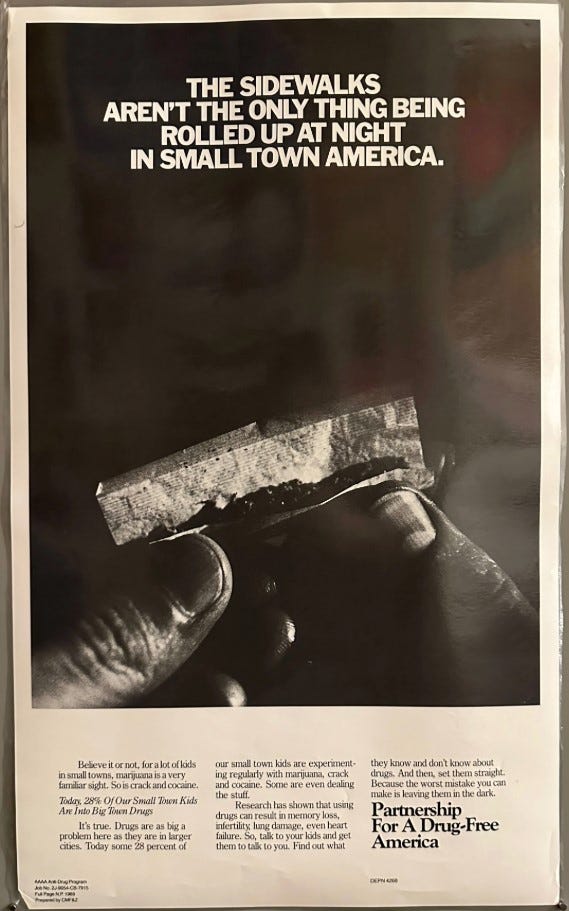
The Reagan/Bush Drug War made it just about illegal to talk about recreational marijuana use, and positive depictions of it disappeared from commercialized popular culture for close to a decade of JUST SAY NO!
The future of marijuana policy reform will play out in a moral arena where the metaphor of recreational intent remains the sole and final issue to be decided. We will come about this in two ways: The criminal prohibition of marijuana will be ended, and the movements it gave rise to will fade away. The marijuana-users will disappear. We will still have cannabis and still use it, but this will in no way indicate anything special about users or force people to assume a political posture in a struggle.
Excerpted from:
Saunders, K. (2002). Marijuana Culture and the Discourse of Pleasure, presented to the American Sociological Association.