
Next Steps
Where do we go? Where do we go now?

What do we do about the current situation, and how do we do it?
Obviously, global change from the status quo to a more humane society, from an imposed politics of division toward a politics of inclusion, one where the fruits of human labor—living and dead—may be shared more equitably and more to the benefit of the general welfare, is not done by imposing it. It is done through a growing gyre of communities choosing to realize (to make real) an institutionalized form of mutual aid.
This will not resemble a hierarchy or bureaucracy, with power flowing in just one direction. This new form of social organization will not eliminate the use of hierarchy or bureaucracy as administrative forms, but it will eliminate domination through those forms. Just as the Bourgeois revolution neutralized religious authority (current efforts from American Christian nationalists notwithstanding) by recognizing it as equal with all other, non-secular forms. In a more humane future, association with a bureaucratic organization will be akin to one’s ability to subscribe to a particular faith.
One may choose to believe salvation is only possible through newborn genital mutilation followed by life-long dietary restrictions and regular intervals of prayer—through ritual means to an end. In a freer society, people will have a wider variety of means (and ends) available, and should a bureaucratic organization prove an acceptable path that will be a choice, but not the only choice. There will be the means to realize alternative forms of social organization that also may achieve desired ends.
Obviously, those who benefit directly from current social power relations are going to resist this. We have seen in this past year, a major advance in the 60-year fight against the general welfare state (how’s that for a Wheel of Fortune “Before & After”?)— funding reductions among social programs and subsidies to certain industries (agriculture, especially; but not rockets or petroleum, at all). What are we witnessing but yet another move by a bourgeois faction to lever their new technology (factories, railroads, oil, and electronics have been utilized in the past—now it is computers), into dictating the relations of production?
Historical materialists don’t make predictions as much as spell out how the past is living in the present and, based on that, what might be expected to happen in the future. People know that Marx and Engels discuss communism in The Manifesto of the Communist Party. Far fewer know that before the brief discussion of communism, there is a lengthier discussion and critique of practiced socialisms. Before that, more than half of the document concerns capitalism.
Aside from writing about the actual Paris Commune, Marx did not write anything else about communism, because it did not exist. Instead, he wrote thousands of pages of political economy, all of it based on historical records and observations from his present day.
Capitalists’ stories say (capitalist) society’s ending must be cataclysmic—Nuclear Winter or Global Warming—wiping out humanity like a comet strike (itself seeming to be an increasing likelihood, the more we search the cosmos for them). Tragically, we will do either unto ourselves; hoist by our collective petard in the morality play. As if the ruling class that both burned a gajillion gallons of hydrocarbons and invented atom bombs to maintain their control of oil was not particularly responsible.
I see reasons why we should be concerned, with what we have shown we are willing to do to ourselves. The greatest unspoken fear of the dominant group is that if some other group gains power, they will treat the former dominant group as they were once treated by them. And now the revolutionary bourgeois faction literally threaten us with their computers—saying that AI will likely escape their control, and then who knows what it will do?
Like autonomous vehicles, AI is a giant social experiment that no one signed up for and no one may excuse themselves from. All we know is not to expect a fair share of any benefits that will be discovered. Our lives are at risk—people have and will continue to be killed by these autonomous vehicles. By virtue of corporate ownership, these machines cannot be held responsible as a human operator would. Corporations are people, but not the kind we can lock in a cage when they commit crimes.
If you want to kill someone in America and not face prison, employ them and put them in an unsafe working condition. Should they die, you may be fined. Alternately, roboticize a bunch of cars and release them in urban areas. The casualties (or their survivors) are to be paid pre-determined settlement amounts, as is the corporate way. It’s called “the cost of doing business.”
When private security firms eventually lobby for—and get—the go-ahead to arm their robot sentry dogs, they will. And when those autonomous robots start shooting people, the question will be whether the victims deserved it. Not the question of, why would we provide autonomous machines the capacity to kill? Those having made that decision will not be those bearing responsibility for the outcome; that will be shifted to the victims.
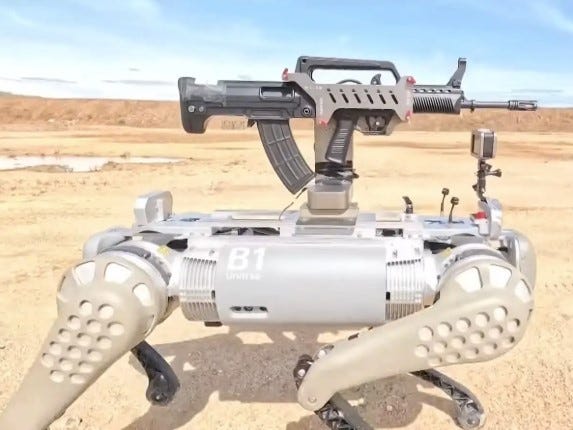
This is hegemony. This is Existential bad faith.
I take it as a sign that the revolutionary faction of the bourgeoisie has dispelled with their old fantasy that innovations will make life better for everyone. While Boomer Bill Gates still pops up now and then with an assurance the work week will be shortened due to all the computation and automation, and Andrew Wang imagines a “Minimum Guaranteed Income,” neither of them has a shred of historical evidence to show they are in their right minds.
Every “time-saving” technology has wound up increasing productivity instead, because the technology itself does nothing to reduce the demand for profit. The only thing that has ever reduced the length of the Modern work week has been workers forcing it to happen.
Similarly, Wang’s minimum income will have to come with price ceilings, especially on necessities such as rent, food, and health care, otherwise the influx of cash will result in higher pricing. “No sooner is the exploitation of the laborer by the manufacturer, so far at an end, that he receives his wages in cash, than he is set upon by the other portion of the bourgeoisie, the landlord, the shopkeeper, the pawnbroker, etc.”—Marx & Engels, The Manifesto of the Communist Party.
Peter Theil and Elon Musk have done away with any talk of a brighter future for all people, through the technology they claim as theirs. Instead, we are getting threats. Our new technology is inherently dangerous, we are using our corporations to force it into your lives (see how much easier it is to plagiarize, using our plagiarism machine?), and the best we can offer is it will proletarianize jobs that once required years of training to do, such as law or sociology.
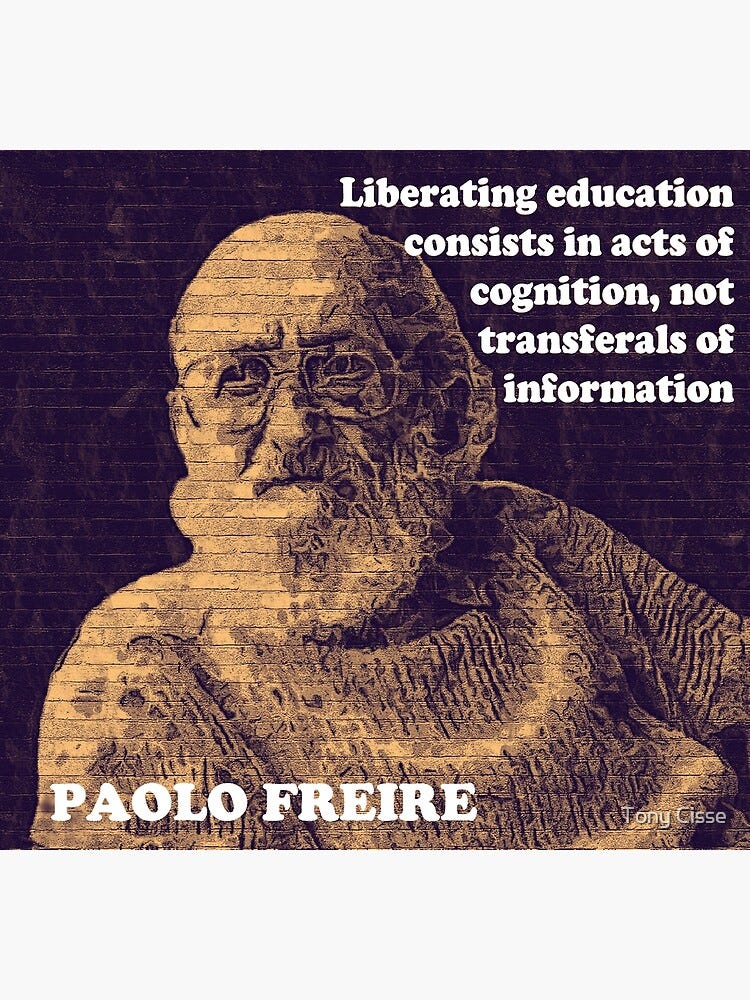
Just kidding. Creating social theory (or any philosophy) is impossible for their machines. Instead, what will happen is that which we call “philosophy” will itself become limited to what the machines are capable of, for as long as those who brought these machines into our lives hold power.
That is when philosophy will necessarily become liberatory.
.
Wow, the comparison between bureaucratic organizations and faith systems was truely insightful; what if we could actually architect social structures with the same personal commitment and diverse paths that individuals pursue in their spiritual journeys, allowing for a more fluid and inclusive form of societal operating system?