
Nostalgia Blitz
Barack Obama is selling the New Conservatism that sells a class-sanitized past

Former President Barack Obama has been on a media blitz. Last week, he appeared on liberal, DNC-darling Brian Tyler Cohen’s podcast. The Daily Show’s Josh Johnson teased the February 18 release of his interview with Obama.
This Wednesday 2/18, a conversation I got to be a part of, with someone I’ve admired for a long time will be out on YouTube.
I’m still wrapping my head around the fact that it even happened.
I have all of you to thank for putting me in spaces like this.
I can’t wait for you to see who it is.
Over the weekend, the Obama’s sat court side at the NBA All-Star Game.
On the morning of February 18, the New York Times put out this ad:
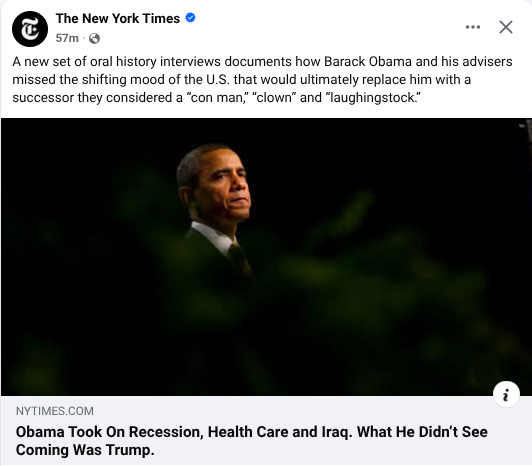
The New York Times
A new set of oral history interviews documents how Barack Obama and his advisers missed the shifting mood of the U.S. that would ultimately replace him with a successor the considered a “con man,” “clown” and “laughingstock.”
Obama Took On Recession, Health Care and Iraq. What He Didn’t See Coming Was Trump.
The question Americans might be asking is why?
Republicans (starting with Lee Atwater?) insisted on referring to Ronald Reagan as “President Reagan” (rather than “Former President Reagan”) while Bill Clinton was in the White House. A linguistic reframing meant to erode the legitimacy of the sitting President. Contrary to more recent events, Donald Trump was not the first to diminish a Democrat’s claim to Presidential authority while they were in office.
Former Presidents (aside from Trump) have tended to keep a low profile. It was easier for Reagan and Bush the Elder, as both could treat the Presidency as a capstone to their careers. The younger Presidents of the recent past, Clinton, Bush the Lesser, and Obama, won office and served to their term limit years before they hit retirement age. Jimmy Carter, though only serving one term, should be counted among them, and he remains the exemplar of what a former President should do—share wisdom through writing books and public speaking, while engaging in public service projects.
While Biden and Trump have both grown frail as they aged into their 80th year, Jimmy Carter was framing houses for poor people at their age.
Obama was confronted early in his Presidency by the Tea Party. It was a fiscal conservative/Libertarian political movement, with a maniacal focus on federal deficit spending and debt. Though it mobilized around Libertarian Ron Paul’s 2008 Presidential candidacy, resources coalesced in and around the Republican Party, whom Paul caucused with as a member of Congress. Everyone who would go on to win office as a “Tea Party” candidate, ran as a Republican.
Bush II had run up gigantic deficits, to fund two new wars in Iraq and Afghanistan, and while Libertarians such as Representative Ron Paul objecting to both foreign interventions and the costs associated with them, the Congress approved one budget deficit after another, regardless of party.
As long as markets increased, the reasoning seemed to go, it does not matter how much debt the U.S. as a nation would incur. Indeed, every dollar of deficit spending by the entity holding the largest fictitious capital (‘credit’) pool in global capitalism caused markets to appear to grow.
Obama’s first priority in office was to address the Great Recession that had begun in 2007. Like FDR before him, Obama had a plan to restart capital accumulation, but unlike Roosevelt, Obama’s “recovery” pushed value toward Capital instead of the People.
While it took time, it was not terribly long before Obama “fixed” the economy. That is, stock markets began to rise, real estate began to rebound, and the very wealthiest began seeing their relative wealth accumulate at exponential rates, once again.
The “Hope” and “Change” was clearly becoming “More of the Same,” with regard to what was officially considered “good” for the economy, and thus good for society. As this became clearer, a new social movement coalesced, focusing on the value-distribution crisis. It took the name “Occupy” and consisted of crowds of people assembling in public spaces, proximate to centers of Capital. Wall Street in New York City, outside Federal Reserve buildings in Boston and elsewhere.

October 2, 2011
The Tea Party hates the government for running a deficit; Occupy Wall St. hates the source of the deficit, which is the failure to tax corporations and wealth.
While both the Tea Party and Occupy held political events in parks, only one of them got the shit kicked out of them by police.
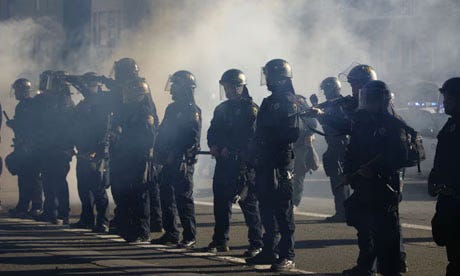
Barack Obama is selling nostalgia for a time with a kinder and gentler federal government, and indeed, he was not one to release a secret police force to erode civil liberties on the daily. But to envision his tenure as without class conflicts that drove the rise of the MAGA political movement, requires forgetting the people in the streets, directly communicating that we were in a value-distribution crisis that he did nothing about.