
Notes on Method
Watch what I'll do for fifty bucks

I started publishing on Substack in November, 2024. I had intended to create a public sociological blog, where I could throw 30 years of lecture and research notes, unpublished essays, poetry and prose, and the occasional piece on contemporary politics. I usually wake up and write what is on my mind, early in the morning.
What you see is very much a first draft—I almost always spot typos and grammatical miscues when I read through it, after I have sent it. Occasionally I will plot out a piece the night before and pick it up in the a.m. But aside from re-publications, these are unpolished and off the top of my head.
Though we share in the passage of time equally, when we look at time as socially constructed, we find that not only people and cultures have different temporal constructions (Coptic Christian Ethiopians observe 13 months while the commercialized world insists there are 12), but that people live at different paces, in different places.
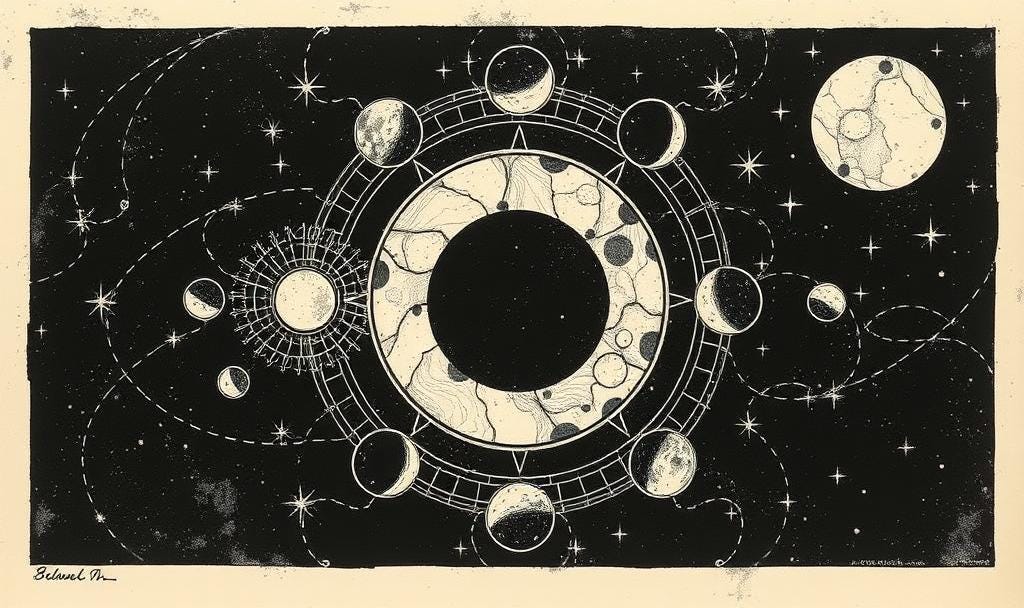
Objectively, there is no solar month without culture. Lunar months, on the other hand, are obvious, but also are 29.5 solar days, and solar months are between 28 and 31 days on the Gregorian (solar) calendar. But the solar calendar dominates, with its not-found-in-nature, 7-day cycle that divides evenly into only three of every forty-eight months.
Without each other, we would surely lose track of the solar calendar.
The pacing of everyday life also varies by social location and role. How far ahead one is expected to plan varies greatly. In academic culture, work is done with the knowledge it will not be published for years. Creating a new course offering can take a full year, from the date of the dean’s approval. April is late in the game for fall semester teaching assignments; tenured faculty in some departments know their teaching schedule through their next sabbatical, many years hence.
It was the part about the job I enjoyed the least. Society—my focal universe—moves and changes so fast that a delay of a few years can alter findings. Social sciences as academic disciplines are rooted in a 19th century pace of practice. Some would say that any research findings that go out of date in a few years’ time are too shallow to be of much value, that the endeavor to discover a truth caught only a facade.
Part of sociology’s absence from most peoples’ everyday tools for understanding the world stems from not a lack of application, but from the slow pace the profession has traditionally been practiced and its isolation and exclusion. We know and can observe how lawyers apply the law in everyday life. We understand psychology as a field of inquiry and its clinical applications in therapy. Sociology does not have a well-understood and capitalizable public service model.
Have a tort? Find an attorney. Feel physically unwell? Find a physician. Feel mentally unwell? Find a therapist. Want to end our subjugation to a coercive and exploitive ruling class? No one’s interested in buying.
Part of the reason is torts and illnesses have been reduced to the individual body (though they are social phenomena), while sociological approaches inevitably require addressing collectives. It’s the American public health problem. Individualized medical practices are able to commodify services in such ways that physicians and health care rationing corporations are among the highest-paid professions and most profitable industries.
Public health, on the other hand, has only one client—everybody—and noone wants to pay for it, since the best they may hope for is peripheral benefits like the absence of disease. We don’t recognize in ourselves the diseases we do not personally contract, though they may be socially present (and thus part of us). This is one reason why some people reject vaccinating their children, though vaccinated themselves. If I never got the measles, why should I pay (perceived risks) to prevent them?
While I loathed the lag time in academic production, I revel in the verbosity. I meant this to be a 3-paragraph appeal:
Thank you for reading and subscribing (whether you already have or are about to). My writing has become more contemporaneous than I had planned, as I try to lend sociological considerations and perspectives to what is going on in America right now. I hope you are finding it informative and that it may provoke the occasional “Aha!” moment.
I plan to continue to keep access free—I have a small handful of awesome people who have helped make Practicing Sociology Without a License more than a hobby—and I need more folks to help keep this happening. Annual subscriptions are available for just $50 through April 20. I have a 5% paid subscriber rate and I am hoping to double that. I appreciate any and all support.
Paid or not, all subscribers are invited to a Special Session at the Summit Lounge 116 Water St. Worcester, MA on Saturday, April 19, starting at 6 p.m. Shoot me an RSVP at keithsaundersphd@gmail.com and I will cover your admission fee for the evening.
#BankruptElon