
Omniscience, at What Cost?
Who owns your data? Who owns your face?

Humans, across cultures and eras, try to make themselves into living versions of the gods they imagine. Animists do not bother segregating the sacred and the profane, so theirs is the smallest leap of faith. Polytheists, with their structured division of labor, have specialized gods; patrons assigned by the relationship of their labor to nature. Where polytheistic society develops an administrative class for the dynasty, realm, or empire, we see a Zeus or Jupiter—the god whose purpose is to manage the other gods.
Monotheism, as best we can tell, arose in the Fertile Crescent after the Great Flood destroyed civilization. A massive disruption of the social order destroyed any division of labor, but a theistic culture persisted. Despite having to begin a multi-generational rebuilding of the world as they knew it from scratch (imagine society, post-global nuclear war), there was not a recession back to animism. Instead, the “poly” was consolidated and became monotheism—one god.
Polytheism became an existential threat, such that the first rule of monotheism recognizes there are other gods, but commands that no other gods are valid. While a polytheism has the ability to incorporate the Abrahamic god and his Christ incarnation and his prophet Mohammad, the monotheism demanded by the Abrahamic god causes Jews to dispute Christ’s legitimacy, and Christians to dispute Mohammad’s prophecy. Both Christians and Muslims believe the Jews are stuck in the past.

And they all believe in the same god. Kinda.
The philosophical dilemma we face, as we attempt to become omniscient, omnipotent, and declare the universe—to the extent we are capable of perceiving it—ours (If a tree falls in the forest and no human hears it, is there a sound?), is that we try to become god, but we may only be a simulacrum of the simulacrum.
We mimic the powers we imagine god to have.
Monotheism is totalistic administration, and administration is only possible through making and enforcing rules. Rule-enforcement makes administrations and institutions material and corporeal. “Effective” rule-enforcement involves surveilling the field of engagements, searching for violations.
When we invented electronic computers we unleashed a capacity for information storage and transfer at volumes and speeds beyond any human capacity. Like heavier-than-air flight, we created a technology that gave us superhuman abilities, that made us more god-like.
For a short while, right at the turn of the new millennium, the internet offered a freedom the material market was incapable of capturing. Not only was it possible to semi-anonymously search for consensual deviants who liked to smoke weed or be bound and gagged, there were few paywalls and whatever media had been digitized and hosted on a server was fair game for downloading. Napster and other platforms were created solely for sharing data, licitly or illicitly.
That was when focus shifted to ensuring that information could not be shared freely. Anti-piracy software and a few high-profile legal cases cut back on the public free-for-all. Today, all of the most popular platforms constantly screen for pirated content.
God is omniscient, and we are too, but you are only part of “we” if you have the money.
A capitalist relation of production controls commodities. Information has become commodified in ways never possible before—plucked from people without them knowing anything about it.
If you want to watch the newest SpongeBob movie, that will be $14.99 (to rent), in addition to your basic (with ads) monthly subscription fee of $8.99 to Paramount+. This is only possible if you also pay $10.99 a month for Amazon Prime.
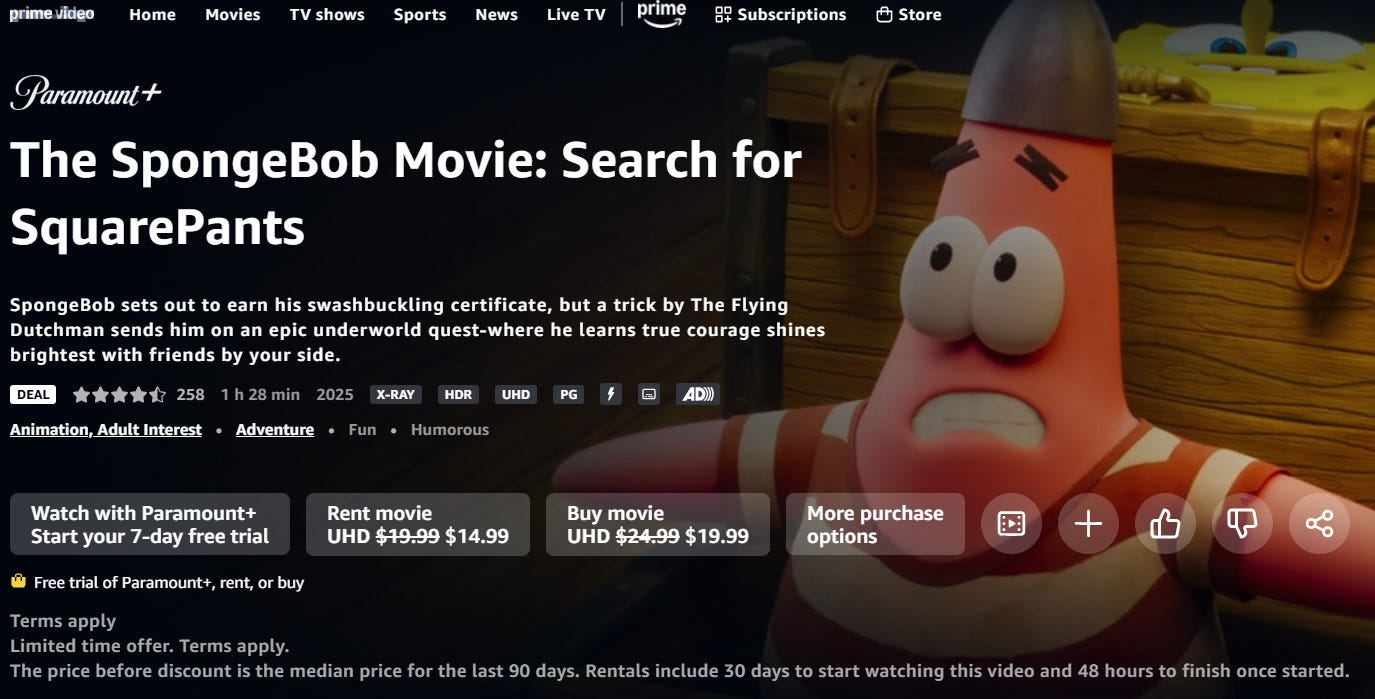

For just $13.99 a month, you can watch movies you pay more than $14 each to rent without ads. Lucky you!
Movie theaters are very expensive to build and maintain, while the streaming viewer covers the cost of their own living room and screen. Similarly, the streaming viewer pays the costs of internet connection and data transfer. Unlike film, digital products require only one edition, rather than at least one hard copy per theater. They do not require a person to run a projector—the computers handle the scheduling, ticket purchases, and exhibition—the viewer provides the popcorn, too.
The cost of exhibiting a film, to the producer, are as low as they could possibly be. For Paramount+, it is promotion, performer royalties, and server costs. Viewers once had to pay portions of rent, maintenance, taxes, fees, labor, printmaking, and shipping in the cost of their movie ticket. None of those exist for a film streamed into a living room.
Because religious epistemics follow modes of production, and we mimic the gods, religion manifests in accordance with social power relations. Those who control the means of production become most like the gods of their era, and vice-versa. Having secured a monopoly on theism in American culture, the new concern is property relations—how to utilize this new technology that allows us to see, record, store, and transmit universes of data, without risking the blasphemy of “piracy.”
We are reminded it is a mortal sin to steal.
It is also a mortal sin to covet, though. Commercial publicity provokes coveting, by design; morality is fit to an era’s relations of production.
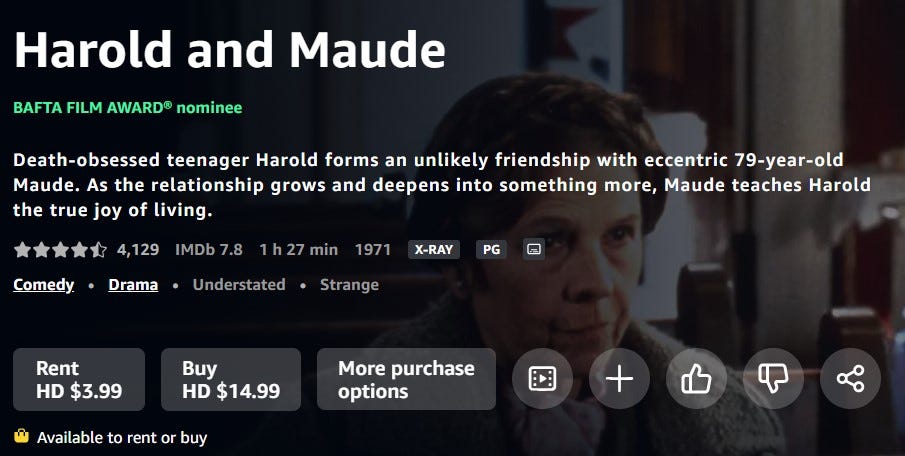
It is immoral to pirate another’s data, yet the data we each produce—that can only be produced by each of us—is extracted via that same tool, commodified, and sold. Unlike a movie made fifty-five years ago that has been wiped from all but one streaming company’s servers, and is rented for the relative bargain price of $3.99,
our social data is contemporary and captured in real time. It includes our particular use of the internet, but also our material lives as they are lived through (amazon deliveries) or alongside the internet (appointments on Google calendar). With the Ring camera network, every doorstep with one becomes part of a social surveillance web that just so happens to be turned over to the state, from time to time (to catch lost pets, you see).
If it is possible for tech companies to create and share information about each of the people who use their software, then it is possible for them to also record how much value they have gotten from each individual user. That makes it possible for users to be assigned commissions for the sale of their own creations: Their data.
Data collection assumes the god-role and the mortals are observed and judged. This is most dramatic in social class terms, where the owning class is gathering and trading value produced outside the shop floor by the people, with absolutely no inclinations for payment. At least our labor-power is purchased; our data is simply pilfered, and justified by a model of an all-knowing god.
For what it is worth, the corporations themselves do not concern themselves terribly with the social class of their consumers—to Google, we are all worthy of being treated like Proletarians. That is why the world is able to read Jeffrey Epstein’s emails detailing piles and piles of information he would have never wanted others to see.
Before the DOJ could release it, the FBI had to obtain it, and before that happened, Epstein had to produce it, and Google had to store it. The all-knowing god is a privately-held entity, but that privacy only works in one direction.
We routinely surrender constitutional rights as the sole means of accessing software, giving to the ruling class what the Founders fastidiously prevented the state from demanding from us, without Probable Cause. They believed personal information to be so important they constructed a right around protecting it. I think ownership of the data one produces (as well as birthright copyright of one’s name and appearance) is both fair and just, in response to information-hoarding by the owning class.