
Please Tax Us!
Cannabis users were once willing to cover their costs

“Please Tax Us!”
It was to be the theme of the 2004 Boston Freedom Rally, highlighting the potential revenues that could be collected by legalizing marijuana (we rarely called it “cannabis”). That year’s Rally was washed out by Hurricane Ivan, and MassCann chose other messaging into the future. The historical moment where Libertarian activists asked the state to levy a tax upon their preferred consumable, lost forever.
Taxing consumption of non-necessities is a means by which the state may both generate revenues to cover the social costs of the behavior as well as reduce (to a degree) the frequency of the behavior. It is widely accepted that drug consumption of all sorts carry a variety of social costs, depending on qualities of the drug as well as the frequency, dose, and duration of use. Non-medicinal drug use is thought to shorten lives because of the risks of lethal overdose, and increased likelihood of consumption-related diseases (cancers, cardio-pulmonary disorders) and prohibition-related circumstances for some drugs (risk-maximization policies). Drug consumption-related negligence and accidents put not only the consumer at risk, but also those who may encounter them.
Calculating the social costs of the consumption of a particular drug is never exact. It is a dynamic equation that makes it impossible to know the precise dollar amount the consumption of 1 gram of 25% THC cannabis flower incurs on society. Variables include the demographic qualities of the consumer, where the cannabis is consumed, how it is consumed, the conditions under which it was grown and distributed, the costs associated with disposal, whether other people are immediately present, whether the consumer then drives or stays in one place, et cetera. In any event, we understand there must be costs associated with consumption.
The sweet spot for taxation would be in an amount that covers the social costs of the consumption, as well as the administration of the regulatory agency that monitors the market and enforces the rules. The burden of paying the costs of the behavior is laid upon those who would engage in the behavior. Those who would abstain bear no responsibility to cover the costs of consumption. Should the tax rate be too low, abstainers will then have to step up and cover the costs of liberty being exercised by others.
While a common refrain from Libertarians is “Taxation is Theft!”
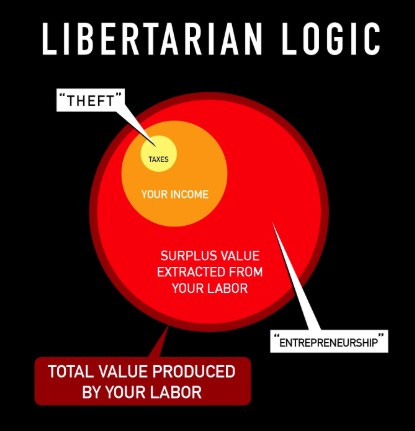
there are some who understand the freedom to act comes with responsibility for the outcomes one’s action produces. The more deeply one comes to understand the exercise of freedom to be a collective activity, rather than springing solely from an individual, the more one is inclined to see workers being coerced into selling labor-power and having the value they produce taken from them due to the sale they were forced to make.
“Liberty” has become tied to social power, with those who have more power exhibiting more liberty, and those who do not have as much social power being coerced into exploitive relationships. This is why dyed-in-the-wool Libertarians do not problematize social power. Their philosophy in a capitalist economy reifies the power of Capital, because Capital holds the greatest apparent power. So when Capital practices socialism through polluting or otherwise laying costs upon the society as a whole, rather than accept them, that’s the “freedom to externalize” where regulation allows it, not “socializing costs.”
Environmental deregulation—from leaving the Paris Accord to gutting the EPA—is Trump’s giant socialist gift to Capital. The society eats all the costs and Capital claims excessive profit—and that becomes the way things ought to be.
Despite rising inflation over the past five years, the retail price of cannabis products in recently-legal states has been falling. Some states’ regulatory structures have resulted in an abundance of supply. Massachusetts and Michigan have seen their retail price for flower drop by more than two-thirds over the past five years.
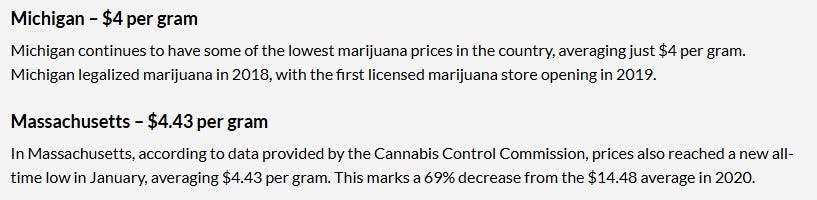
Michigan - $4 per gram
Michigan continues to have some of the lowest marijuana prices in the country, averaging just $4 per gram. Michigan legalized marijuana in 2018m with the first licensed marijuana store opening in 2019.
Massachusetts - $4.43 per gram
In Massachusetts, according to data provided by the Cannabis Control Commission, prices also reached a new all-time low in January, averaging $4.43 per gram. This marks a 69% decrease from the $14.48 average in 2020.
On the other side, Massachusetts’ 20% cannabis tax now generates over a billion dollars a year in revenues, which are disbursed among those municipalities hosting licensed cannabis businesses, used to administer the state’s Cannabis Control Commission, used to fund the state’s Social Equity loans and grants program, and otherwise go to the Commonwealth’s General Fund.
The tax rate was not established by considering the social costs of cannabis consumption. Instead, it was by a couple state senators who had opposed the initiative, detoured the legislation into their control, and changed and raised the tax rate.
Raising tax rates is one of the most effective means by which large-scale reductions in drug consumption have been achieved. This was the underlying strategy of the Clinton Administration’s efforts to get America to quit smoking tobacco—raise taxes to the point that consumption becomes too costly, personally. The only drawback to this approach is that people will develop non-taxed or less-taxed alternative distribution networks, as the tax rate climbs.
I met a couple cigarette smugglers when I lived in New Hampshire. The state’s officials make a big deal of “Tax-Free New Hampshire,” and the tobacco and gasoline taxes are among the lowest in the nation—encouraging Massachusetts smokers to travel north, buy the carton limit and fill the tank. These guys worked at a state line convenience store/gas station. Unlike retail customers, they were able to obtain cigarettes by the case at wholesale cost, plus NH tax. They may have been paying $25 a carton, in 2011.
They would load a trailer every month and drive to the Bronx. Cigarettes in New York City were selling for close to $10 a pack at the time. They were making thousands per round-trip.
Starting with a high tax does not leave much room to move, in terms of improving public health by reducing non-medicinal drug consumption. As more border states legalize cannabis, it becomes a competition between states. There is also a number of legacy growers and sellers that need to be accounted for, but their numbers are shrinking, as they are being underpriced by the licensed market. One of the expressed goals of the Massachusetts CCC was to put the legacy market (and all its small businesspeople) out of business. Personally, I would have invited them to the party, first, since they had shown the ability to operate in the cannabis industry.
But it was important not to show up the prohibitionists. You may have noticed that every form of legalization implemented is built from the imaginary condition that prohibition was successful, rather than a failure. Those most active in the unregulated market were largely excluded from forming the regulated one. Various barriers—financial, primarily—were erected to keep them out.
All of this is prelude to saying: Michigan’s choice to raise a new, 26% wholesale cannabis tax, is not going to “drive people back” into unregulated markets. What happened was the state projected some amount of tax revenues from cannabis sales. How they would choose to disburse them or why they chose the initial rate they did is immaterial. What matters is they thought cannabis flower was going to retail at close to $5 a gram, and they found the market price at $4 a gram. This will cut projected tax revenues, relative to consumption, and would cause a tax shortfall relative to projections that were made and expenses to be incurred. The way to raise the revenue would either be to increase the tax rate (as they did) or decrease the supply through regulation, until the retail price rose.
What does the 26% Michigan wholesale cannabis tax mean? A $4 gram of flower is now $5.04. It remains among the lowest prices in legal states. The legacy market will still have difficulty meeting $5 a gram, and we have seen the majority of legal cannabis purchasers prefer the variety and convenience of retail shops. There will likely be a reduction in the volume consumed, and some who may have made a purchase will decide the price is too high, but overall the legal market will not see the exodus some warn about.