
Polling Data
Popularity does not matter under a dictatorship

All the hypotheses of manipulation are reversible in an endless whirligig. For manipulation is a floating causality where positivity and negativity engender and overlap with one another; where there is no longer any active or passive. It is by putting an arbitrary stop to this revolving causality that a principle of political reality can be saved. It is by the simulation of a conventional, restricted perspective field, where the premises and consequences of any act or event are calculable, that a political credibility can be maintained (including, of course, "objective" analysis, struggle, etc.) But if the entire cycle of any act or event is envisaged in a system where linear continuity and dialectical polarity no longer exist, in a field unhinged by simulation, then all determination evaporates, every act terminates at the end of the cycle having benefited everyone and been scattered in all directions.
— Jean Baudrillard (1981) "Simulacra and Simulation."
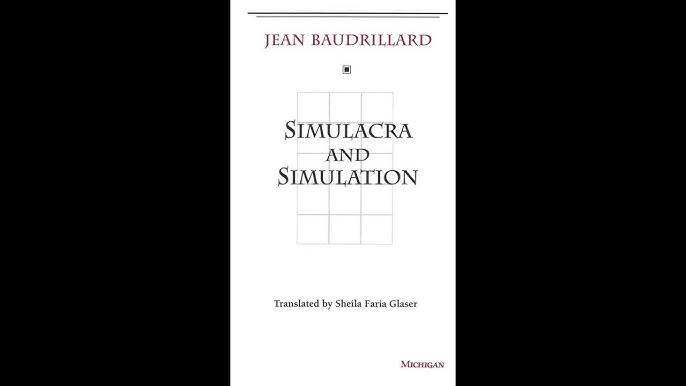
Lately I have been reading Postmodern and Poststructuralist theory, in part because it seems to me we are further into their praxes. We are orders of magnitude deeper into an electronically-mediated social order since I last wrestled with Baudrillard, Derrida, and their ilk, near the turn of the millennium.
Public image matters in a democracy—this is the reason for preoccupation with political polling results. Popularity matters, and every so often, we select members of our political administrative class solely by that measure. Or, at least we used to. Machinations to limit exactly whose opinion counts further reinforce the concern with popularity, and illustrates the amorphous nature of its determinism.
Our politics have traditionally rested on the ruling class filtering candidates for federal office through a bifurcated, though wholly corporate capitalist, party scheme. The more established this party rule became, the safer it became to open voting to women, racial minorities, and 18-year-olds. By virtue of their lesser social power, the self-interests of these groups challenged the rule of white, landowning men. But the party scheme would ensure no “third party candidate” (though there have always been more than three parties—this is how hegemony works) would stand much chance.


Since 1888, eighteen candidates who were not members of the Democratic or Republican party received at least 2% of the popular vote, across 35 presidential elections. Combined, those 18 “third party candidates” amassed 213 total Electoral Votes. Not enough to win one time. Note: Former Republican President Teddy Roosevelt won 88 Electoral votes as the Bull Moose Party candidate in 1912; the strongest-ever showing by an outsider candidate—who had previously been screened and selected by one of the franchises.
Popular determinism, however, has again become problematic. While the uniform whiteness of the political class has been challenged (though we have never come close to proportional representation by race) and the Republican Party is strengthening its glass ceiling for racial minorities, the more important element of the original political power structure—social class—remains.
While the poor have been welcomed into suffrage, there are piles of systemic and procedural barriers that make it impossible for people who must sell their labor to survive, to run for federal office. The first qualification to be a candidate remains having demonstrated that one can survive in a capitalist economy without being required to daily sell one’s labor-power. In other words, to own a means of production. The most prominent “third party” candidates of my lifetime have been self-financed billionaires (Perot, Forbes, Bloomberg), whose greatest qualification has been that they are wealthy enough not to have to rely on being popular.
But as the schism between those who own and those who work becomes more obvious we have seen voters coming to appreciate a romanticized version of the past.
One one side, those workers who subscribe to the hegemonic framing of social class want America to be “Great” again and believe eliminating outsiders, pushing women from the workforce, and corralling “liberals” will cause their earnings and quality of life to grow. On the other side are those who see our status quo as the result of policies that diminished the public sphere while accelerating the upward flow of value. They believe that by reinvigorating state support programs (universal health care, expanding public education, infrastructure) while regulating and taxing the transfer of value, that the quality of life for all non-wealthy Americans will improve enough that they might again imagine they can work their way into the ruling class.
One group falls hard for the old hegemony (while their leader is dismantling what’s left of it), while the other recognizes it has broken down, but wants to bring it back.
Underlying all of this is the assumption that popularity matters. A cursory examination though will show us that when he lost the 2020 election, Trump initiated a simulation in which he won. He convinced members of the new, white lumpenproletariat (as evidenced by their criminal convictions, post-pardon) that they were empowered to overthrow the government, in the case of his election being stolen.

Lumpenproletariat
Roughly translated as slum workers or the mob, this term identifies the class of outcast, degenerated and submerged elements that make up a section of the population of industrial centers. It includes beggars, prostitutes, gangsters, racketeers, swindlers, petty criminals, tramps, chronic unemployed or unemployables, persons who have been cast out by industry, and all sorts of declassed, degraded or degenerated elements. In times of prolonged crisis (depression), innumerable young people also, who cannot find an opportunity to enter into the social organism as producers, are pushed into this limbo of the outcast. Here demagogues and fascists of various stripes find some area of the mass base in time of struggle and social breakdown, when the ranks of the Lumpenproletariat are enormously swelled by ruined and declassed elements from all layers of a society in decay.
Despite piles of evidence (and 10 counts of obstruction of justice Robert Mueller discovered in a separate matter), the Biden administration showed the opposite of urgency, when it came to prosecuting the attack on the nation. It would be the greatest dereliction of duty of the old nation’s history, if one thinks of the franchises of the political cartel as opposed to each other. But if one sees them as a façade for a single ruling class, and the nation-state as increasingly the instrument of that class, it was very important that Trump not be held accountable.
The ruling class has had about enough of the liberal nation-state. It has served its purpose and with rising, direct surveillance technology, this general guarantor of personal privacy needs to be sidelined.
We have been simulating democracy in a variety of ways, in terms of who is permitted to vote, and who they are permitted to vote for. The ruling class being content, for the most part, with an a priori narrowing of the candidates, either through the old way with backroom dealings, or through the new style, where party leadership hands resources to its favored candidate while suppressing primary challengers.
Voter fraud is also a simulation—made to seem far more impactful than it ever could be. The sheer volume of votes cast in a Presidential election renders voter fraud essentially meaningless, and the means to minimize the impact of voter fraud would be to get as close to 100% of eligible voters to cast a ballot. Statistically, more access to voting and more participation are the workable strategies.
It should come as no surprise that Republicans see the “solution” to be exactly what would make voter fraud more impactful.
The Heritage Foundation discovered (and they argued, before collecting this evidence, that voter fraud is a problem) dozens of cases of election fraud, over the past 24 years. Dozens might seem high, but there were more than 885,000,000 ballots cast in Presidential elections over that time. The effect of election fraud—even with pathetically-low voter turnout—is statistically negligible.
So as we lived for years under a simulation that the 2000 election produced a winner through voting, and the 2020 election was illegitimate, we are now forced to deal with a simulation that frames electoral fraud as a meaningful problem. The large majority of those convicted of voter fraud since 2016 have been registered Republicans, but it is the Republicans in office who are most publicly concerned. It’s much like how those convicted of child sex offenses will have a past record of persecuting “groomers and pedos.” Or how some of the more vociferous, anti-gay “family values” candidates and officeholders turned out to be in the closet.
A whole lot of simulation has been taking place.
In terms of the operation of the Trump Administration, we have long known that image is believed to be more important than substance. It was the case with the earliest ICE deportations, it has been the same with hiding the Epstein files, and it has carried over to foreign policy. We are now in a war of indeterminate purpose, and the United States is suffering casualties like it has not since Viet Nam—not in terms of lives lost, but bases that have had to be abandoned, key military equipment destroyed or damaged, and lack of public approval.


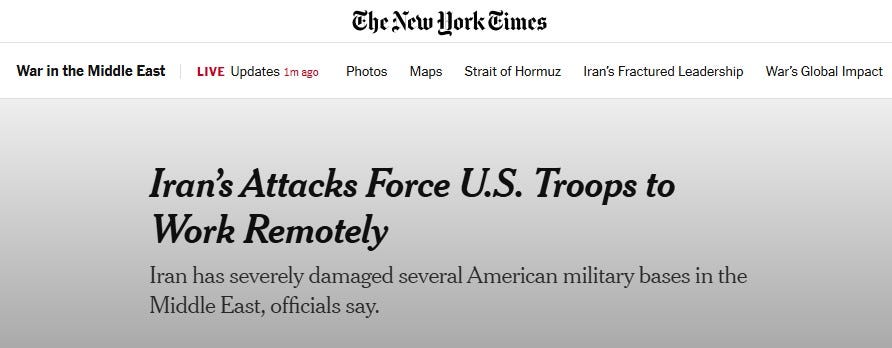

Unlike with Bush I and II, there was no attempt to sell the American public on the war, and Trump’s experiential learning style has left him flummoxed. All his past experience showed that military strikes were short-lived and successful. Why would there have been any reason to believe Iran would be different?
There were lots of them, actually—Iran’s control over the Straight of Hormuz merely being the most obvious. But Afghanistan, Syria, Iraq, Yemen, and Venezuela did not have such capabilities, so Trump never experienced military aggression prompting an energy crisis.
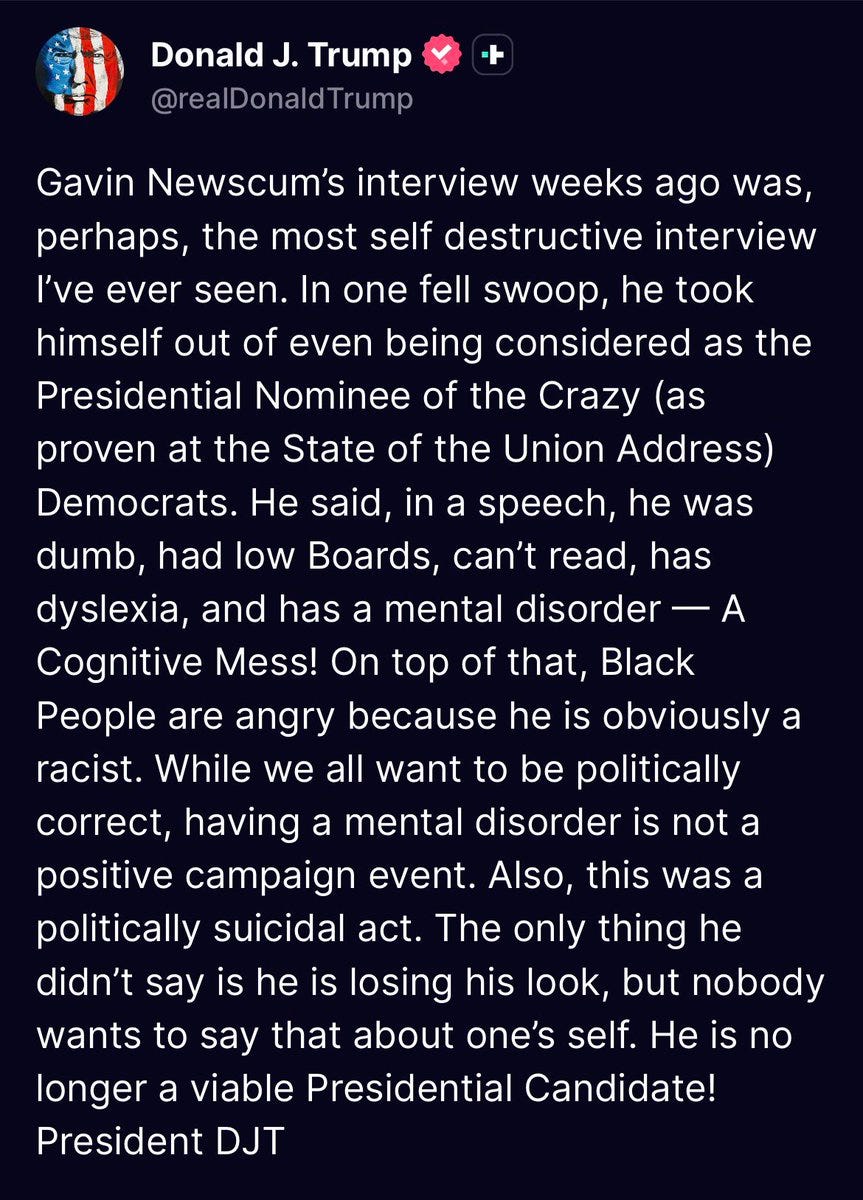
While Trump casually attacks Gavin Newsom, saying Newsom has a “mental disorder” for being dyslexic, the evidence of Trump’s own learning disability (and his creeping dementia) mounts.
Every accusation is a simulation, when they are actually confessions.