
Power, or The People
Deep in the battle over legitimacy

The nation-state exists in the records it keeps of its populations—birth, marriage, and death, traditionally. A variety of other records are established over the course of the average lifespan—public education, tax payments, licensures, deeds, military service, civil and criminal legal actions—but these vary by time, place, and personage. The records that make the state occur in every instance of a citizen, the others are records of the administration of the state.

The nation-state also realizes itself upon the bodies of its population, by making demands from them, from time to time. Through military conscription, legally-required public service, seizures of property, incarceration and prisoner-slave labor. The state also mandates (for some) ten secular “holidays,” the term coming from “holy days,” during which laboring was prohibited. This secular version demonstrates a different ruling hegemony—the purchase of labor-power having been rendered a minor matter of morality.
Less than fifty years ago in Massachusetts, the only retail establishments open on fifty-two Sundays a year were grocery stores, convenience stores, and gas stations. That was it. In a densely-Catholic area, Sunday was a day of rest for everyone. When I was a student in public school, Good Friday was a school holiday, despite having no official state designation.
A special exemption had to be carved out in 1929, to allow baseball to be played in Boston on Sundays.
According to the city archives, the first Sunday Red Sox game was an exhibition, with the crosstown Boston Braves, on April 14, 1929. Some 5,000 people attended.
That game was down Commonwealth Avenue from Fenway, though. Here’s why: “Fenway Park’s proximity to a house of worship forced the team to play its Sunday home games at Braves Field instead.”
It was more than three years later before the first Sunday game was played at Fenway.
Like with today’s cannabis retail stores, playing baseball too close to a church was problematic; like God might see it.
It was actually a Latter Day Saint, Mitt Romney, who lifted the ban on Sunday retail, when he was Governor of the Commonwealth.
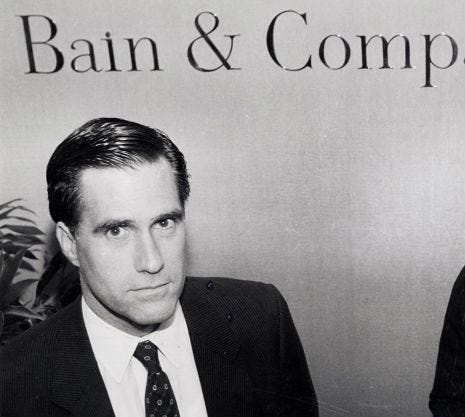
Mitt was once head honcho at Bain Capital and the milk-drinking, non-smoking, living peer of Wall Street’s Gordon “Greed is good” Gekko. No doubt he tithes generously back to the community; social ties are both strained and strengthened under desert conditions, it is where all Abrahamic faiths grew from and Brigham Young happened to find the North American simulacrum of the Promised Land.


[n.b. While the desert and the salt lake on each continent are materially different, the meaning of the desert and the salt lake are perfect copies of an original that has never existed. It is not the place that is the simulacrum—regardless of resemblance of the locations to each other, or the resemblance of the meaning assigned—it is the assignation of meaning to the symbol.]
Cults gain legitimacy through amassing material forms of social power. It is not the power of the theology or philosophy itself that makes a new religion make the leap from margin to mainstream. Cult members are by definition major deviants, and cults use this marginalization to build member loyalty, whether in the desert or not. Proselytizing serves two purposes—to spread general awareness of group principles and values, and to recruit new members.
The secular state was utilized as a tool in a series of localized religious conflicts against the Mormons, a large number of whom fled/migrated to the shore of the Great Salt Lake following the vigilante mob murder of Joseph Smith. From there they levered secular state-formation as a tool for establishing their religion’s legitimacy. Before the state started keeping records of births, marriages, and deaths, the Catholic Church realized its administrative power via documentation of social life. Protestantism’s invalidation of bureaucratic salvation individualized Christian dogma and spelled the end of centralized record-keeping. Lutheranism memed out into a hundred epistemological houses over the following centuries.
The nation-state took that administrative authority, secularized it, and levered it to mobilize huge populations. The natural resources commanded via territorial sovereignty materialized as power—in the case of petroleum, methane, coal and uranium, literally. Beyond natural resources, productive capabilities in every direction (including destructive), became the measure of a nation-state’s worth. Conveniently measured in the currency of the most economically-dominant nation-state.
The nation-state was the administrative means by which the Americans separated themselves from the British. It was not through British or any international law that the first nation-state was formed, but from a praxis of Bourgeois class interests. The social class formation was itself cult-like—where a small number of early-adopters began to lay claims on territory and manufacturing.
The tale of Robin Hood is still told today because it contains allusions to private property and foreshadows what would become the demos. Robin Hood did not rob from the rich and give to the poor—those were not social classes, they were castes. No amount of stolen taxes would change the relationship between monarch and serf, because the serf could never legitimately claim that which belonged to the monarch. Ultimately, everything in a kingdom was the king’s, the lands issued to various princes, dukes, and lords, to administer on titular grounds. Over generations they laid claim to growing portions of what was once the monarch’s.
This proto-bourgeoisie came to value communication as a resource so greatly as to include a postal service in the language of their Constitution, and to explicitly ensure free communication (speech, assembly, petitioning) through the first amendment. Democracy required open communication, both for the legitimacy of the new state as well as for its ongoing operation. If the People are their own source of governance, then the strength of the government is found in the health, strength, and knowledge of the People.
The liberal nation-state has again become a problem for a ruling class. It is not clear at this time precisely what is going on. We have a tiny number of global billionaires who are now claiming resources greater than several nation-states. They are engaged in technological development that once was reserved for nation-states, simply because only the nation-state had the capacity to mobilize resources sufficiently to build the Hoover Dam, atomic weapons, or the internet. Still, there is no social body that has the ability to lever the promise of future production as the United States has, over the past century. When capitalism runs into one or more of its contradictions and staggers, the nation-state is the only entity that has shown the capacity to save that economic form.
While a global trillionaire might have the wherewithal to muster an economic recovery, he will never find the motivation to do so until it is too late for him.
Trump, Musk, and others are leveraging the nation-state in manners not unlike how lesser royalty leveraged crumbling feudal relations of production. More than anything, we are engaged in a battle over legitimacy. The legitimacy of this proto-class’ claims to resources and the People’s legitimacy as self-governing. Only one can survive.