
Principles and Purposes
The How and Why for a New Phase of Resource Mobilization

Today’s “Practicing Sociology Without a License” comes from “The Floral Society” page, which is a new project to move cannabis legalization forward by appealing to casual consumers in legal states.
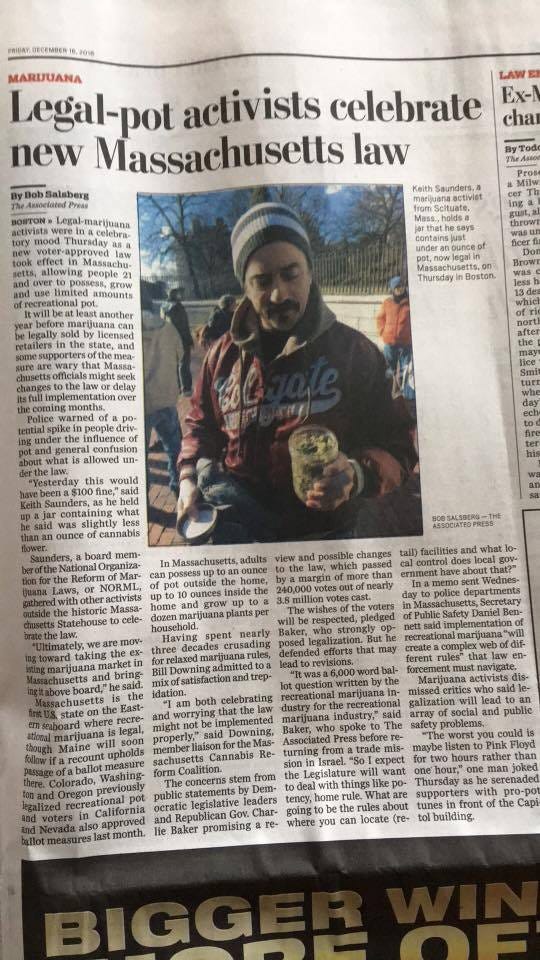
Dr. Keith Saunders, a sociologist by training, chose to focus his professional career on studying social movements—the marijuana policy reform movement, in particular. A regular marijuana user since his first year in college, Saunders had a scientific obligation to disclose his self-interest in the ethnographic research he was undertaking. “This is a War, and I am an Enemy,” he acknowledged in his doctoral dissertation proposal, which also listed 25 drugs (including marijuana) that he had consumed in his lifetime, and his reasons for consuming them. The Chair of his department tried to prevent him from doing this research by refusing to sign off on his proposal, claiming his admission of having used marijuana would put University funding at risk.
Most marijuana policy reform activists are proud deviants, who speak up when they believe they have been wronged. It is a rare, and necessary, personality trait. But personality is formed as much from our social lives and biographical incidents, as it may be baked into biology. The proud deviant must be made into a deviant by others, first.
Many marijuana reformers can trace the root of their activism to a particular encounter with police or other authority figures that did not turn out well for them. Having to overcome the cannabigotry and other obstacles to his undertaking drove Saunders, who had been in the “cannabis closet,” to become closer to his research subjects. To do research on marijuana reform activists, Saunders first had to become one, fighting institutional discrimination against a marijuana user—himself.
After getting past the Chair’s obstruction and completing his dissertation, Saunders spend the next twenty-five years organizing marijuana users as a NORML member, chapter leader, and national board member. Across the years, more and more states adopted medical marijuana policies, and then the legalization wave scored its first victories in 2012.
Social movements coalesce around sentiments, when people feel the world around them need to be changed. These movements are both against a status quo (thus are sometimes referred to as “counter-cultural”) and made possible through mobilizing resources (human, financial, political, cultural) to achieve goals believed to be favorable to the movement. The problem that spurred the development of the marijuana policy reform movement was prohibition and the criminalization of the marijuana users. The users did not coalesce around a sentiment of opposing prohibition, though—it was through shared enjoyment of getting high.
While the criminal prohibition of marijuana may or may not exist, relying upon it as if it was the central motivation for the formation of marijuana culture and a social movement of marijuana users misses the mark. While prohibition had a dramatic effect upon the appearance and dynamic of marijuana culture as one of self-selected, marginalized people, the end of prohibition means greater normalization and changes in how aficionados regard each other, communicate, and what interests they may share.
In short, ending prohibition ends the prevalence of the marijuana policy reformers as a defining element of popular marijuana culture. They were a rare breed, to begin with, but were remarkably successful (race, sex & social class had a lot to do with this) in a very short period of time, for a social movement. One means of differentiating a social movement from a phenomenon like a fashion or trend is the multi-generational aspect, both internally at any given time as well as across generations. Some of today’s American feminists, for example, are among the eighth generation of women who started a social movement by self-advocating for the right to vote and own property, equal to men.
For as long as the act of getting high is taboo, for as long as there is suspicion around the enjoyment of cannabis, the enjoyment of cannabis is ripe for gathering people by this shared sentiment. Sharing criminality demanded trust and built strong bonds, but it also discouraged public disclosures. Legalization has brought people who would never before have disclosed their consumption to turning over their government-issued ID to be scanned and recorded as a condition of purchasing cannabis products—which remains a federal offense.
The core of a cannabis culture and social movement remains. State legalization has led masses of people who are otherwise apolitical to violate federal prohibition, to create a cumulative state-licensed market currently estimated to be worth a bit over $30 billion a year in combined retail and patient-only sales. The American firearms industry (including sales to military and police), by comparison, is estimated to sell under $24 billion of products a year. A major difference being guns are legal in every state, while cannabis is legal in less than half of them.
Clearly, the cannabis consumers are a substantial market segment and have been used by licensed cannabis businesses and trade associations to fund lobbying at the state and federal levels. The idea behind The Floral Society is to direct resources (human, financial, and cultural) to create political change—to kill prohibition, but also to create better conditions for cannabis consumers in legal states. The Floral Society is for people who enjoy cannabis and who appreciate having their “fandom” rewarded, it is for people who like to gather with old and new friends to discover and learn while getting high, it is for people who want to support legalization and beyond.