Proletarianization
And other devaluations of labor

Profit is located in the gap between Exchange Value and the cost of Labor-Power.

By design, the Exchange Value must always exceed the total costs of production, of which Labor-Power becomes the greatest proportion. If, for example, a capitalist invests in a new machine, the cost of that machine will be amortized over every item manufactured by that machine. Recouping the entire cost of the machine can be achieved in relatively short order, but even should the machine allow the capitalist to dismiss half the labor force, those laborers’ Labor-Power may only be amortized over the items they manufacture in a pay period. There is no possible final payoff of the cost of Labor-Power. Instead, there is an incessant downward pressure upon how much laborers may charge.


This is the everyday class war. A global social class of workers sell their ability to work for just enough (or not enough) to afford to return to work the next day. Capitalists are the only buyers and are incentivized as a social class to reduce the cost of Labor-Power to near zero.
This is often achieved via mechanization, where the costs of the machine may be amortized across its entire productive output. Ideally reduced to a small fraction of a penny per consumer item, after “the machine has paid for itself” (hint: It never does, purchasers of the products pay for the machine, not the capitalist, if he knows how to be a capitalist). Capitalists outlay capital with the expectation that the productive process will render sufficient value to cover their outlay in short order.
An imaginary, fully-automated, productive process, from extraction to transportation to processing to manufacture to promotion and sales to fulfillment and follow-up—what it took to put a cup of Starbucks coffee within your reach—that has NO human labor involved cannot possibly exist if you do not have sufficient Exchange Value to give, that more than covers the amortized costs of all those machines, the raw materials and energy required for each stage of the process, and the maintenance of the culture in which coffee has value.
The pressure on Capital is to constantly reduce the Absolute Value (Combined costs of Raw Material + Overhead + Labor-Power) of productive processes, principally through reducing the cost of Labor-Power in that process. For this end, every technology developed since the middle of the 19th century that has been introduced to productive processes has been to reduce the cost of Labor-Power.
Tool-assistance, mechanization and robotics, and computers and analytics—these have been the three main stages of Capital development in technology. Each allows a single worker to increase productivity, relative to workers in previous stages. Increasing the rate of productivity also necessarily simplifies the productive process—this is called proletarianization. The Proletariat is the working class and as productivity is simplified, de-skilled, and homogenized, the pool of potential laborers grows. With more supply and steady (or shrinking) demand, prices fall. Fewer corporations competing for workers along with more people seeking paid work drives wages downward, which is the goal of every capitalist.
The interests of the owning class are directly opposed to the interest of the dispossessed. The owning class must ensure the dispossessed not accumulate Capital sufficient to not be compelled to sell their labor-power daily. Those who sell their labor-power are seeking the highest price they can find, but as they are without Capital, they are coerced into selling at whatever price they can.

Manufacturing processes are constrained by the supply of raw materials and the time it takes to convert them into the finished product. Machines may speed the process (faster outputs mean lower cost-per-unit for Labor-Power), and must reduce labor costs. However, the production of language-based culture—words, sounds, and images—what Capital has come to rely upon more heavily, as the constraints of physical manufacture have begun eating into profitability, is increasingly being assigned to machines.
I regularly employ the Substack graphic AI in my pieces on this platform. I have seen it exhibit “human” biases and stereotypes in its rendition of persons and interpretation of phrases. I have also noted that when I use a Substack AI-generated image for a thumbnail, I see more frequent opening of articles than when I use a personal or popular media photo. This is most likely due to algorithmic homophilia, where the algorithm “recognizes” and promotes itself.
The AI machines homogenize human cultural labor, processing uncounted masses of examples to find a combination of variables that make sense to the humans who order them. They do not make sense to the machines; the machines do not have sapience. The machines learn what might make sense to humans by recording what has made sense to humans. Extra fingers, missing appendages, dream-like absences of full gravity, the term “war” requiring weaponry and fire—these are the gaps between the machine processing data and knowing what something should look like.
The recording technologies of the late 19th century and beyond—records, film, digital files—offered Capital the promise of commodities as infinite as culture itself.

Streaming and the enshittification of the internet proved even more profitable than hard copies (which are only purchased once). Immediately after filesharing software had proliferated into the earliest incarnations of Napster, MySpace, and YouTube, we saw the development of anti-piracy programs with their ongoing, mechanized search of the web for unauthorized storage of binary code. Digital files both take up virtually no space and do not degrade with playback—they offer infinite, free culture-sharing, and there is only one force that is preventing this from being universally the case.
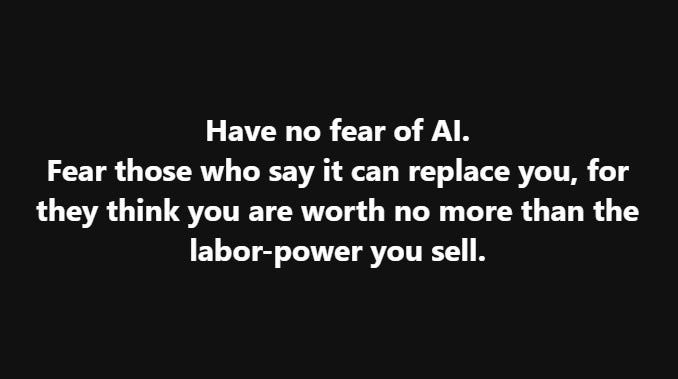
As labor is distilled and homogenized, and increasingly replaced by machines, it becomes worth less and less. For all its speed, AI is incapable of creating anything new—if it was intelligent, it should have at least invented a new math by now (different cultures use different maths; we know the inventors of Planar Geometry and Calculus). Brute force calculations will produce what appear to be human-created outcomes (winning at chess, for example), but those human endeavors that require subtlety and nuance—such as creating a new joke, or a social theory—are outside its current capabilities.
There is much concern over Capital’s drive to fully automate all productive processes, not least of which should come from a basic understanding that without sufficient money in the hands of the purchaser, no profit can be realized from manufacture.