
Reunions
You can't go home again, but with social media, you don't need to

Suburban Americans are an Ethnic Group
I graduated high school in 1986, so 2026 is a Reunion year—our fortieth.
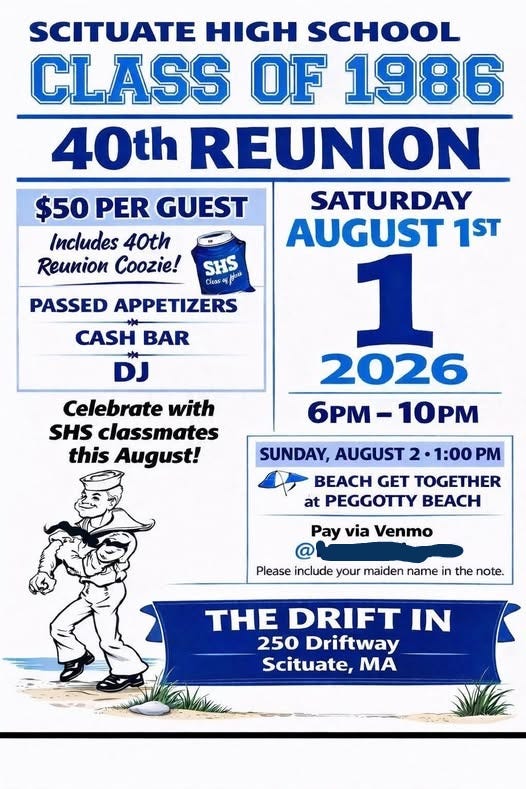
The town of Scituate, Mass., where I was raised and went to high school, was in the cultural wheelhouse of post-WWII American suburbia in the Northeast. We recognized each other by the cars we drove, prime time TV-watching was a near-daily ritual, we found recreation at the local shopping mall, and we judged each other by the commodities our parents were willing to purchase for us. We never thought about the racial segregation ingrained in suburbia, largely because we never knew anything different.
American suburbs developed differently, based on existing population densities. There were suburbs before the popularization of the automobile, whose residents relied on trolleys to commute the six or eight miles into downtown. These earliest, 19th century suburbs, such as Jamaica Plain in Boston or Jamaica, Queens, NYC, were urbanized in the first half of the 20th century, as the automobile changed how Americans arranged themselves.
Post-WWII suburban development was tied to the automobile, which allowed the population to scatter and resettle, establishing wide fields of purely-residential plots, and planting commercial districts along state highways. The residents of these new communities sought retreat from urban density but did not want to live in rural idiocy. Instead, they got an in-between, though still inexorably bound to the city, as evidenced by the name sub-urb, rather than supra-rural.
The automobile allowed the suburbanite the mobility needed to independently commute to work, to shop, and to travel hundreds of miles or more while on vacation. It required an array of new purchases and services, with specialized businesses populating suburbia from the Interstate highway, outward.
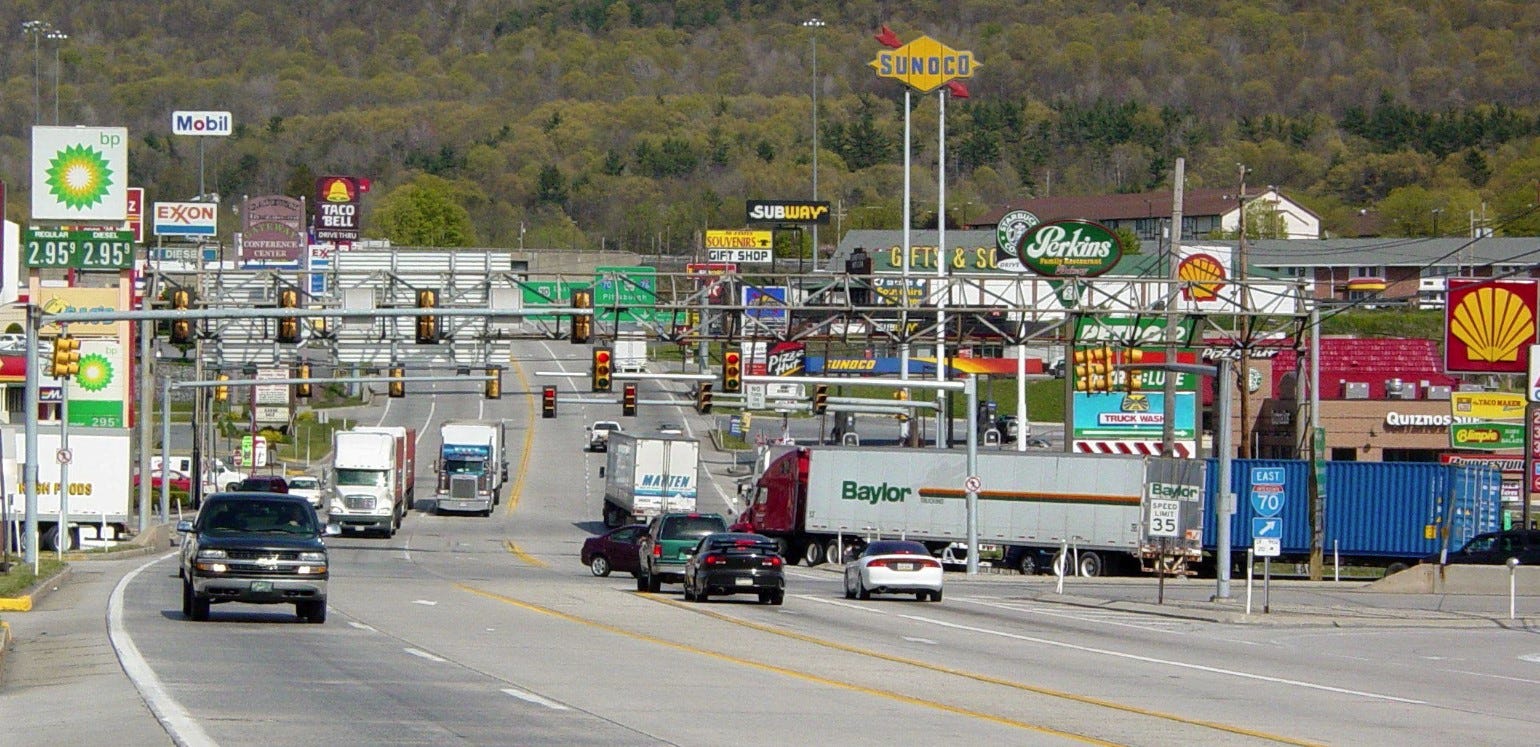
To this day, the suburban highway exit ramp spills into a commercial zone with gas stations, fast food joints, and car dealerships among the first businesses one drives past. The suburban landscape has to accommodate the technology that makes it possible.
Scituate, MA Population (U.S. Census Bureau)
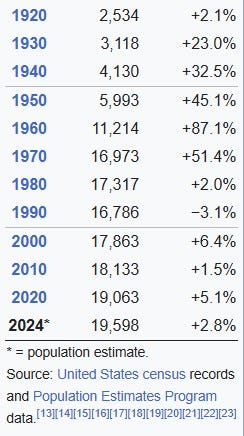
There were 4,130 Scituate residents in 1940. Over the next thirty years, the town’s population would grow by 12,843 (311%). This growth was accommodated by major infrastructural built-outs, including four new school buildings, a new police station, fire station, and town hall, added in the late 1950’s/early 1960’s.
Concurrent with the residential explosion there was the loss of what had been farmland. Flash-freezing, the Interstate system, and commercial flight allowed for more centralized agricultural production than before the war. While prior to WWII, Scituate’s townsfolk ate produce grown locally, the town’s (and surrounding area’s) expanding population alone would have tested the land’s ability to provide. Farmland was sold and subdivided into housing plots, forest land purchased and clear-cut for development.
The commitment to the automobile became so great that the train that once ran from Scituate to Boston was abandoned (while the town’s population was booming in the 1950’s). The land that once bordered the tracks was found much more appealing, and housing developments were erected. Fifty years later, over race- and class-coded objections aired at multiple Town Meeting, the town approved the return of the Commuter Rail train.
The members of the Scituate High School Class of 1986 were born in the late 1960’s, a large portion of them (myself included) whose parent(s) had also been educated in the SPS system. My mother’s was the first class to graduate from the “new” high school building (1962); she and I shared a few teachers there, 24 years apart.
Between her graduation and my enrollment, Scituate opted into participation in the METCO program, designed to bring a modicum of racial diversity to Boston’s suburban school systems. While Scituate has had an enclave of Cape Verdeans and their descendants since the middle of the 1800’s, it has always been than more than 9 of 10 residents are white (actually, more like 9.6 or .7).
There’s an inevitable tendency by members of the majority group to tokenize minorities; to view the people encountered via scant integration as being the “exception.” The negative stereotyping still applies to the identity group, but it applies less to the small number of them encountered through everyday life. Their existence, however, is not enough to counter the belief the stereotypical is the “true” identity.
So while social media (Facebook, in particular) has allowed for classmates to remain in contact with each other in ways never before possible, it changes the nature of the Reunion. The Classes of 1986 held their 10- and 20-year reunions in a world without much social media. The public internet was nascent in 1996—Napster did not yet exist—file-sharing was possible of course, but we had yet to see entire social media platforms developed around it. By 2006, Myspace was the leading social media platform, soon to fall in popularity to Facebook, after its sale to Rupert Murdoch.
By 2016 most of us (it seemed) had Facebook accounts, and it has been through that platform that we planned our 30th Reunion and have been able to stay in touch and observe what has been going on in our lives. Unlike going into the 20th, I know which of my classmates have passed away since our last gathering, I know of their kids—who have grown into adults—and I see them proudly posting their grandchildren’s birth announcements. I know who got divorced, who has launched new businesses, and who has relocated out of state.
I also know who voted for Trump in 2016—about five months after our 30th Reunion—as well as those who went full-MAGA in the years since.
I have former classmates, some of whose own family members were undocumented, who love the War on Immigrants. They cheered absolutely everything the first Administration did, deny Joe Biden won in 2020, and turned the “whataboutism” to 11 over the suspected content of the Epstein files, and than jacked it to 111 as the details have emerged. They are vested in the Administration’s means and the ends. Not financially—there are no deci-millionaires, much less a billionaire among us—but in terms of identity.
I have seen them root for death and cheer human suffering, couched in the politics of the moment. While they can be cordial on social media with our racial minority classmates through liking posts and commenting, they deny that Trump (or they) could be racist. They do not see a contradiction between their xenophobia and their pride in having grown up in “the most Irish town in America.”
They well understand that the version of the American Dream, where labor itself could be a pathway to a wealthier quality of life, has died. Our parents’ generation was the last who knew wages to rise with productivity. The town of Scituate sacrificed agriculture and light industry to build a tax base off residential property, tying the town to the city of Boston and transnational corporations, and causing property values to climb out of reach for many. The majority of my classmates who grew up in Scituate could no longer afford to live in Scituate, decades ago.
The unchecked decline in the quality of life for this generation of Suburban Americans has spurred a violent nativism, their devotion to the Church of the Individual offers them no collective solution to their economic woes. They have found their best efforts have produced no more than social class subsistence, they are resentful, and they were told who to blame.
Given the enhanced, long-term communication channels made possible through social media, I find myself less interested in attending my 40th high school class reunion than any of the prior ones. I have found myself tempted to put together a MAGA-free reunion, for those disinterested in hearing their tongues loosen while they get drunker.