
Social Class Anxiety
Imagined threats take the place of the real one

Social panic is the name sociologists have given to seemingly-irrational group responses to perceived threats. Unlike an individual’s panic, which manifests as acute worry, racing thoughts, and hyperactivity or paralysis, social panics last for extended periods and take on the appearance of everyday life.
Social panic will inculcate individual psyches, prompting them to constantly surveil themselves and their surroundings. The social panic is founded in perception of a threat; surveillance is offered as the treatment for panic. It does not matter what the danger may be: cancer; teen pregnancy; drug abuse; foreigners; guns; malpractices; literally anything that has been identified as a threat can be minimized with adequate surveillance.
Except the redistribution of wealth from the shop floor to the owning class. Our relations of production, in so much as they favor the owning class, are never considered a danger to society.
We might target the residual effects of the relations of production—climate change, for example—and the root of that personal anxiety is treated by making sure one separates recyclables from disposables, and to minimize one’s use of petroleum-based plastics (Use plant-based and biodegradable instead, say the anxiety-management advisors) and other “nonrenewable resources.” This socially-approved self-soothing was so successful we have created a global recycling industry that works well for metals and glass, but unfortunately not well at all for the plastics.
Does anyone else recall when the single-use plastic shopping bag began appearing everywhere, in the early 1980’s? Before then, plastic shopping bags were of a thicker gauge and found in high-end department stores. Our local stores used paper bags for everything from groceries to stationery to six-packs. We were encouraged to use the new plastic bags to “save a tree,” as the 1970’s version of environmentalism focused on domestic air, water, and land pollution. The solution to pollution is to clean. The solution is not to be found in recognizing pollution as the socialization of costs. Addressing the problem in that manner would lean toward changing the relations of production so it “will never work.”
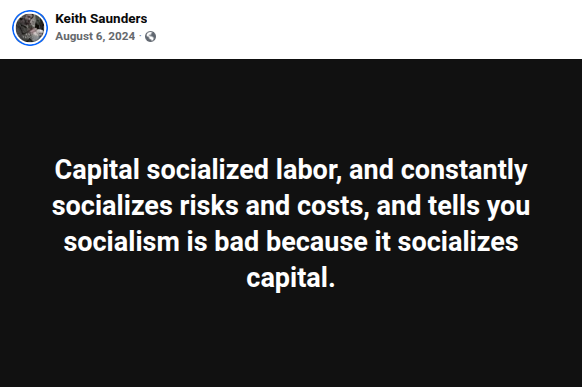
Individuals recycling will do nothing to stop the socialization of the risks and costs of production. Production has been institutionalized as such that even should one choose not to use plastics of any sort, or buy anything packaged in plastic, one must contribute to a mode of production that defaults to plastics. One’s contribution to the plasticizing of Earth (“Purposeful evolution” holds that the planet created us because it could not manufacture plastic itself—so there’s that for redemption) is coerced from you, just as value is drawn from your labors—often through the very same process.
Health has been individualized, as well. We are each responsible for surveilling ourselves. In Modernity this is done using health surveillance modes developed and advanced through the scientific method. Modern surveillance, noted Michel Foucault, started with the Panopticon but would grow to become the responsibility of the self. The Modern individual becomes acutely aware of their blood pressure in ways no humans have been before, and believe they can and should control it. If diagnosed with hypertension, the prescription will include self-surveillance.
Every social panic may be treated with surveillance, every symptom of personal panic arising from social panic may be treated with its own forms of surveillance.
The past forty-five years of globalizing markets has resulted in the collapse of the American Labor Elite. They have been joined by de-skilled former professionals, in their declining quality of life. As the social panics of the same era have been made manifest and institutionalized by Capital and the state (Drug War, War on Terror, War on Immigrants), each of them provide diversion from social class-specific understanding of the phenomenon.
Worry less about declining purchasing power and focus instead on drugs and crime, and then terrorists, and now immigrants. At times the arguments will veer into blaming the targets for working class economic woes, but by and large the mere existence of the threat is sufficient diversion. The treatment, as always, is surveillance.
In order for surveillance to work, everyone must be observed, including the innocent. But if you are innocent, you have nothing to worry about. Of course, with threats abounding it is impossible to say that one’s innocence in one regard does not mean one is not guilty in another. Americans can get uptight about surveillance, so it’s best for those doing it to be as unobtrusive as possible—make the cameras smaller, or just plant a cookie on their phone.

The American middle class has always been in a precarious position in terms of class location; this remains true for what is left of it. There is a cornucopia of management strategies for social class anxiety offered in American suburbia—beyond the conspicuous consumption centers. There are youth sports leagues, gyms, yoga studios, summer camps, weight loss clinics, college prep coaching services, and private club memberships, offering services and/or social networks to demonstrate, improve, or maintain one’s social class position.
The personal relationship most plagued with social class anxiety belongs to middle class parents and their children. Should their children fail to demonstrate sufficient discipline through their childhood, unlike those of the very wealthy or poor, middle class kids will not retain their social class position. Downward class mobility starts at an early age—parents need to constantly surveil their children to be sure they do not use drugs, have premarital sex, play violent video games, et cetera.
The D.A.R.E. program was a remedy for social class anxiety, while promoting it. The treatment is surveillance, both of parents over their kids and, in the early days of D.A.R.E., kids over their unsuspecting parents.
Anxiety-peddling moral entrepreneurs will be visiting Massachusetts in the coming weeks. They will be selling the threat of capitalism, though without ever seeking to address the cause. They will instead say it is “greed” that motivates Capital to create as much demand for their product as possible, while saying our only viable approach is to recriminalize marijuana. They will propagate horror stories whose outcomes were the result of legalized marijuana. They will sell a treatment for the anxiety they spread: Greater surveillance and stricter discipline.
Every evil they attribute to the cannabis industry as an industry applies to the private prison industry. However, they do not seem to object to capitalism in that regard.
Project SAMBO’s solution to cannabis capitalism is to feed the prison-slavery machine more brown bodies.