
Social Desirability
Don't try to make the data say what you want it to say

Someone has come upon the perfect formula for Americans who dislike the Trump administration, part deux: You don’t have to do ANYTHING in particular—there’s a MAGIC NUMBER that will solve all your problems!
3.5
That’s the alleged percentage of the population that must take part in non-violent, public demonstrations, to cause a massive change in the government. With over 3.5% of the people in the streets for a few hours, there’s nothing else they need to do: The government as it stands is through.
It is my professional opinion as a sociologist who has studied social movement that this hypothesis does not hold true across cases—most importantly it does not hold true in the case it is being applied to.
Sure, there are multiple examples of civil unrest that have produced regime changes, where massive public demonstrations signaled the end of the old and the start of the new, but people on streets can only be a correlation, and it simply is not a cause.
There were no mass public demonstrations approaching 3.5% of the population in the months leading up to November, 1989, in East Berlin.
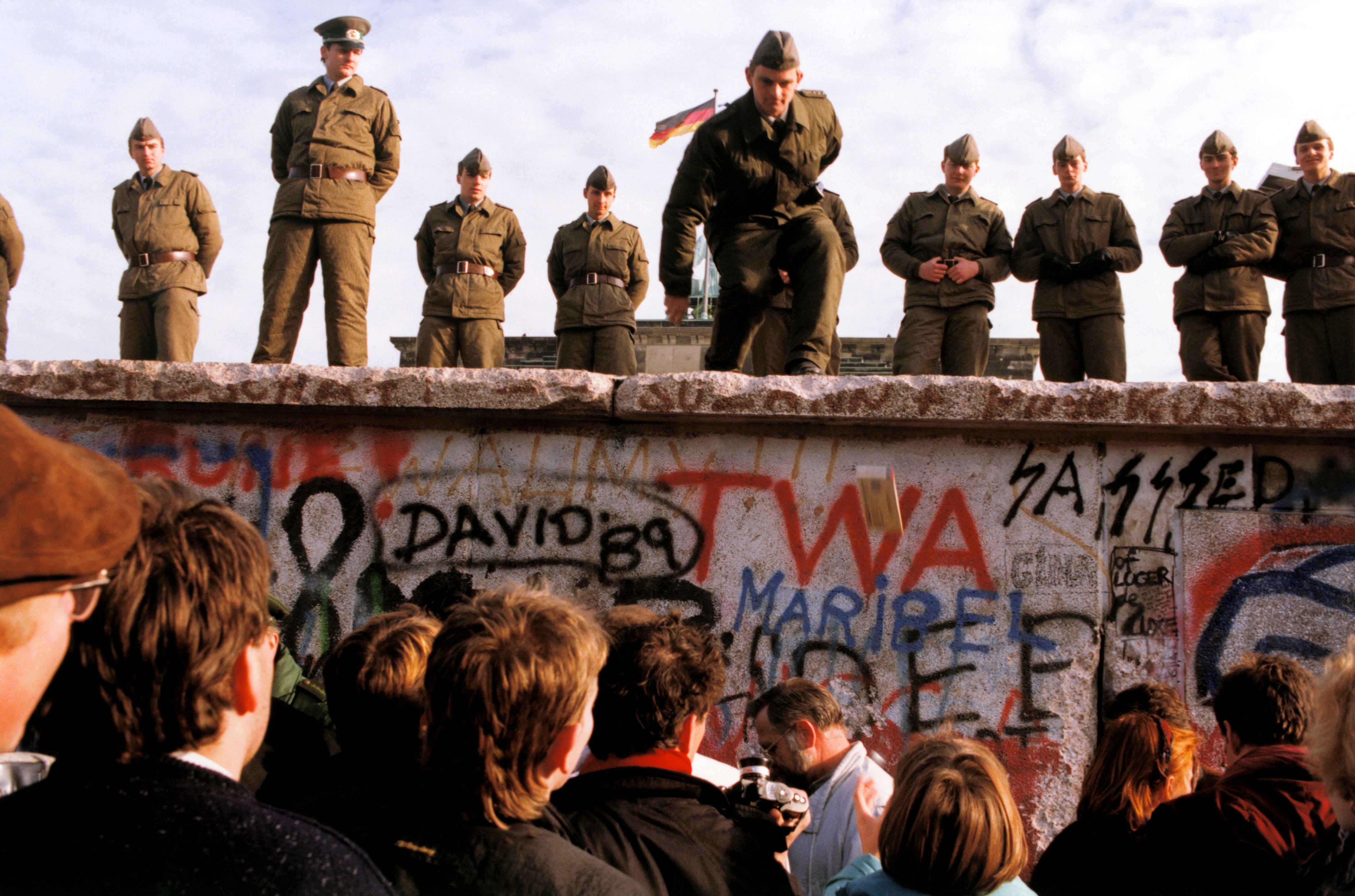
The Berlin Wall was destroyed because an East German official misread an announcement.
Schabowski, reading the statement for the first time, delivered the incredible news that East Germans would be able to leave the GDR without preconditions at all border crossings with West Germany.
“And then all of us started asking, ‘When, when, when, when, when?’” Brinkmann said.
Schabowski responded with: “as far as I know, it’s effective immediately, unverzuglich.”
People needed to act.
There is another historical example we need to keep in mind, when we are talking about tipping points for a population: The MAGA movement.
I understand the MAGA movement to have arisen from over forty years of uncontested Neoliberalism, a corporate capitalist party monopoly over the operation of all federal and state elections, and unrestrained capital development at the expense of those who sell their ability to work in order to survive.
The economy grew, while wages did not. The quality of life declined significantly, but electronics got cheaper so we were told that those are the measurement of our living standard: Phones got smaller, TV’s got bigger, and computers got faster—all while prices were dropping!
That which once was purchased by saving income over a period of time, such as a car or a college education, was no longer attainable without financing from Capital. Health care expenses grew with privately-rationed care, and left one in six people with no coverage at all and living just one affliction or accident from personal bankruptcy.
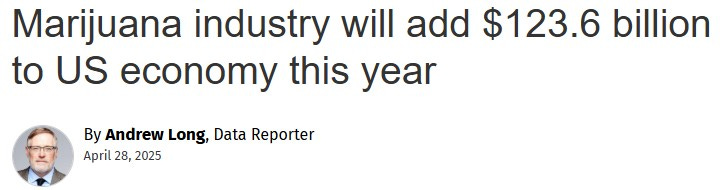
Barack Obama promised Hope and Change, and managed to create a semi-public (as in it’s mandatory, but it’s not single-payer) health care program, but in terms of the economy, he was no friend to working people. Obama’s administration was the epitome of identity politics over social class—his mission was to advance the Neoliberal cause, while increasing civil rights protections for gay people and adopting (after publicly mocking us, on two separate occasions, for suggesting it) a hands-off approach to state marijuana reforms.
“We took votes about which questions were going to be asked, and I think 3 million people voted or 3.5 million people voted. I have to say that there was one question that was voted on that ranked fairly high, and that was whether legalizing marijuana would improve the economy and job creation.
“I don't know what this says about the online audience, but I just want -- I don't want people to think that -- this was a fairly popular question. We want to make sure that it was answered. The answer is, no, I don't think that is a good strategy to grow our economy.”
n.b.
Obama’s election led to people in streets. On one side there was the Tea Party movement, which laid blame on elected officials for failing to balance the federal budget, held rallies in public parks, and seated Republican-affiliated candidates in federal and state offices. The Tea Party’s concern with deficit spending did not arise during those Republican administrations (Reagan, Poppy Bush, and W. Bush) that continuously set deficit spending records. There was something different about Obama, to them, though.
On the other side was Occupy, which laid blame on the wealthiest 1% for economic practices that were leaving the large majority of people behind. Neoliberalism, in other words. They also held rallies in public parks, but unlike the Tea Partiers, got the piss beaten out of them by state agents.
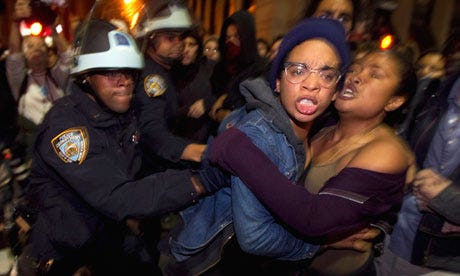
A critical sociological eye would ask why it is that these two movements suffered such divergent outcomes—one got people elected to public office and the other was violently quashed. The authorities were the same in both cases, but the protestors’ targets were quite different. The elected public official is a Bourgeois creation, designed to take the heat off the economic ruling class. Being pissed off at politicians, clamoring for term limits, decrying their irresponsible spending, and calling them corrupts means the politicians are doing their job. When people start laying blame upon those actually calling the shots, they call upon their agents to start shooting at YOU.
Despite these two movements, arising alongside each other, and capturing a sizeable piece of popular attention, there was no regime change projected while Obama was in office. There were no social scientists promoting a quantitative measure that would surely spell the end of the government as we knew it, should the threshold be reached.
But the Tea Party and Occupy were not a unified movement.
Ah, yes, an intervening variable that has been left out of the 3.5% discussion—what are the motivations of those who are taking to the streets? Does the hypothesis prove true when 2% want one form of change and another 2% want its opposite? In this case we will have more than 3.5% of the population seeking change.
Okay, so the 3.5% means all of them support the same general idea of changing the government in the same way. So it’s not just 3.5%, but it is a particular 3.5%. There’s a specificity to the movement, in terms of goals and backing. Surely, there must be other, unspoken variables.
What about money? What percentage of political spending in a given year is enough to transform larger governmental institutions? We have seen one social class—a small minority (less than 2%)—transform the electoral process into a pure pay-to-play scheme, via the sheer vastness of their financial resources. Would 3.5% of Americans from outside the ruling class be able to overcome being outspent, out-messaged, and otherwise locked out of political office? By merely taking to the streets?
There’s one other thing the social scientists who are promoting this idea of a 3.5% threshold failed to take into account: Donald Trump never drew 3.5% of the population into public demonstrations against the government at any time, from 2015 through today, yet he’s creating a new style of governance for America.
He did not seem to need the 3.5% that we have been promised will automatically result in regime change.
This is an illustration of how to critique social movement theories. It would be nice if there was a magic number, but there simply is not. Public demonstrations are a manifestation of social movement, but they are not the movements themselves. Without doing actual labor, nothing will happen.
Reducing a theory of large-scale social change to a particular quantity is part of the reason we are in the mess we are in. Computers and bureaucrats work well with quantities, but social life is more qualitatively complex than to be understood by counting people.
If we are to create a new government from the collapse of the old one, we are going to have to have a new constitution (or something that resembles a constitution). If those 3.5% of people hitting the streets is indeed enough to topple the Trump administration and the MAGA party, we will be seeing other, very powerful people stepping up to tell us what this new constitution will consist of. Without those 3.5% sharing a good idea of what they want the new governmental form to look like, the one we get will not be far removed from the one we have.
.