
Spectacular Exhibitions
Give the people what they think they want

The “professionalization” of sports involves attaching all the meanings and relations of production that come with commodification upon the sporting activity and—more significantly—its participants. It means producing sporting events for the sake of selling them to non-participants, who choose multiple points of engagement with the spectacle.
Some are fans, who have personalized their relationship to the brand or franchise and demonstrate their loyalty through the amount of time and money they dedicate to their identity. Others have rooting interests in the sports market, less for one team in particular than for their own investments, betting interests, or employment opportunities.
The spectacular qualities of commercial sports are put into synergy with broadcast/streaming media, and game play has long been altered for commercial purposes. If baseball had not already existed, television would have invented a game much like it. The game has built-in breaks in the action: there are eighteen half-innings, in a 9-inning game; seventeen, if the home team wins. In a 135-minute (2 hours, 15 minutes) game broadcast, that’s a 2-minute commercial break about every 7.7 minutes, on average.
The “golden ratio” of commercial broadcasting is 20% ads and 80% “content,” typically a 24-minute show is broadcast in a 30-minute slot. MLB baseball offers an average of 35 minutes of ads, and 100 minutes of content, or almost 26% of broadcast time. This is why MLB changed the rules to limit time between pitches, pickoff attempts, and mound visits (all in-game pauses too short for a commercial break)—to fix the ratio. A 3-hour game has the same 17.5 expected commercial breaks (~every 10.3 minutes) but the ad content drops to 19.4% of airtime, below the golden ratio.
The spectacle has come to dominate the cultural realm of sporting activities. People still engage in sports for purely recreational purposes—that remains the majority of sporting activity in the United States—however, children and teens have been drawn into sporting participation with hopes and dreams of someday competing at the highest levels, which for the most popular sports means professionally.
Their vision and motivations are often tied directly to the spectacle of the sport because that is the version they have seen on television or perhaps played live in front of paying attendees.
There is a saying among professional athletes: If you think like a fan, soon you will be sitting with them. All professional athletes come to understand that the game as a spectacle to be watched is different than the game as it is played. Not that the game has a core purity to it that cannot be touched by commodification and commercialization, but that what matters to the spectator is not necessarily what matters to athletic success.
There remains a correlation between a team winning competitions and the degree of public interest and commercial activities related to the franchise. Winning teams create more economic activity around them than losing teams. As teams are localized (like newspapers, North American sports teams are geographically bound by their very names) a franchise winning championships can offer a boost to the local economy.
Donald Trump’s relationship to sporting spectacle has run through his career. When he bought into the USFL he demanded the team sign the highest-profile college players of the middle 1980’s, Heisman Trophy winners Herschel Walker and Doug Flutie. Trump paid them far more than the NFL rookie wage—more than a new team in an unestablished league could ever afford, even when playing in the New York metropolitan area. So Trump tried to get the other team owners to each pay a portion of their salaries, arguing they would bring added revenue, when the New Jersey Generals (Trump’s obsession with generals was apparent, even then) visited their stadiums.
He assured them the players would boost the value of the spectacle. The other team owners rejected his offer they pay his employees a salary they had no part in negotiating, so Trump turned to the NFL, trying to get his team into the league. In doing so, Trump was setting up his fellow USFL owners, and the NFL saw through that. The pro sports cartels require the owners of the various franchises to agree not to compete with each other in that way. It is acceptable for a team to dominate on the field for a decade, but unacceptable to undermine another owner’s interests by relocating a team to their territory, or creating a licensing deal that excludes the others in the league.
The NFL team owners wanted nothing to do with an owner who showed them from the start that he would be willing to screw them over, should the chance arise. And that is why Donald Trump still has a beef with the NFL.
After the USFL folded (in large part due to Trump suing the NFL on the USFL’s behalf), Trump turned his attention to another realm of spectacle: Casinos. He bought a handful of them in Atlantic City. In retrospect, with what we have learned about Trump’s operations, casinos were a natural fit. He got to play Big Kahuna—the guy who was putting (“his”) House money up on every wager. Of course, the initial money was not Trump’s, it came from high-yield bonds—that novel financial instrument first introduced just before the Great Depression, and rediscovered by Michael Milken. The high-yield “junk” bond was a means of channeling large amounts of capital, on the promise of 25% - 50% returns, in a matter of months; perfect for staking a start-up casino.
Casinos make their money on the volume of cash wagered, as all the games offered have a house edge. The take will be a known percentage, varying only by what games the bettor plays and how much they stake while playing. The trick is to get the money to walk into the door, so casinos expend on spectacles—boxing was a big one at the Trump casinos.
In the gap between bankrupting the casinos (a likely side-effect of running a washing machine for money) and landing a regular spot on NBC, Trump began dallying with Vince McMahon, the owner/promoter of the World Wrestling Federation (now WWE). Trump became a character in their universe, once getting into a stage fight with McMahon outside the ring at Wrestlemania, the organization’s annual, signature event. Trump was inducted into the WWE Hall of Fame, though he never actually wrestled; it looks like another case of shutting him up by giving him what he wants, no matter how little he deserves it.
So it should have come as no surprise when Trump announced that his version of a bi-sesquicentennial celebration would include a bloody fight on the White House lawn. MMA fighting has supplanted boxing as the most commercially-successful form of pugilism in the U.S., and Dana White, the promoter who built the sport and became a billionaire promoting other people fighting, was assigned to set it up for July 4.
But we don’t need Dana White at all. People seem to have forgotten that the MMA fight Trump wants was already set up by the fighters themselves, almost three years ago:
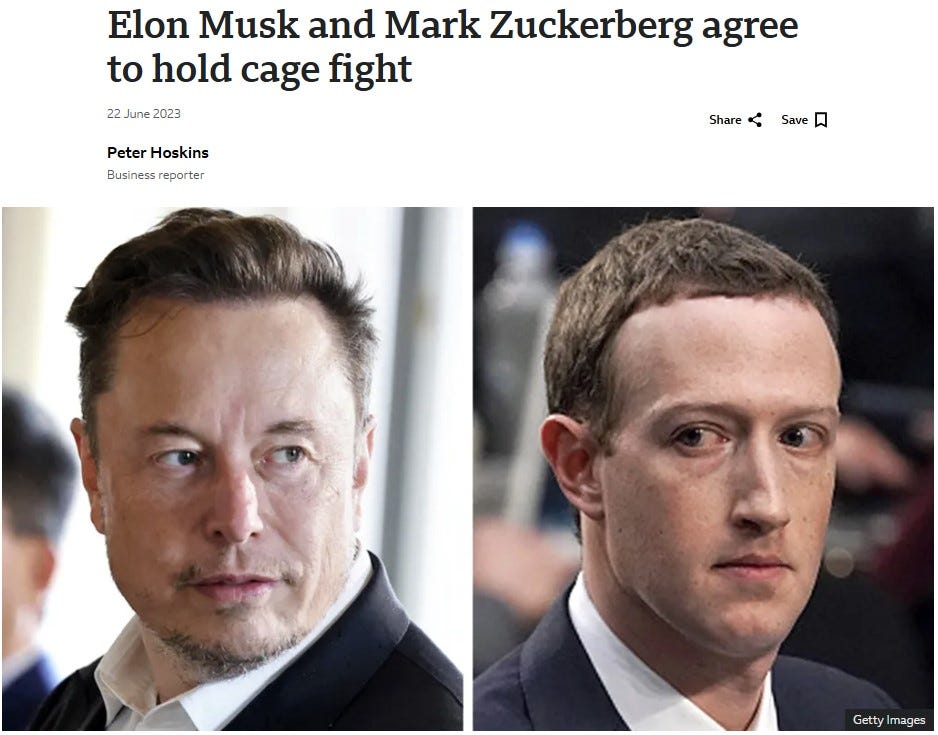
Elon Musk and Mark Zuckerberg agree to hold cage fight
22 June 2023
Musk tweeted details just a few months later:
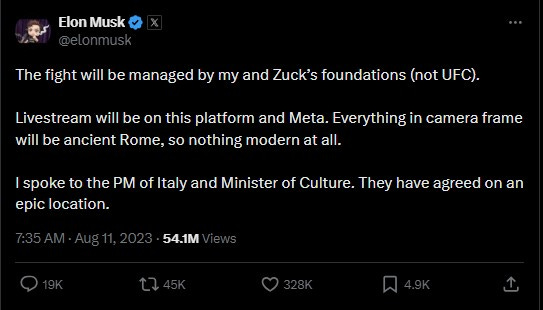
The fight will be managed by my and Zuck’s foundations (not UFC).
Livestream will be on this platform and Meta. Everything in camera frame will be ancient Rome, so nothing modern at all.
I spoke to the PM of Italy and Minister of Culture. They have agreed on an epic location.
7:35 AM - Aug 11, 2023
The plan for the two centi-billionaires to duke out their differences was still being reported on, a year later:
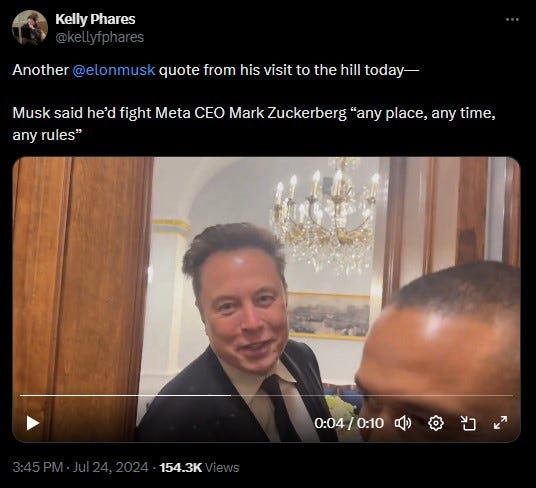
Another @elonmusk quote from his visit to the hill today—
Musk said he’d fight Meta CEO Mark Zuckerberg “any place, any time, any rules”
3:45 PM - July 24, 2024
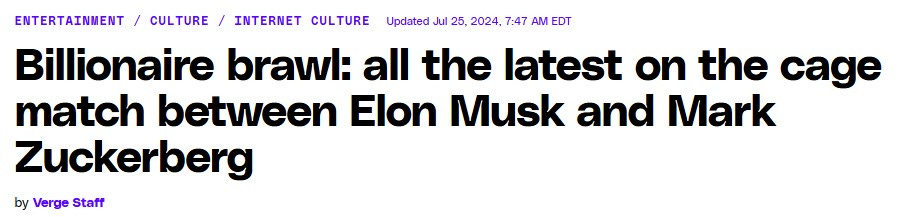
Billionaire brawl: all the latest on the cage match between Elon Musk and Mark Zuckerberg
July 25, 2024
Given Trump’s proclivity to shine a bright light on a distraction, every time more proof of his criminality is produced (new war for oil, anyone?), it may only take another tranche of disclosures to get him thinking: Americans dislike both Musk and Zuckerberg and would gladly tune in to the spectacle of the two of them, beating the crap out of each other. It just needs a hook, like Vince McMahon was so good at with pro wrestling. How about this:
The only way out of the cage for the loser is on a stretcher.
The spectacle is not about the fight, or even who wins. It’s about capturing the audience by promising them sights they have never before seen. The Musk v. Zuck MMA bout would fit the bill, perfectly.
The breakdown on the MLB and the new timing rule was incredible 😲 Wow! Great work 👏 👍