
The Common Defence
Dealing with the enemies of the People

If it is to mean anything, the promotion of the general welfare would include public health: Clean air and water, safe food products (and enough of them), shelter, recreational opportunities, and sufficient medical care as the need arises. Research and education as well as the arts would be promoted. There would be ample means and channels/platforms for public communication, as well as public transportation. As our own government, we would do well to focus on promoting the general welfare as much as “the common defence.”
The General Welfare

Sociologist Max Weber focused on the disciplinary nature of the nation-state: The nation-state is the political body that holds a monopoly on legitimate violence in a territory. The legitimacy of the nation-states does not stem from the violence itself (“Might makes right”) but from the
As social supports are removed, the state will lose legitimacy and there will be new social institutions vying to replace it. Corporations are the most obvious successor—especially among those who believe the state to be an impediment to “the market” they worship as the source of truth and validity. Breaking down social supports is much easier than it would be, had we added a general welfare amendment to the constitution—one that reflects the collective nature of the nation, the least-common denominator qualities of the public good and their need for ongoing improvement, and that would make the abandonment of classes of people literally unconstitutional.
What the People have become, in the centuries following the declaration they existed as a legitimizing force in society. are far greater in scope than what the Framers envisioned as people. Blacks and women, in particular, were not considered full people in that they were largely denied suffrage from the outset.
The constitutional amendments that conferred suffrage to these classes of “new” people are celebrated as if they are proof of full equality. This framing neglects the material disenfranchisement that accompanied the lack of a vote, and which has never been rectified. Reparations will never be made, for either chattel or domestic slavery, under a Bourgeois-controlled system. That value was taken legally from not-full people who did not have a right to claim it. In American society, it is not the vote that determines full person-hood—it is the ability to lay a legal claim to value.
Slaves and women were dispossessed. While granted suffrage by constitutional amendments, these two new classes of voter struggled mightily for decades to follow, before most members were considered viable as property owners. Still, it took further legislation to address how Blacks and women might be allowed to claim ownership and participate in the Bourgeois market. This process is ongoing, as legislating potential ownership does not convey the qualities of actual ownership.
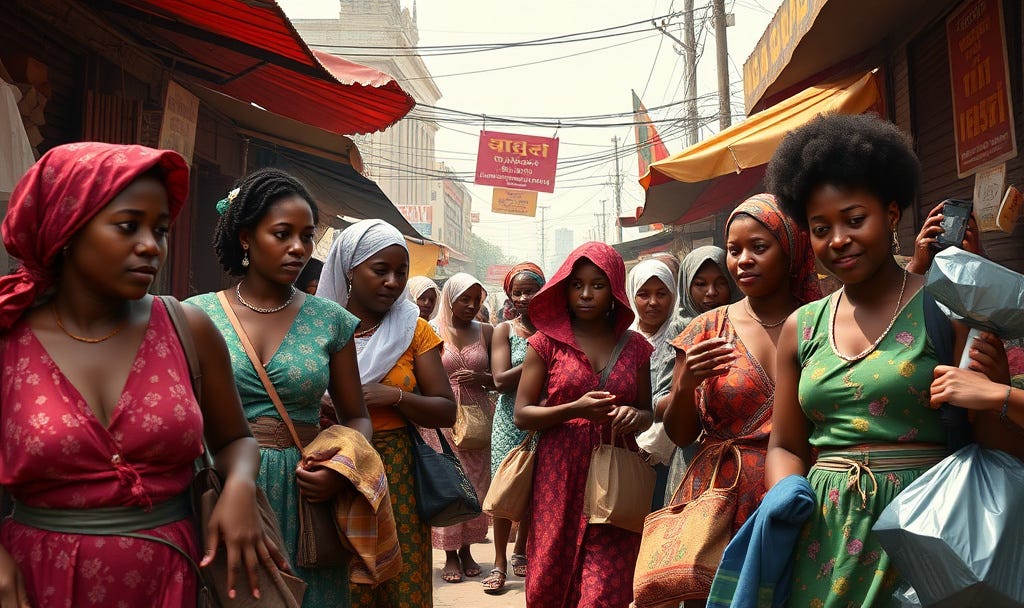
First-wave Feminism focused on civic equality, suffrage in particular. Middle and upper class women were able to exercise social power via their husbands’ sponsorship. The earliest temperance movements were women-led, and focused on working class men’s alcohol and tobacco consumption, along with prostitution (“white slavery”). The co-incidence of the 18th & 19th amendments (women’s suffrage & alcohol prohibition) being ratified within a year of each other was due to the deep connection between the two social movements, over the prior eighty years.
America was the first modern nation-state, and it was formed in the image of a rising Bourgeoisie. Land-owning slavers whose philosophic “liberty” was enshrined in a document that does not mention rights, that fractionalizes personhood, and ensures equal suffrage of states but not people.
It’s an old document, but we can amend it.
Not really. There have been twenty-seven amendments, and ten of them came with the original (another originally-proposed amendment became the 27th, in 1992). Others have been passed in bunches, with the 13th through 15th addressing slavery, ratified between 1865 - 1870, the 16th through 19th ratified between 1913 - 1920, and the 23rd through 26th ratified between 1961 - 1971.
3 over 5 years (Civil War/Reconstruction)
4 over 7 years (Progressive Federalism)
4 over 10 years (Housekeeping)
10 at once, and then 11 of 17 other amendments across just 22 of 250 years.The constitution is not a living document in the sense that it may be amended as needed. Instead, we see a clear pattern of amendments when possible, in bunches. The last contemporary amendment to pass was in 1971 (Suffrage to 18-year olds). We have never gone so long as we have recently, without states fundamentally modifying our form of government. The 27th amendment was proposed in 1783, and passed in 1992—it forbids Congress to give itself pay raises, while in session.
Dilutions of Grandeur

As originally designed, the United States federal government is an awful beast, offensive to its posterity’s sense of citizenship and rights.
Viewing past as prologue, I personally doubt the current Constitution can be amended into functionality for the People, instead of the Bourgeoisie for whom it was created. Still, that will be the approach taken by the most radical reformers allowed a presence on corporate-controlled media platforms. With that in mind, I suggested a handful of amendments in the “Dilutions of Grandeur” piece, but I neglected to include a General Welfare amendment.
Conceptually, it would be a codification of what the general welfare includes, and would make laws counter to the general welfare unconstitutional. We would ensconce our obligations to each other as the People, and draw the Bourgeoisie back into the concept they birthed themselves with and have since grown away from—Equality.